Trek To Evil Mad Scientist Laboratories

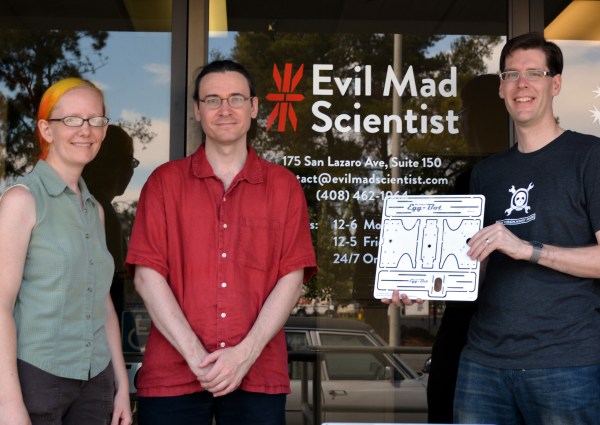
I’ve been a huge fan of EMSL for quite some time now, and my recent field trip proved that it has earned the name Evil Mad Scientist Laboratories for a good reason. For instance, look at the reflection in the glass near the bottom and you’ll glimpse the hearse that [Lenore] and [Windell] have sitting in front of the shop. But stop at the threshold, inside there are delights that ate up a couple of hours without me even noticing. And they thought they were going to get work done that day.

Don’t judge me by my appearance. This is late afternoon on a summer Saturday in Sunnyvale. Why does that matter? Obviously summer Saturdays in Silicon Valley always start with the Electronics Swap Meet and Engineer’s breakfast! That was a ton of fun but if you’re doing it right it’s also a bit tiring. No worries, a shot of excitement came over me as soon as I walked in that front door.

Continue reading “Trek To Evil Mad Scientist Laboratories”

Sine Waves, Squares Waves, And The Occasional FFT

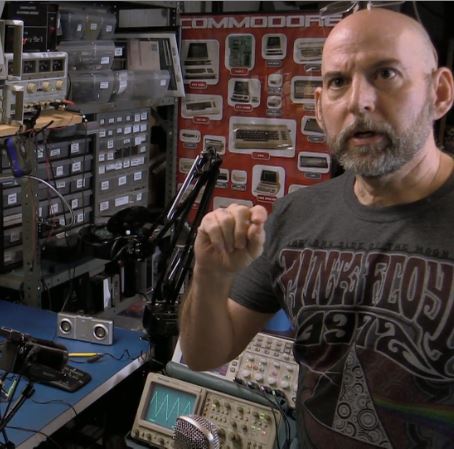
I became aware of harmonics and the sound of different shaped waveforms early in my electronics career (mid 1970’s) as I was an avid fan of [Emerson Lake and Palmer], [Pink Floyd], [Yes], and the list goes on. I knew every note of [Karn Evil 9] and could hear the sweeping filters and the fundamental wave shapes underneath it.

bil1

I remember coming to the understanding that a square wave, which is a collection of fundamental and (odd) harmonics frequencies, could then be used to give an indication of frequency response. If the high frequencies were missing the sharp edges of the square wave would round off. The opposite was then true, if the low frequencies were missing the square wave couldn’t “hold” its value and the top plateau would start to sag.

Continue reading “Sine Waves, Squares Waves, And The Occasional FFT”

Unreal Line-up And Live Stream Of Hackaday’s 10th

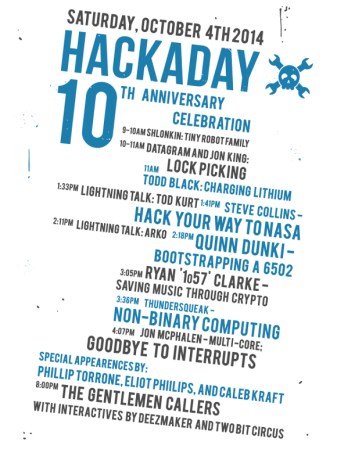
10th-Anniversary-Lineup-scaledYeah, check out that line-up poster. We’re so lucky to have an unreal collection of talented people pitching in to make this event happen. This Saturday is going to be Epic! Good thing since we’re celebrating 10-years-of-Hackaday!

What’s that you say? You don’t live in Los Angeles and are going to miss out? We’ll be live-streaming the event on:

Hackervision #1

Hackervision #2

You should put this feed on in the background while you hone your solding skills on that project you’ve been meaning to finish.

We will also be recording and posting the talks so that you may watch at your leisure.

Here’s a quick run-through of all that we have going on:

Ticket-buttonThe day will start with three workshops, the first is a tiny-robot build based on [shlonkin’s] design. The second is a lockpicking workshop hosted by [datagram] and [Jon King]. And the third is a Lithium charger workshop and build hosted by [Todd Black].

The afternoon brings the mini-conference with major talks by [Ryan ‘1o57’ Clarke], [Steve Collins], [Quinn Dunki], [Jon McPhalen], and [ThunderSqueak]. There will be Lighting Talks by [Tod Kurt] and [Arko], as well as special appearances by Hackaday head editors from the past decade.

In the evening we’ll move into party mode. Music is presented by [The Gentlemen Callers] with interactives by [Deezmaker] and [Two Bit Circus].

Of course there will be a handful of the Hackaday writers in town for the event as well. [Adam Fabio] will be leading the robot workshop, [James Hobson] will be leading a build-off throughout the day, and [Mike Szczys], [Brian Benchoff], and [Bil Herd] will be on hand to do whatever is needed.

If you are interested in attending there may still be tickets available. We have been sold out but we’ve asked anyone who is unable to attend to cancel their ticket so new tickets become available as that happens. Yep, fans of Hackaday are courteous people. Yet another reason to celebrate.

[Poster Art by Joe KimFull Resolution 15.5MB]

Content Centric Networking And A Tour Of (Xerox) PARC

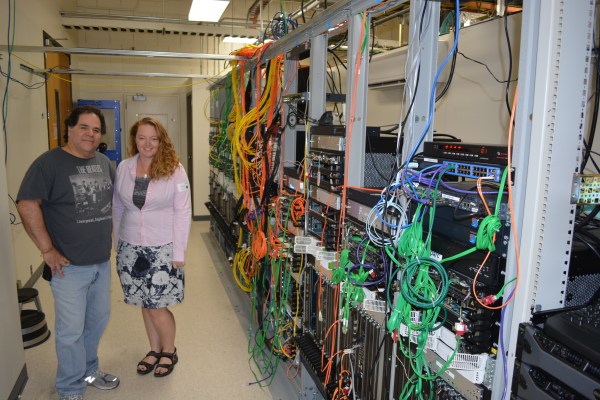
You may be used to seeing rack mounted equipment with wires going everywhere. But there’s nothing ordinary about what’s going on here. [Elecia White] and [Dick Sillman] are posing with the backbone servers they’ve been designing to take networking into the era that surpasses IPv6. That’s right, this is the stuff of the future, a concept called Content Centric Networking.

Join me after the break for more about CCN, and also a recap of my tour of PARC. This is the legendary Palo Alto Research Company campus where a multitude of inventions (like the computer mouse, Ethernet, you know… small stuff) sprang into being.

Continue reading “Content Centric Networking And A Tour Of (Xerox) PARC”

Speakers At Hackaday’s 10th Anniversary

It is with great pleasure that we are able to announce the final slate of speakers for Hackaday’s 10th Anniversary on October 4th in Pasadena. There are still around 30 tickets left for the conference so get yours now!

The most recently confirmed speaker is a man of many names. [Ryan Clarke] may be better known as [LosT], [1o57], or [Lostboy]. For years he has been driving the flagship contest at DEFCON by generating cryptographic puzzles that run far and deep through the 4-day conference and beyond. His talk will venture into the art and science of putting together these challenges, and the lengths at which determined hackers will go to solve them. His site gets taken over each year for DEFCON, so you might want to explore his Twitter account if you’re looking to learn more about this mysterious figure.

The other four speakers have already been mentioned in the initial announcement and last week’s follow-up. [Steve Collins] will discuss how his early interest in hacking led him to become an engineer at NASA. [Quinn Dunki] will have her scratch-built Veronica computer on hand and explain the adventure of the impressive project. [ThunderSqueak] will help us wrap our minds around the concept of non-binary computing, and [Jon McPhalen] will present the benefits of multi-core embedded processing versus traditional interrupt-based design.

We can’t wait for this amazing afternoon of talks which is just one week from Saturday. We hope to see you there!

Freescale And Texas Instruments Goodies And World Maker Faire

Freescale was very kind to Hackaday at Maker Faire this weekend, showing off a few boards and answering a few questions about why old Motorola application notes aren’t available on the Internet.

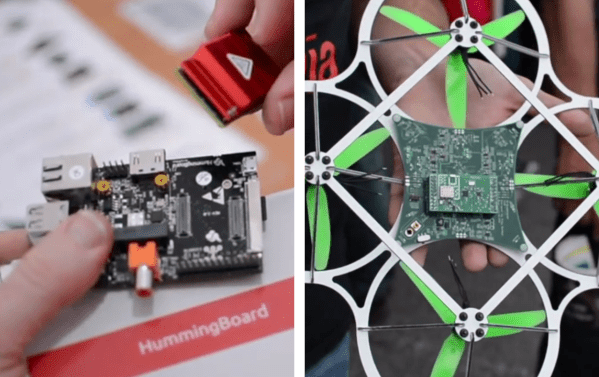
The Hummingboard from SolidRun comes in an oddly familiar form factor to anyone who has ever handled a Raspberry Pi. It also has an interesting feature: the CPU is on a small module, allowing anyone to upgrade the chipset to something significantly more powerful. In the top of the line configuration, it has a two core iMX6 CPU with a Gig of RAM, LVDS output, and Gigabit Ethernet. All the complex bits for this board are on a single module, allowing anyone to take the module and put it in another project, a la the Intel Edison.

Also in the Freescale booth was the pcDuino, a dual core ARM Cortex A7 with Ethernet, WiFi, and a SATA, with Arduino form factor pinouts. It’s a somewhat niche product, but being able to stack shields on something comparable to a Raspi or BeagleBone is a nice feature.

[Trey German] from Texas Instruments showed off some very cool stuff, including a quadcopter board for a Launchpad microcontroller. This isn’t a board with an IMU and a few servo outputs; this is the whole shebang with a frame, motors, and props. The frame was cut from some odd composite that’s usually used for road signs, and even though it wasn’t flying at the Faire (nothing was flying, by the way), it’s pretty light for a quad made at a board house.

Also from TI was their CC3200 dev board. This is a single chip with an ARM Cortex M4 and a WiFi radio that we’ve seen before. The CC3200 runs TI’s Wiring/Arduino inspired development environment Energia, and at about $30 for the CC3200 Launchpad board, it’s an easy and cheap way to build an Internet of Things thing.

Lulzbot & Lime Green Begonias

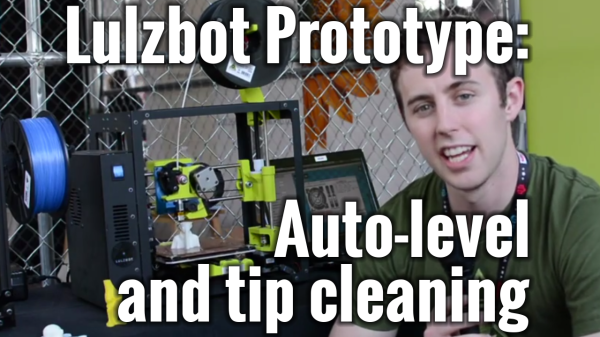
Lulzbot, or more specifically Aleph Objects, had a booth at Maker Faire this year, and unlike a lot of other 3D printer manufacturers they’re not afraid to show off what they currently have in development. The latest is code-named Begonia, although when it makes it to production it will probably be called the Lulzbot Mini. It’s a smaller version of their huge Taz 3D printer that trades build volume for a lower price.

The Lulzbot Mini will have a 6x6x6 inch build volume, heated bed, and all the other features you would expect in its larger counterpart. One interesting feature is automated nozzle cleaning and bed leveling. At the start of every print run, the nozzle runs over a small felt pad at the back of the build plate, touches off four metal washers at each corner, and recalculates the GCode for a level print. You can check out a demo of that in the video above.

Also in the works in the Lulzbot labs is a controller panel with an SD card, display, and (I think) a touch interface. Lulzbot didn’t have a demo of this, but rest assured, we’ll post something on that when it’s released. The last time we saw Lulzbot we heard of a 3D scanner project they’re working on that will turn any physical object into an .STL file, without having to mess about in Meshlab. Development on this project is stalled, but that is a very difficult problem. Can’t fault them for that.

Oh, the price for the unannounced Lulzbot Mini? Somewhere around $1300-1400.

Continue reading “Lulzbot & Lime Green Begonias”