The Rise And (Eventual) Fall Of The SIM Card

There are few devices that better exemplify the breakneck pace of modern technical advancement than the mobile phone. In the span of just a decade, we went from flip phones and polyphonic ringtones to full-fledged mobile computers with quad-core processors and gigabytes of memory.

While rapid advancements in computational power are of course nothing new, the evolution of mobile devices is something altogether different. The Razr V3 of 2003 and the Nexus 5 of 2013 are so vastly different that it’s hard to reconcile the fact they were (at least ostensibly) designed to serve the same purpose — with everything from their basic physical layout to the way the user interacts with them having undergone dramatic changes in the intervening years. Even the network technology they use to facilitate voice and data communication are different.
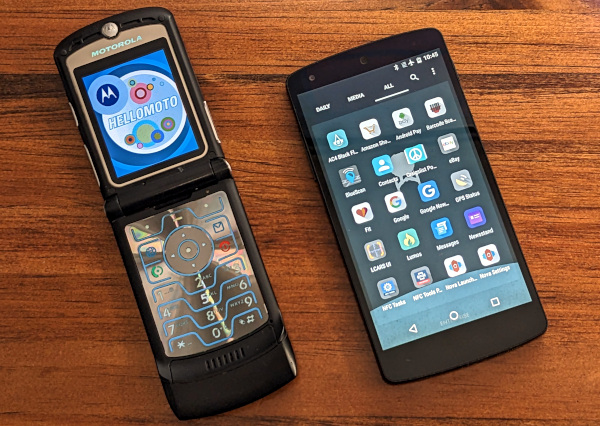
Two phones, a decade apart.

Yet, there’s at least one component they share: the lowly SIM card. In fact, if you don’t mind trimming a bit of unnecessary plastic away, you could pull the SIM out of the Razr and slap it into the Nexus 5 without a problem. It doesn’t matter that the latter phone wasn’t even a twinkling in Google’s eye when the card was made, the nature of the SIM card means compatibility is a given.

Indeed there’s every reason to believe that very same card, now 20 years old, could be installed in any number of phones on the market today. Although, once again, some minor surgery would be required to pare it down to size.

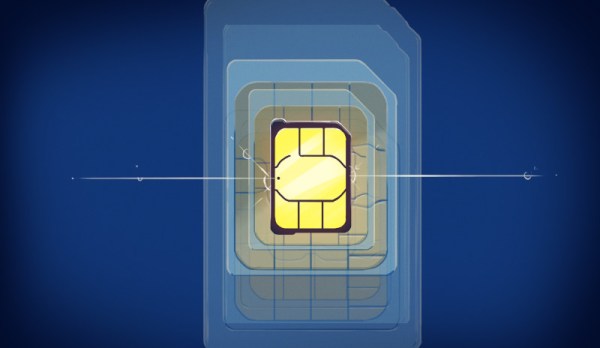
Such is the beauty of the SIM, or Subscriber Identity Module. It allows you to easily transfer your cellular service from one phone to another, with little regard to the age or manufacturer of the device, and generally without even having to inform your carrier of the swap. It’s a simple concept that has served us well for almost as long as cellular telephones have existed, and separates the phone from the phone contract.

So naturally, there’s mounting pressure in the industry to screw it up.

Continue reading “The Rise And (Eventual) Fall Of The SIM Card”

Hackaday Links Column Banner

Hackaday Links: March 19, 2023

We get results! Well, sort of. You may recall that in this space last week we discussed Ford’s plans to exclude AM reception on the infotainment systems of certain of their cars starting in 2024. We decried the decision, not for the loss of the sweet, sweet content that AM stations tend to carry — although we always enjoyed “Traffic on the 8s” back in our dismal days of daily commuting — but rather as a safety concern, because AM radio can reach almost the entire US population with emergency information using just 75 stations. To our way of thinking, this makes AM radio critical infrastructure, and eliminating it from motor vehicles is likely to have unintended consequences. Now it seems like there’s some agreement with that position, as former administrators of FEMA (Federal Emergency Management Administration; and no, not FEDRA) have gotten together to warn about the dangers of deleting AM from cars. Manufacturers seem to be leaning into the excuse that EVs emit a lot of radio frequency interference, rendering static-sensitive AM receivers less useful than other, more profitable less susceptible modes, like digital satellite radio. That seems like a red herring to us, but then again, the most advanced infotainment option in any car we’ve ever owned is a CD player, so it’s hard for us to judge.

Continue reading “Hackaday Links: March 19, 2023”

The Singularity Isn’t Here… Yet

So, GPT-4 is out, and it’s all over for us meatbags. Hype has reached fever pitch, here in the latest and greatest of AI chatbots we finally have something that can surpass us. The singularity has happened, and personally I welcome our new AI overlords.

Hang on a minute though, I smell a rat, and it comes in defining just what intelligence is. In my time I’ve hung out with a lot of very bright people, as well as a lot of not-so-bright people who nonetheless think they’re very clever simply because they have a bunch of qualifications and diplomas. Sadly the experience hasn’t bestowed God-like intelligence on me, but it has given me a handle on the difference between intelligence and knowledge.

My premise is that we humans are conditioned by our education system to equate learning with intelligence, mostly because we have flaky CPUs and worse memory, and that makes learning something a bit of an effort. Thus when we see an AI, a machine that can learn everything because it has a decent CPU and memory, we’re conditioned to think of it as intelligent because that’s what our schools train us to do. In fact it seems intelligent to us not because it’s thinking of new stuff, but merely through knowing stuff we don’t because we haven’t had the time or capacity to learn it.

Growing up and making my earlier career around a major university I’ve seen this in action so many times, people who master one skill, rote-learning the school textbook or the university tutor’s pet views and theories, and barfing them up all over the exam paper to get their amazing qualifications. On paper they’re the cream of the crop, and while it’s true they’re not thick, they’re rarely the special clever people they think they are. People with truly above-average intelligence exist, but in smaller numbers, and their occurrence is not a 1:1 mapping with holders of advanced university degrees.

Even the examples touted of GPT’s brilliance tend to reinforce this. It can do the bar exam or the SAT test, thus we’re told it’s as intelligent as a school-age kid or a lawyer. Both of those qualifications follow our educational system’s flawed premise that education equates to intelligence, so as a machine that’s learned all the facts it follows my point above about learning by rote. The machine has simply barfed up what it has learned the answers are onto the exam paper. Is that intelligence? Is a search engine intelligent?

This is not to say that tools such as GPT-4 are not amazing creations that have a lot of potential to do good things aside from filling up the internet with superficially readable spam. Everyone should have a play with them and investigate their potential, and from that will no doubt come some very interesting things. Just don’t confuse them with real people, because sometimes meatbags can surprise you.

This Week In Security: Kali Purple, Malicious Notifications, And Cybersecurity Strategy

After a one-week hiatus, we’re back. It’s been a busy couple weeks, and up first is the release of Kali Purple. This new tool from Kali Linux is billed as an SOC-in-a-box, that follows the NIST CSF structure. That is a veritable alphabet soup of abbreviated jargon, so let’s break this down a bit. First up, SOC IAB or SOC-in-a-box is integrated software for a Security Operation Center. It’s intrusion detection, intrusion prevention, data analysis, automated system accounting and vulnerability scanning, and more. Think a control room with multiple monitors showing graphs based on current traffic, a list of protected machines, and log analysis on demand.

NIST CSF is guidance published by the National Institute of Standards and Technology, a US government agency that does quite a bit of the formal ratification of cryptography and other security standards. CSF is the CyberSecurity Framework, which among other things, breaks cybersecurity into five tasks: identify, protect, detect, respond, and recover. The framework doesn’t map perfectly to the complexities of security, but it’s what we have to work with, and Kali Purple is tailor-made for that framework.

Putting that aside, what Purple really gives you is a set of defensive and analytical tools that rival the offensive tools in the main Kali distro. Suricata, Arkime, Elastic, and more are easily deployed. The one trick that really seems to be missing is the ability to deploy Kali Purple as the edge router/firewall. The Purple deployment docs suggest an OPNSense deployment for the purpose. Regardless, it’s sure to be worthwhile to watch the ongoing development of Kali Purple.

Continue reading “This Week In Security: Kali Purple, Malicious Notifications, And Cybersecurity Strategy”

The X Macro: A Historic Preprocessor Hack

If we told you that a C preprocessor hack dated back to 1968, you’d be within your rights to remind us that C didn’t exist in 1968. However, assemblers with preprocessors did, and where there is a preprocessor, there is an opportunity to do clever things. One of those things is the so-called X macro, which saw a lot of use in DEC System 10 code but probably dates back even earlier. You can still use it today if you like, even though there are, of course, other arguably better ways to get the same result. However, the X macro can be very efficient, and you may well run into it in some code, too.

Background

Preprocessing used to be a staple of programming. The idea is that code is manipulated purely at the text level before it is compiled. These days, languages with a preprocessor usually handle it as part of the compiler, but you can also use an external preprocessor like m4 for more sophisticated uses.

Modern languages tend to provide other ways to accomplish many of the tasks handled by the preprocessor. For example, if you have a constant you want to set at compile time, you could say:

int X = 32;
y = X;

But then you’ve created a real variable along with the overhead that might entail. A smart compiler might optimize it away for you, but you can be sure by writing:

#define X 32
y = X;

A modern compiler would prefer you to write:

const int X=32;
y = X;

But there are still some common uses for macros, like including header files. You can also make more sophisticated macros with arguments so you don’t incur a function call penalty, although modern usage would be to mark those functions as inline.

The Problem

Which brings us to the X macro. With all great hacks, there is first a problem to solve. Imagine you have a bunch of electronic parts you want to deal with in your code. You don’t want a database, and you don’t want to carry a bunch of strings around, so you define an enumerated type:

Continue reading “The X Macro: A Historic Preprocessor Hack”

Retrotechtacular: Military Graphics In The 1960s

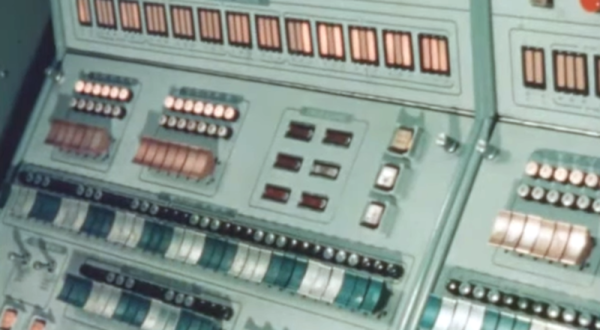
While you might think the military doesn’t have a sense of humor with names. Take the AN/MSQ-19 “automated tactical operations central” for example. (Video, embedded below.) But then, when you find out that the truck-sized computer at the heart of it was MOBIDIC — yes, that’s pronounced Moby Dick — you know someone had a good chuckle somewhere. The video below was a promotional video from the early 1960s, and although it shows the unit in operation, it was most likely a mockup and not fully functional.

The MOBIDIC program ran from 1960-1964 and cost a whopping $25 million in 1960-era money. In 1964, testing revealed the system was too unwieldy, requiring at least five tractor-trailers, eight generators, portable buildings, and several large trucks to move around.

Continue reading “Retrotechtacular: Military Graphics In The 1960s”

Review: XHDATA D-219 Short Wave Radio Receiver

As any radio amateur will tell you, the world of radio abounds with exciting possibilities. Probably the simplest pursuit of them all is that of the SWL, or short wave listener, who scours the airwaves in search of interesting stations. SWLs will often have fully-featured setups with high-end general-coverage communications receivers and tuned antenna arrays, but it can start with the cheapest of radios at its bottom end. Such a radio is the subject of this review, the XHDATA D-219 is a miniature portable receiver that costs under ten dollars, yet is currently the talk of the town in SWL circles. This interest is in no small amount due to its being an especially low-price way to get your hands on a shortwave radio using one of the SIlicon Labs integrated software-defind radio receiver chips. We don’t often review a consumer radio here at Hackaday, but with an avid eye for unexpected gems at the cheaper end of the market this one’s worth a second look.

What Do You Get For Your Tenner?

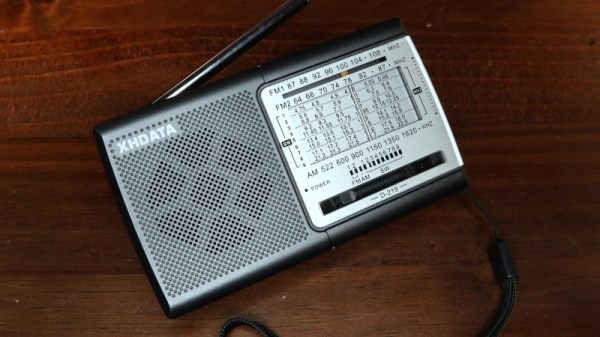
A picture of the radio on my bench
This form factor is very typical for cheap “world band” radios.

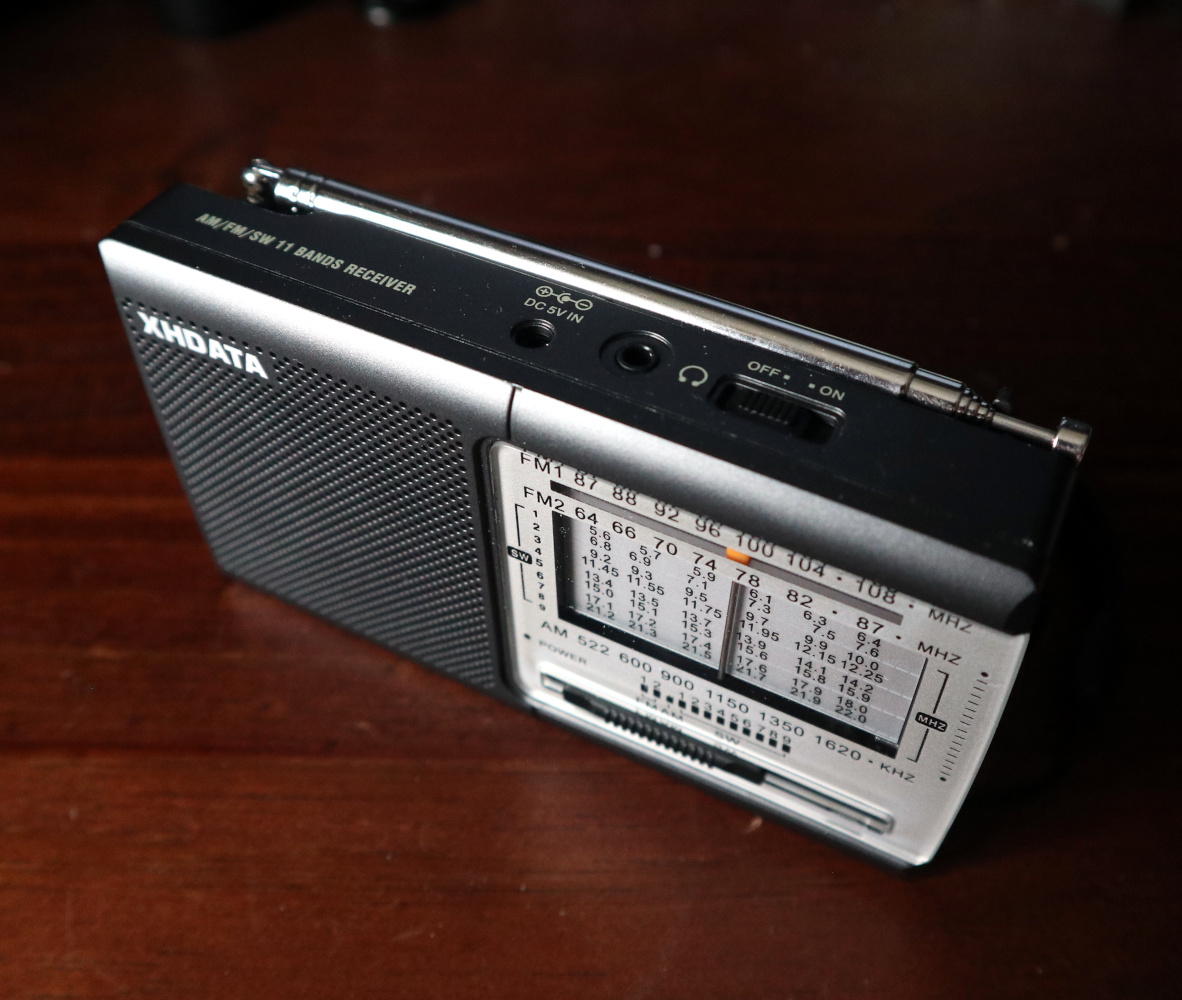
I ordered my D-219 from the XHDATA website, spending about £10 including the postage from China. The usual wait ensued before the package landed on my doormat, and inside was the radio in its box with an instruction leaflet. It’s a small unit about 135 mm x 75 mm x 30 mm, and it follows closely the form factor of other similar radios.

On the top is the extensible antenna with an on-off switch and sockets for headphone and 5 V power, on the side are side-on knobs for tuning and volume, while on the front is the speaker and old-style multi-band tuning display.

On the back is a flip-up stand and a hatch for a pair of AA cells. There’s a band switch covering AM, nine different shortwave bands from 4.75 MHz to 22 MHz, the east Asian FM band from 64 MHz to 87 MHz, and the international FM band from 87 MHz to 108 MHz. The tuning indicator is very old-school, a vertical bar that moves across a frequency scale with the tuning knob. Continue reading “Review: XHDATA D-219 Short Wave Radio Receiver”