Pick Locks Like In The Movies: Using A Bobby Pin

Sure, many of us don’t hold our hair in place with bobby pins, but just in case we need to break into a secure location, like the broom closet we locked ourselves out of, it wouldn’t hurt to know how to use them to pick a lock.

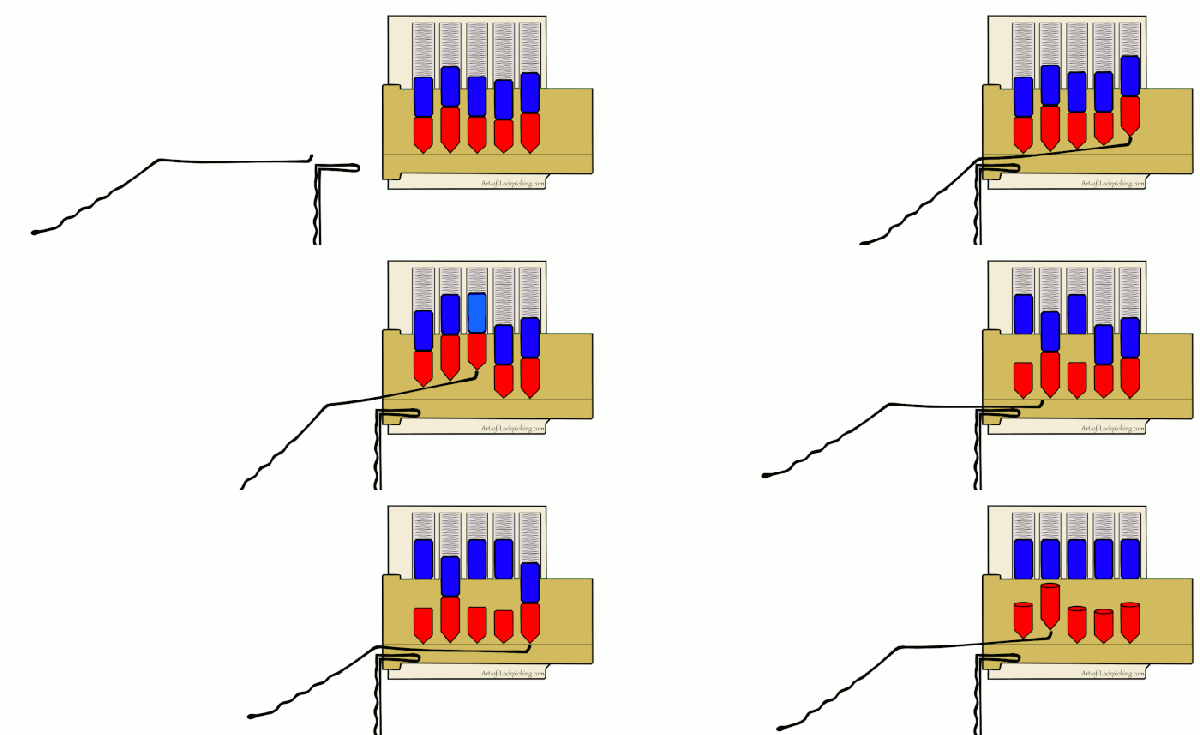
There are worse things you can make a lockpick set out of. After you’ve secured two bobby pins, one for the tension wrench and one for a small hook pick. To make the small hook simply flatten the pick and remove the rubber cap from the side without waves; this is the small hook. To make the tension wrench, bend the second pin in half. Simple.

The guide also functions as a very good beginner tutorial on lock-picking, covering the types of simple locks one is likely to encounter, and the various shortcomings of their construction that could impede efforts to open them. The whole site is a good resource for those who enjoy the art.

After that it is standard lock picking. Put torsion on the barrel and prod those pins into place with your reconfigured fashion accessories.

The Origin Of QWERTY

There are very few things that are surrounded with as much hearsay and rumor as the origins of the QWERTY layout of typewriters and keyboards. The reason behind the QWERTY layout isn’t as simple as ‘so the bars for each letter don’t collide with each other.’ That’s nonsense – it would make far more sense to improve the mechanism before changing the arrangement of the keyboard around.

That’s not the only fallacious argument for the creation of QWERTY. It’s also been called a marketing ploy; Stephen Jay Gould popularized the idea of the QWERTY keyboard being as it is so a salesman could peck out TYPE WRITER on the top row [1]. This also makes little sense. Why would the top row and not the home row be so privileged as to contain all the letters the make up the name of the machine. For that matter, wouldn’t a sales pitch be more impressive if TYPE WRITER were typed with one hand?

This doesn’t mean there’s not a method behind the madness of QWERTY – it’s just not as simple as jammed typewriter mechanisms or appeasing the wishes of salesmen in the 1870s. QWERTY didn’t come out of thin air, though, but folk tale history of this keyboard layout is sadly deficient.

Continue reading “The Origin Of QWERTY” →

SDRAM Logic Analyzer Uses An AVR And A Dirty Trick

We often see “logic analyzer” projects which are little more than microcontrollers reading data as fast as they can, sending it to a PC, and then plotting the results. Depending on how fast the microcontroller is, these projects range from adequate to not very useful.

At first glance, [esot.eric’s] logic analyzer project has an AVR in it, so it ought to be on the low end of the scale. Then you look at the specs: 32 channels at 30 megasamples per second. How does that work with an AVR in it?

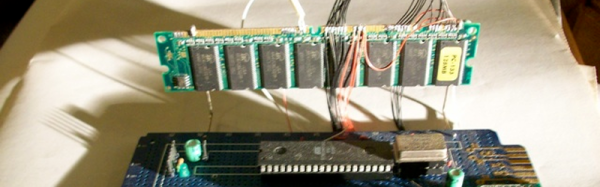
The answer lies in the selection of components. The analyzer uses a 128MB SDRAM DIMM (like an older PC might use for main memory). That makes sense; the Arduino can’t store much data internally. However, it isn’t the storage capacity that makes this choice critical. It seems [esot.eric] has a way to make the RAM “free run”.

The idea is to use the Arduino (or other host microcontroller) to set up the memory. Some of the memory’s output bits feedback to the address and data lines. Then the microcontroller steps aside and the SDRAM clocks samples into its memory by itself at the prevailing clock rate for the memory.

Continue reading “SDRAM Logic Analyzer Uses An AVR And A Dirty Trick” →

Prime Numbers Are Stranger Than You Thought

If you’ve spent any time around prime numbers, you know they’re a pretty odd bunch. (Get it?) But it turns out that they’re even stranger than we knew — until recently. According to this very readable writeup of brand-new research by [Kannan Soundararajan] and [Robert Lemkein], the final digits of prime numbers repel each other.

More straightforwardly stated, if you pick any given prime number, the last digit of the next-largest prime number is disproportionately unlikely to match the final digit of your prime. Even stranger, they seem to have preferences. For instance, if your prime ends in 3, it’s more likely that the next prime will end in 9 than in 1 or 7. Whoah!

Even spookier? The finding holds up in many different bases. It was actually first noticed in base-three. The original paper is up on Arxiv, so go check it out.

This is a brand-new finding that’s been hiding under people’s noses essentially forever. The going assumption was that primes were distributed essentially randomly, and now we have empirical evidence that it’s not true. What this means for cryptology or mathematics? Nobody knows, yet. Anyone up for wild speculation? That’s what the comments section is for.

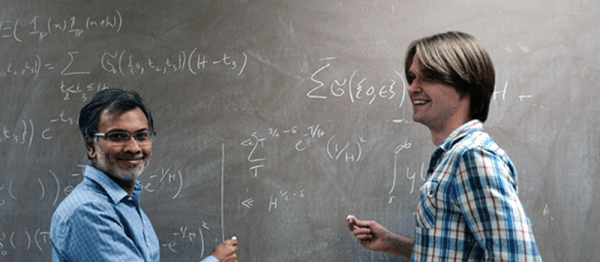
(Headline photo of researchers Kannan Soundararajan and Robert Lemke: Waheeda Khalfan)

Engineer Humanity’s Future: The 2016 Hackaday Prize

Today we are proud to launch the 2016 Hackaday Prize. Build Something That Matters and you’ll contribute positively to humanity’s future by expand the frontiers of knowledge and engineering. You’ll also score recognition of your skills, and position yourself to land one of 105 cash prizes totaling over $300,000. Choose a technology issue facing humanity today and build a project that fixes, improves, or bypasses the problem.

You have the talent, the energy, and the capacity to change the world. Make the time and make a difference.

The Hackaday Prize is a competition synonymous with creating for social change. Using your hardware, coding, scientific, design and mechanical abilities, you will make big changes in people’s lives. Every idea has impact, and a massive force of ideas creates real change. This year we have more power than ever before to recognize the engineering projects that are solving problems: One hundred finalists will get $1,000 each for their efforts. This flat prize structure encourages collaboration rather than direct competition. Team up on each others’ projects and improve your overall chances of making it into the finals.

But it doesn’t stop there. From one hundred finalists, five will rise to be named top winners. Our expert judges will carefully review each of 100 world-changing final entries, choosing a grand prize winner to receive $150,000. Second place will be awarded $25,000, with $10k, $10k, and $5k going to third, fourth, and fifth.

Continue reading “Engineer Humanity’s Future: The 2016 Hackaday Prize” →

Beyond Measure: Instrumentation Essentials

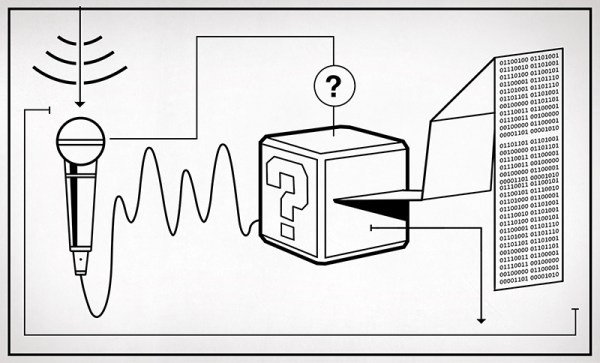
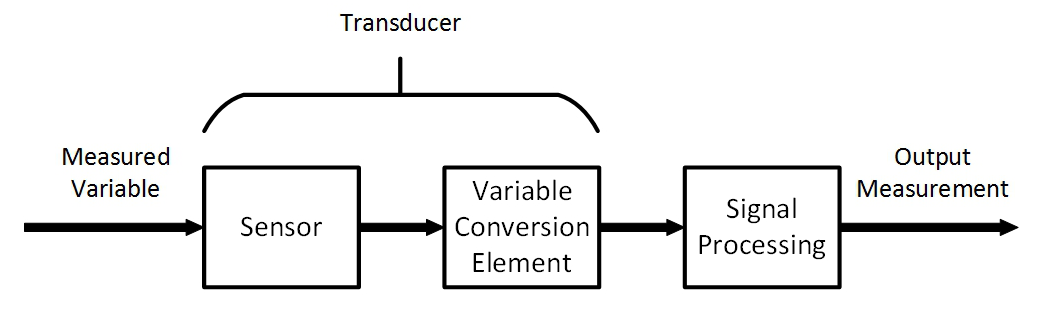
The physical world is analog and if we want to interface with it using a digital device there are conversions that need to be made. To do this we use an Analog to Digital Converter (ADC) for translating real world analog quantities into digital values. But we can’t just dump any analog signal into the input of an ADC, we need this analog signal to be a measurable voltage that’s clean and conditioned. Meaning we’ve removed all the noise and converted the measured value into a usable voltage.

Things That Just Work.

This is not new information, least of all to Hackaday readers. The important bit is that we rely on these systems daily and they need to work as advertised. A simple example are the headlights in my car that I turned on the first night I got in it 5 years ago and haven’t turned off since. This is not a daytime running lights system, the controller turns the lights on when it’s dark and leaves them off during the day. This application falls into the category of things that go largely unnoticed because simply put: They. Work. Every. Time. It’s not a jaw dropping example but it’s a well implemented use of an analog to digital conversion that’s practical and reliable.

flow
Figure 1

Continue reading “Beyond Measure: Instrumentation Essentials” →

Endless Pancakes

Sometimes along comes a machine so simple yet so alluring in what it does and how it achieves its aim that you just want one. Doesn’t matter what it does or indeed whether ownership is a practical proposition, you wish you could have one in your possession.

What machine could trigger this reaction, you ask? [Robbie Van Der Walt] and [Christiaan Harmse] have the answer, their machine performs the simple but important task of cooking an endless pancake. A hopper dispenses a layer of pancake batter onto a slowly rotating heated roller that cooks the ribbon of pancake on one side, before it is transferred to another roller that cooks the other side. It seems simple enough yet the simplicity must hide a huge amount of product refinement and probably many miles of lost pancake. Pancakes it seems are a traditional South African delicacy, evidently they must have king-sized appetites to satisfy.

In the video below (Afrikaans, English subtitles) they make an attempt at a world record for the longest ever pancake, though sadly they don’t seem to appear in a Guinness  World Records search so perhaps they didn’t achieve it. Still, their machine is a work of art, and we applaud it. Continue reading “Endless Pancakes” →