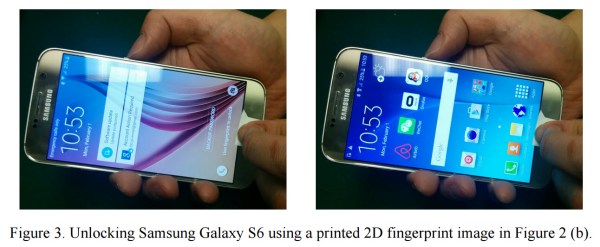
Maybe you suspected this already, but researchers at MSU Computer Science just published a paper explaining just how easy it is to spoof a fingerprint scanner with a ink-jet printed scan of a finger.
We’re not talking about casting a new finger using superglue or anything, but rather using conductive ink you can literally print — on paper. A paper-printed-fingerprint that will unlock your smartphone. We’ve already told you fingerprints suck for security, but hopefully this drives the point home.
[Kai Cao] and [Anil K Jain] released this paper (Direct PDF link) outlining their technique. Using an existing scan of a fingerprint (which can be taken from your phone’s scanner), the image is mirrored, and then printed using a regular ink-jet printer, with all of its color cartridges replaced with AgIC4 silver conductive ink. Continue reading “Finger Print Scanners Really Aren’t That Secure”→
Retro gaming consoles exploded with the introduction of the Raspberry Pi and other similar single-board Linux computers. They all work the same way in that they emulate the original game console hardware with software. The game ROM is then dumped to a file and will play like the original. While this works just fine for the vast majority of us who want to get a dose of nostalgia as we chase the magic 1-up mushroom, gaming purists are not satisfied. They can tell the subtle differences between emulation and real hardware. And this is where our story begins.
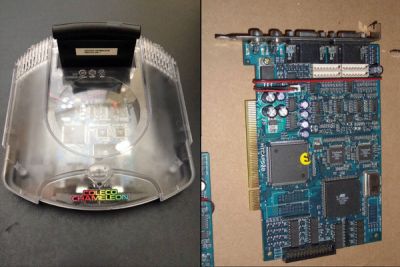
Meet the Coleco Chameleon. What appears to be just another run-of-the-mill retro gaming console is not what you think. It has an FPGA core that replicates the actual hardware, to the delight of hardcore retro game enthusiasts around the world. To get it to the masses, they started an ambitious 2 million US dollar Indiegogo campaign, which has unfortunately come to a screeching halt.
Take a close look at the header image. That blue circuit board in there is nothing but an old PCI TV tuning card. To make matters worse, it also appears that their prototype system which was displayed at the Toy Fair in New York was just the guts of an SNES Jr stuffed into their shell.
This scam is clearly busted. However, the idea of reconstructing old gaming console hardware in an FPGA is a viable proposition, and there is demand for such a device from gaming enthusiasts. We can only hope that the owners of the Coleco Chameleon Kickstarter campaign meant well and slipped up trying to meet demand. If they can make a real piece of hardware, it would be welcomed.
The general process of circuit board assembly goes like this: You order your PCBs. You also order your components. For surface mount components, you apply solder paste to the pads, put the components on top, and then heat the board up so the solder paste flows and makes a bond. Then for through hole components you put the leads through the holes, and solder them with an iron or a solder wave or dip. Then you do an inspection for defects, program any microcontrollers, and finally test the completed board to make sure everything runs.
The tricky part is in volumes. If you’re only doing a few boards, it’s usually easiest to assemble them by hand. In the thousands you usually outsource. But new tools, and cheap hacked tools, have made it easier to automate small batches, and scale up into the thousands before outsourcing assembly.
In this new series which we’re calling Tools of the Trade we’ll be covering a variety of tools used for building products, and we’re starting with circuit board assembly. Let’s investigate our tools of the trade: solder paste dispensing. Continue reading “Tools Of The Trade – Solder Paste Dispensing”→
There are a couple of really great things about transmitting data using light as the carrier. It can be focused so that it doesn’t spill all over the neighborhood like radio signals do — giving it both some security against eavesdropping and preventing one signal from stepping on another’s toes. And while you can modulate radio signals up nearly to the carrier frequency, the few gigahertz we normally use for radio just won’t cut it for really high bit rates. Light gets you terahertz.
The Koruza project is an open-source, “inexpensive” system that aims to transmit 1 Gb/sec over distances around 100 meters, using modulated infrared light. The intended use-case is urban building-to-building communication at speeds that would otherwise require laying fiber-optic cables. Indeed, the system piggy-backs on existing fiber-optic equipment to get the job done, but the hard part is aligning the units to get maximum signal from point A to point B.
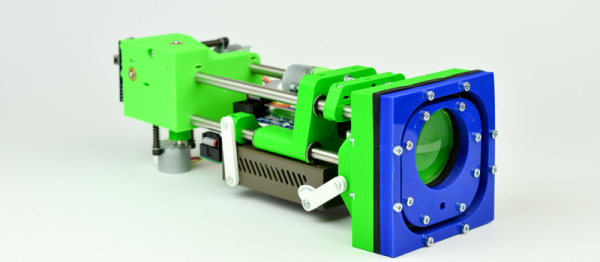
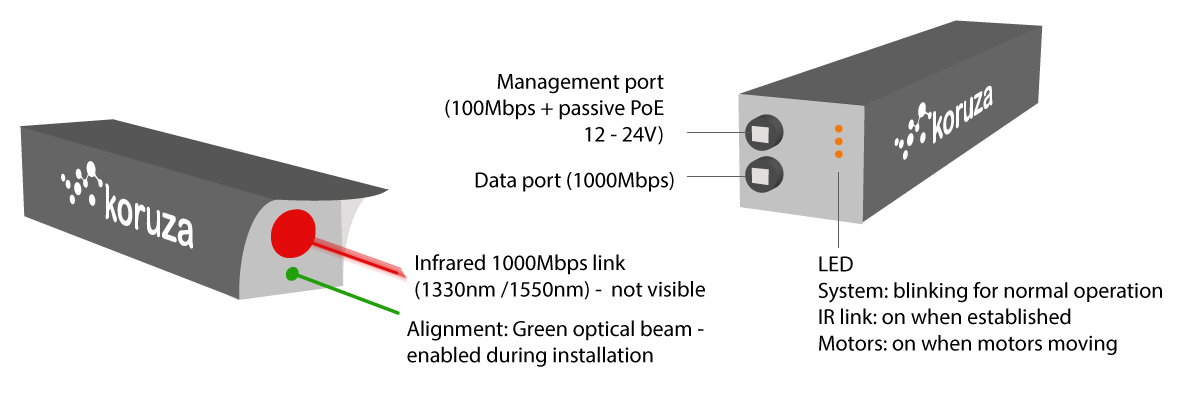
Koruza does this by including motorized lenses on the 3D-printed chassis. You make a rough alignment with a visible green laser, and then fine-tune the IR beams from a web console where you get immediate feedback on how the received signal strength is changing. Both Koruza boxes have a Raspberry Pi inside and use normal networking for calibration and signal-strength statistics. It’s a really neat system, and it’s fully DIY’able except for the commodity fiber-optic bits.
We’ve always had a soft-spot in our heart for transmitting data over light beams. The Ronja project has been doing so since 2001, and over longer distances, with completely DIY hardware, if at a slower bitrate. And now that Li-Fi seems to be getting traction, we might see an unfocused equivalent running inside our homes.
We wake up this morning to the news that Google’s deep-search neural network project called AlphaGo has beaten the second ranked world Go master (who happens to be a human being). This is the first of five matches between the two adversaries that will play out this week.
On one hand, this is a sign of maturing technology. It has been almost twenty years since Deep Blue beat Gary Kasparov, the reigning chess world champion at the time. Although there are still four games to play against Lee Sedol, it was recently reported that AlphaGo beat European Go champion Fan Hui in five games straight. Go is generally considered a more difficult game for machine minds to play than chess. This is because Go has a much larger pool of possible moves at any given time.
Does This Matter?
Okay, the news part of this event has been covered: machine beats man. Does it matter? Will this affect your life and how? We want to hear what you think in the comments below. But I’m going to keep going with some of my thoughts on the topic.
You’re still better at Ms. Pacman [Source: DeepMind paper in Nature]Let’s look first at what AlphaGo did to win. At its core, the game of Go is won by figuring out where your opponent will likely make a low-percentage move and then capitalizing on that choice. Know Your Enemy has been a tenet of strategy for a few millennia now and it holds true in the digital age. In addition to the rules of the game, AlphaGo was fed a healthy diet of 30 million positions from expert games. This builds behavior recognition into the system. Not just what moves can be made, but what moves are most likely to be made.
DeepMind, the company behind AlphaGo which was acquired by Google in 2014, has published a paper in Nature about their approach. They were even nice enough to let us read without dealing with a paywall. The secret sauce is the learning process which at its core tries to mimic how living entities learn: observe repetitively while assigning values to outcomes. This is key as it leads past “intellect”, to “intelligence” (the “I” in AI that everyone seems to be waiting for). But this is a bastardized version of “intelligence”. AlphaGo is able to recognize and predict behavior, then make choices that lead to a desired outcome. This is more than intellect as it does value the purpose of an opponent’s decisions. But it falls short of intelligence as AlphaGo doesn’t consciously understand the purpose it has detected. In my mind this is exactly what we need. Truly successful machine learning will be able to make sense out of sometimes irrational input.
The paper from Nature doesn’t go into details about Go, but it explains the approach of the learning system applied to Atari 2600. The algorithm was given 210×160 color video at 60Hz as an input and then told it could use a joystick with one button. From there it taught itself to play 49 games. It was not told the purpose or the rules of the games, but it was given examples of scores from human performance and rewarded for its own quality performances. The chart above shows that it learned to play 29 of them at or above human skill levels.
As the year of 2005 was drawing to a close, a website known as Myspace was basking in popularity. With millions of users, the site was the most popular social networking site in the world. It was unique in that it let users use HTML code to customize their Myspace page. Most of us, c’mon…admit it….had a Myspace page. The coding part was fun! But not everything was changeable with code. You could only upload up to 12 images and the Relationship Status drop-down menu only had a few options to choose from. These limitations did not sit well with [Samy Kamkar], a 19 year old hacker out of Los Angeles.
It didn’t take [Samy] long to figure out how to trick the site to let him upload more images and change his relationship status to a customized “in a hot relationship”. After hoodwinking the Myspace site with some simple hacks, he realized he could do just about anything he wanted to with it. And this is where things get interesting. It took just over a week to develop a script that would force people who visited his page to add him as a friend. But that wasn’t enough. He then programmed the script to copy itself onto the visitor’s page. [Samy] had developed a self-propagating worm.
The script went live as [Samy] went to bed. He woke up the next morning with 200 friends requests. An hour later the number had doubled. [Samy] got worried and sent an anonymous email to the webmaster warning of the worm. It was ignored. By 1:30PM that day, he had over 6,000 friends request. And like any good hacker worth his weight in floppy drives, his sense of humor had him program the script to also add his name to each visitor’s Heroes List. This angered many people, who deleted him from their page, only to get reinfected moments later when they visited another (infected) page.
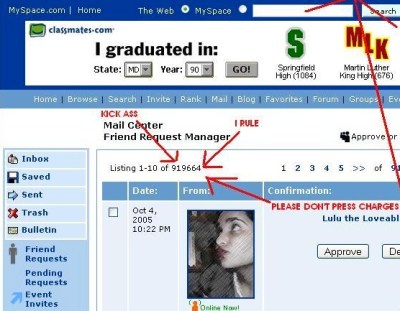
[Samy’s] script was raging out of control. As the evening closed in, his friends count had reached 919,664. It would top the 1 million mark just before Myspace took their servers offline to figure out what was going on. Two hours later, the site was back up. [Samy’s] profile page had been deleted.
[Samy] had used a technique known as cross-site scripting (XSS) to pull off his hack. We’ll touch on XSS in a later article. For now, we’re going to stick to the basics – proper passwords and SQL Injection.
Newly minted hams like me generally find themselves asking, “What now?” after getting their tickets. Amateur radio has a lot of different sub-disciplines, ranging from volunteering for public service gigs to contesting, the closest thing the hobby has to a full-contact sport. But as I explore my options in the world of ham radio, I keep coming back to the one discipline that seems like the purest technical expression of the art and science of radio communication – low-power operation, or what’s known to hams as QRP. With QRP you can literally talk with someone across the planet on less power than it takes to run a night-light using a radio you built in an Altoids tin. Now that’s a challenge I can sink my teeth into.


 enthusiasts around the world. To get it to the masses, they started an ambitious 2 million US dollar Indiegogo campaign, which has unfortunately come to a