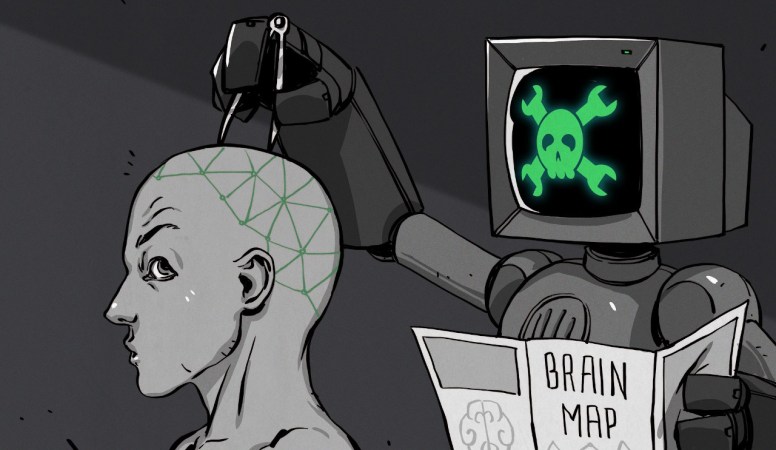
Tool Embodiment And The Dead Trackball

There is a currently ongoing debate in the neuropsychology world about how we relate to the tools that we use. The theory of “tool embodiment” says that when we use some tools frequently enough, our brain recognizes them similarly to how it recognizes our own hands, for instance. There is evidence and counter-evidence from experiments with prosthetics, trash-grabber arms, and rubber dummy arms, just to name a few. It’s fair to say the jury is still out.

All I know is that today my trackball broke, and using a normal gaming mouse to edit the podcast was torture. It would be an exaggeration to say that I felt like I’d lost a hand, but I have so much motor memory apparently built up in my use of the trackball that switching over to another tool to undertake the exact same series of hundreds of small audio edits – mostly compensating for the audio delay across continents, but also silencing coughs and background noises – took an extra hour.

Anyone who has switched from one keyboard to another, or heck even from emacs to vim, knows what I experienced. My body just knows how to flick my wrist to make the cursor on the screen move over to the beginning of that “umm”. It’s not like I don’t conceptually know how to use a mouse either, and it does exactly the same job. But the mouse wasn’t my tool for this application. And saying that out loud makes it almost sound like I’m bordering on embodying my trackball.

I probably should have taken the trackball apart and replaced the bad tact switch on the left-click – that would have taken maybe twenty minutes – but I completely underestimated how integral the tool had become to the work. Anyway, as I write this, tomorrow is Saturday and I’ll have time to fix it. But today, I learned something pretty neat about myself in the process, even if I don’t think my single datapoint is going to rock the academic psych world.


Hackaday Podcast Episode 366: DOOM On A Toaster, Music In LED Strips, And Old Drives In New Clothes

It’s the evening before publication, and a pair of Hackaday writers convene to record the week’s podcast. This week Elliot Williams is joined by Jenny List, and it’s a bumper episode!

Of course, a bit of Hackaday news makes the cut, as it’s time to make an entry in the Green Powered Challenge. Then we make the first of a couple of sojourns into AI, as we talk about the Linux kernel stance on AI code. In short: if you submit AI code you’re responsible for its bugs. Meanwhile out of this world, we look forward to a time when astronauts breathe oxygen from moon dust.

There are hacks aplenty for your enjoyment, starting with far more than you ever thought it was possible to know about  sound-reactive LED strips. Then we have among others a Mac on an ESP32 forming the UI for a weather monitor, Doom on a toaster, and a fascinating look at screw threads for plastic.

In the longer reads we have our colleague [Tom Nardi] finding Chinese people’s personal data on hard drives he bought in an electronics store, and an attempt to look at what an LLM can do that might be useful. Grab your headphones, and join us!

Download your own Podcast!

Continue reading “Hackaday Podcast Episode 366: DOOM On A Toaster, Music In LED Strips, And Old Drives In New Clothes”

This Week In Security: Docker Auth, Windows Tools, And A Very Full Patch Tuesday

CVE-2026-34040 lets attackers bypass some Docker authentication plugins by allowing an empty request body. Present since 2024, this bug was caused by a previous fix to the auth workflow. In the 2024 bug, the authentication system could be tricked into passing a zero-length request to the authentication handler. In the modern vulnerability, the system can be tricked into removing a too-large authentication request and passing a zero-length request to the authentication handler.

In both cases, the authentication system may not properly handle the malformed request and allow creation of docker images with access to stored credentials and secrets.

Bugs like these are increasing in visibility because AI agents running in Docker, like OpenClaw, may be tricked via prompt injection into leveraging the vulnerability.

Windows CPU Tools Compromised

videocardz.com notes that the popular Windows monitoring software Cpu-Z and HWMonitor appear to have been compromised. Reports indicate that the download site was compromised, not the actual packages, but that it was redirecting update requests to packages including malware. While the site has been repaired, unfortunately it looks like there is no warning to users that the downloads were compromised for a period of time.

Anecdotally, there has been a rash of Discord account takeovers in the past week, where long-standing accounts in multiple servers have been compromised and turned into spambots. While there is no evidence these events are linked, clearly a new credential or authentication stealing malware is in play, which involves stealing credentials from Discord.

X.Org and XWayland Updated

The X.Org and XWayland servers saw security updates this week, fixing a handful of vulnerabilities involving uninitialized memory use, use-after-free, and reading beyond the end of a buffer.

The vulnerabilities are generally classified as “moderate”, but of course, don’t leave known vulnerabilities when you can avoid it! Fixed releases should find their way into distributions soon.

Continue reading “This Week In Security: Docker Auth, Windows Tools, And A Very Full Patch Tuesday”

AI For The Skeptics: Attempting To Do Something Useful With It

There are some subjects as a writer in which you know they need to be written, but at the same time you feel it necessary to steel yourself for the inevitable barrage of criticism once your work reaches its audience. Of these the latest is AI, or more specifically the current enthusiasm for Large Language Models, or LLMs. On one side we have the people who’ve drunk a little too much of the Kool-Aid and are frankly a bit annoying on the subject, while on the other we have those who are infuriated by the technology. Given the tide of low quality AI slop to be found online, we can see the latter group’s point.

This is the second in what may become an occasional series looking at the subject from the perspective of wanting to find the useful stuff behind the hype; what is likely to fall by the wayside, and what as yet unheard of applications will turn this thing into something more useful than a slop machine or an agent that might occasionally automate some of your tasks correctly. In the previous article I examined the motivation of that annoying Guy In A Suit who many of us will have encountered who wants to use AI for everything because it’s shiny and new, while in this one I’ll try to do something useful with it myself.

Continue reading “AI For The Skeptics: Attempting To Do Something Useful With It”

China Is Shooting For The Moon Sooner Than You Think

Humanity first reached the moon in 1969. We went back a few times, then lost interest within three short years, and we haven’t been back since. NASA has just flew a quartet of astronauts around the moon last week, and hopes to touch lunar soil by 2028. But the American space program is no longer the only game in town.

China has emerged as another major player in the second race for the Moon. Having mastered human spaceflight 23 years ago, the country’s space program has been moving from strength to strength. A moon landing is on the cards, with the country hoping to plant its boots, and presumably flag, in 2030.

Continue reading “China Is Shooting For The Moon Sooner Than You Think”

Reverse-Engineering Human Cognition And Decision Making In A Modern Age

Cognitive processes are not something that we generally pay much attention to until something goes wrong, but they cover the entire scope of us ingesting sensory information, the processing and recalling thereof, as well as any resulting decisions made based on such internal deliberation.

Within that context there has also long been a struggle between those who feel that it’s fine for humans to rely on available technologies to make tasks like information recall and calculations easier, and those who insist that a human should be perfectly capable of doing such tasks without any assistance. Plato argued that reading and writing hurt our ability to memorize, and for the longest time it was deemed inappropriate for students to even consider taking one of those newfangled digital calculators into an exam, while now we have many arguing that using an ‘AI’ is the equivalent of using a calculator.

At the root of this conundrum lies the distinction between that which enhances and that which hampers human cognition. When does one merely offload tasks to a device or object, and when does one harm one’s own cognition?

Continue reading “Reverse-Engineering Human Cognition And Decision Making In A Modern Age”

Hackaday Links Column Banner

Hackaday Links: April 12, 2026

At this point, we’ll assume you already know that four humans took a sightseeing trip around the Moon and made their triumphant return to Earth on Friday. Even if you somehow avoided hearing about it through mainstream channels, we kept a running account of the mission’s highlights stuck to the front page of the site for the ten days that the crew was in space.

On the assumption that you might be a bit burned out with space news at this point, we won’t bring up it up in this post… other than to point out that excitement for the lunar flyby has driven the number of simultaneous players of Kerbal Space Program to its highest count ever — nearly 20,000 armchair astronauts spent this weekend trying to cobble together their own rocket in honor of the Artemis II mission.

With so many folks focused on the Moon it would be the perfect time for a company to sneak out some bad news, which is perhaps why Amazon picked this week to announce they would be dropping support for Kindles released before 2012. Presumably there aren’t too many first and second generation Kindles still out there in the wild, but the 2012 cutoff does mean the first iteration of the Paperwhite will be one of the devices being put out to pasture come May 20th.

Continue reading “Hackaday Links: April 12, 2026”