FLOSS Weekly Episode 783: Teaching Embedded With The Unphone

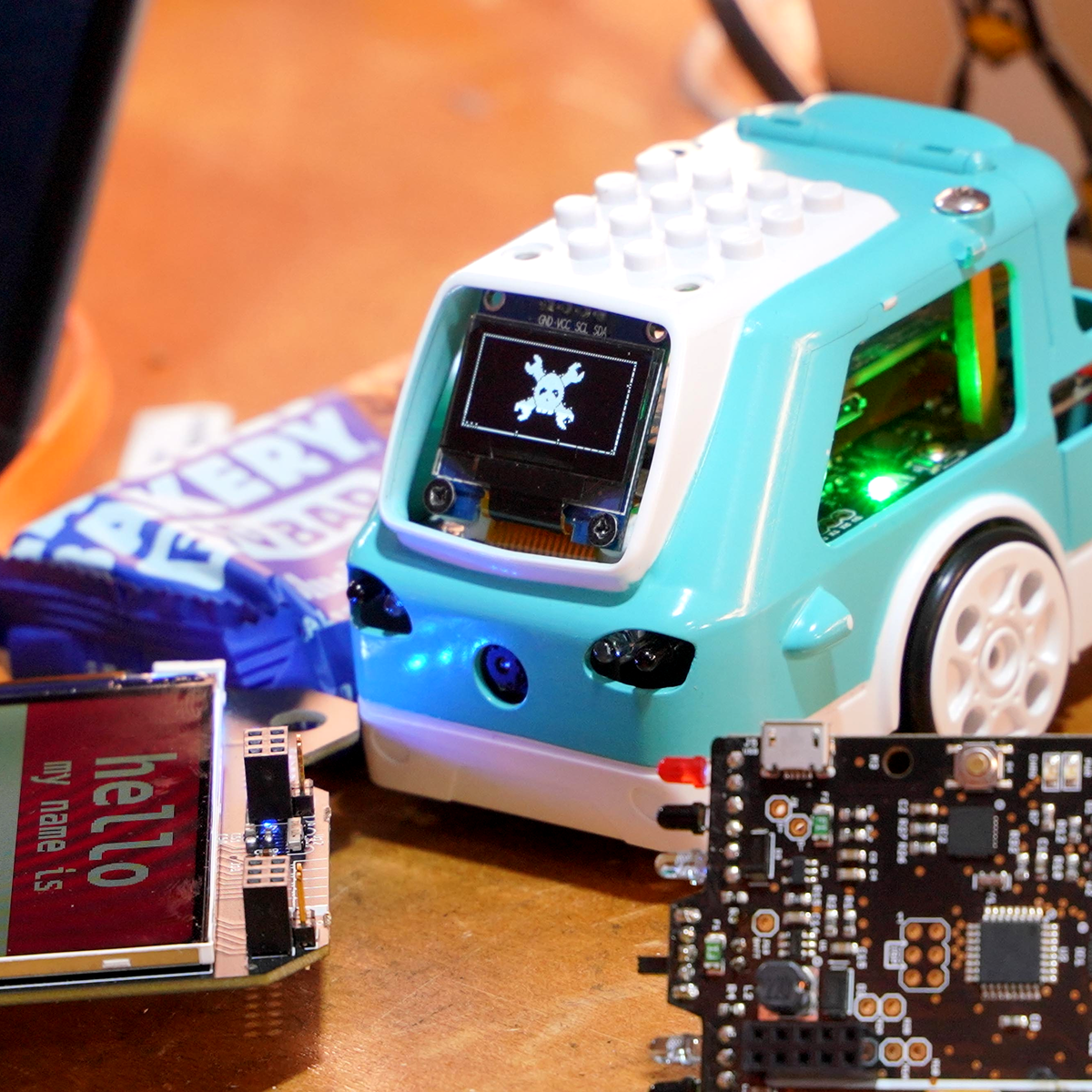
This week Jonathan Bennett and Rob Campbell talk with Gareth Coleman and Hamish Cunningham! It’s all about the Unphone, an open source handset sporting an ESP32, color touchscreen, and LoRa radio. It’s open hardware, and used in a 3rd year university course to teach comp sci majors about hardware and embedded development.

Continue reading “FLOSS Weekly Episode 783: Teaching Embedded With The Unphone”

Hackaday Supercon 2024 Call For Participation: We Want You!

We’re tremendously excited to be able to announce that the Hackaday Supercon is on for 2024, and will be taking place November 1st through the 3rd in sunny Pasadena, California. As always, Supercon is all about you, the Hackaday community. So put on your thinking caps because we’d like to hear your proposals for talks and workshops! The Call for Speakers and Call for Workshops forms are online now, and you’ve got until July 9th to get yourself signed up.

Supercon is a fantastic event to geek out with your fellow hackers, and to share the inevitable ups and downs that accompany any serious project. Like last year, we’ll be featuring both longer and shorter talks, and hope to get a great mix of both first-time presenters and Hackaday luminaries.

Honestly, just the crowd that Supercon brings together is reason enough to attend, but then you throw in the talks, the badge-hacking, the food, and the miscellaneous shenanigans … it’s an event you really don’t want to miss. And as always, presenters get in for free, get their moment in the sun, and get warm vibes from the Hackaday audience. Get yourself signed up now!

PCB Design Review: HDMI To LVDS Sony Vaio LCD Devboard

Today, we revisit another board from [Exentio] – a HDMI/DVI to LVDS transmitter for the Sony Vaio P display. This board is cool to review – it has a high-speed serial interface, a parallel interface, a healthy amount of power distribution that can be tricky to route, and many connectors to look over.

I’ve decided to show this review to you all because it demonstrates a PCB improvement concept we haven’t yet touched upon, that you should absolutely know about when doing board layout. Plus, I get a chance to talk about connector choice considerations!

The board is lovely. It integrates the DPI-LVDS circuit we’ve previously reviewed, but also a HDMI to parallel RGB chip from Texas Instruments, TFP401, a chip appreciated enough that even Adafruit has adapters with it. The fun thing about this chip is that it doesn’t even handle EDID like the usual HDMI to RGB/LVDS chips you get on cheap Aliexpress boards. So, there’s no firmware to take care of – it just receives a HDMI/DVI signal, converts it into parallel RGB, then converts that to LVDS, and off to the display it goes. The downside is that you have to provide your own EDID with an EEPROM, but that isn’t that tricky.

Again, this is a two-layer board, and, again, I like this – fitting tracks to the smallest possible space is a respectable and enjoyable challenge. This board has absolutely done well by this challenge. I do see how this board could be routed in an even better way, however, and it could be way way cleaner as a result. For a start, rotating the chip would improve the odds a whole lot.

The Chip Gets Rotated

Continue reading “PCB Design Review: HDMI To LVDS Sony Vaio LCD Devboard”

Supercon 2023: Building The Ultimate Apple IIe, Decades Later

The Apple II was launched in 1977, a full 47 years ago. The Apple IIe came out six years later, with a higher level of integration and a raft of new useful features. Apple eventually ended production of the whole Apple II line in 1993, but that wasn’t the end. People like [James Lewis] are still riffing on the platform to this day. Even better, he came to Supercon 2023 to tell us all about his efforts!

[James]’s talk covers the construction of the Mega IIe, a portable machine of his own design. As the name suggests, the project was based on the Mega II chip, an ASIC for which he had little documentation. He wasn’t about to let a little detail like that stop him, though.

The journey of building the Mega IIe wasn’t supposed to be long or arduous; the initial plan was to “just wire this chip up” as [James] puts it. Things are rarely so simple, but he persevered nonetheless—and learned all about the Apple II architecture along the way.

Continue reading “Supercon 2023: Building The Ultimate Apple IIe, Decades Later”

The Art Of Hackaday Hack Chat

Join us on Wednesday, May 15 at noon Pacific for the The Art of Hackaday Hack Chat with Joe Kim!

Here at Hackaday, we writers strive to bring you the freshest hacks and the best news from the world of engineering and science. When we miss the mark and make technical errors or stake out a controversial position on something, our readers will certainly let us know in the comments section. It’s a love-hate thing.

While we don’t always see eye to eye, there’s one thing that everyone seems to agree on: Hackaday’s art is amazing! Our unique look comes down to one man: art director Joe Kim. Joe’s creations have graced Hackaday’s pages for years, and his ability to come up with just the right art to illustrate subject matter that’s often complicated and abstract never ceases to amaze.

join-hack-chatA lot of you have asked about Hackaday’s art over the years, so we asked Joe to come on the Hack Chat to talk about the process of creating these mini masterpieces. If you’ve ever wondered about the art of Hackaday, or just wanted to say thanks for the visual feast, here’s your chance.

Our Hack Chats are live community events in the Hackaday.io Hack Chat group messaging. This week we’ll be sitting down on Wednesday, May 15 at 12:00 PM Pacific time. If time zones have you tied up, we have a handy time zone converter.

Hackaday Links Column Banner

Hackaday Links: May 12, 2024

Don’t pack your bags for the trip to exoplanet K2-18b quite yet — it turns out that the James Webb Space Telescope may not have detected signs of life there after all. Last year, astronomers reported the possible presence of dimethyl sulfide there, a gas that (at least on Earth) is generally associated with phytoplankton in the ocean. Webb used its infrared spectrometer instruments to look at the light from the planet’s star, a red dwarf about 111 light-years away, as it passed through the hydrogen-rich atmosphere. The finding was sort of incidental to the discovery of much stronger signals for methane and carbon dioxide, but it turns out that the DMS signal might have just been overlap from the methane signal. It’s too bad, because K2-18b seems to be somewhat Earth-like, if you can get over the lack of oxygen and the average temperature just below freezing. So, maybe not a great place to visit, but it would be nice to see if life, uh, found a way anywhere else in the universe.

Attention Fortran fans: your favorite language isn’t quite dead yet. In fact, it cracked the top ten on one recent survey, perhaps on the strength of its numerical and scientific applications. The “Programming Community Index” is perhaps a bit subjective, since it’s based on things like Google searches for references to particular languages. It’s no surprise then that Python tops such a list, but it’s still interesting that there’s enough interest in a 67-year-old programming language to make it onto the list. We’d probably not advise building a career around Fortran, but you never know.

Continue reading “Hackaday Links: May 12, 2024”

Institutional Memory, On Paper

Our own Dan Maloney has been on a Voyager kick for the past couple of years. Voyager, the space probe. As a long-term project, he has been trying to figure out the computer systems on board. He got far enough to write up a great overview piece, and it’s a pretty good summary of what we know these days. But along the way, he stumbled on a couple old documents that would answer a lot of questions.

Dan asked JPL if they had them, and the answer was “no”. Oddly enough, the very people who are involved in the epic save a couple weeks ago would also like a copy. So when Dan tracked the document down to a paper-only collection at Wichita State University, he thought he had won, but the whole box is stashed away as the library undergoes construction.

That box, and a couple of its neighbors, appear to have a treasure trove of documentation about the Voyagers, and it may even be one-of-a-kind. So in the comments, a number of people have volunteered to help the effort, but I think we’re all just going to have to wait until the library is open for business again. In this age of everything-online, everything-scanned-in, it’s amazing to believe that documents about the world’s furthest-flown space probe wouldn’t be available, but so it is!

It makes you wonder how many other similar documents – products of serious work by the people responsible for designing the systems and machines that shaped our world – are out there in the dark somewhere. History can’t capture everything, and it’s down to our collective good judgement in the end. So if you find yourself in a position to shed light on, or scan, such old papers, please do! And then contact some nerd institution like the Internet Archive or the Computer History Museum.