Blinded With Science

So the room-temperature superconductor was a super disappointment, but even though the claims didn’t stand up in the end, the even better news is that real science was done. A paper making extraordinary claims came out, the procedure to make LK-99 was followed in multiple labs around the world, and then it was tested. It didn’t turn out to conduct particularly well at all. After a couple weeks of global superconductor frenzy, everything is back to normal again.

What the heck happened? First of all, the paper itself made extravagant claims about a holy-grail kind of material. There was a very tantalizing image of a black pellet floating in mid air, which certainly seems like magic, even though it’s probably only run-of-the-mill ferromagnetism in the end. But it made for a great photo-op in a news-starved August, and the then-still-Twitterverse took to it by storm. And then the news outlets piled on the hype fest.

If you’re feeling duped by the whole turn of events, you’re not alone. But the warning signs were there from the beginning, if you took the time to look. For me, it was the closing line of the paper: “We believe that our new development will be a brand-new historical event that opens a new era for humankind.”

That’s not the kind of healthy skepticism and cautious conclusion that real science runs best on. Reading the paper, I had almost no understanding of the underlying materials science, but I knew enough about human nature to suspect that the authors had rushed the paper out the door without sufficient scrutiny.

How can we keep from being fooled again? Carl Sagan’s maxim that “extraordinary claims require extraordinary evidence” is a good start. To that, I would add that science moves slowly, and that extraordinary evidence can only accumulate over time. So when you see hype science, simply wait to draw any conclusions. If it is the dawn of a new era, you’ll have a lot of time to figure out what room-temperature superconductivity means to you in the rosy future. And if it’s just a flash in the pan, you won’t have gotten your hopes up.

Retrotechtacular: Building The First Computers For Banking

If you’ve ever wondered where the term “banker’s hours” came from, look back to the booming post-war economy of 1950s America. That’s when banks were deluged with so many checks, each of which had to be reconciled by hand, that they had to shut their doors at 2:00 or 3:00 in the afternoon, just to have a hope of getting all the work done at a reasonable time. It was time-consuming, laborious, error-prone work that didn’t scale well, and something had to be done about it.

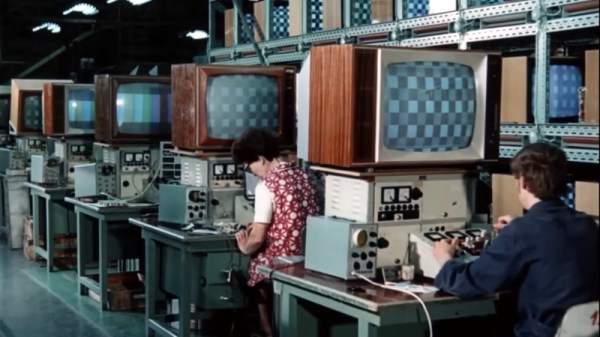
The short film below, “Manufacturing Competence,” details the building of ERMA, the Electronic Recording Machine, Accounting. ERMA was the result of years of R&D work, and by the early 1960s, General Electric was gearing up production at its new Phoenix, Arizona plant. The process goes from bare metal racks and proceeds through to manufacturing the many modules needed for these specialized machines, which were perhaps the first commercial use of computers outside of universities and the military.

The sheer number of workers involved is astonishing, especially in backplane assembly, with long lines of women wielding wire-wrapping guns and following punch-tape instructions for the point-to-point connections. PCB stuffing was equally labor-intensive, with women stuffing boards from a handful of seemingly random components. And the precision needed for some of the steps, like weaving the ferrite core memory, was breathtaking. We really enjoyed the bit where the tiny toroids were bounced into place with a vibrating jig.

The hybrid nature of ERMA, and the assembly methods needed to produce it, are what strike us most about this film. The backplanes were wire-wrapped, but the modules were wave-soldered PCBs. Component leads were automatically formed and trimmed, but inserted by hand. Assembly and testing were directed by punched tape, but results were assessed by eye. Even ERMA itself was prototyped with vacuum tubes, but switched to transistors for production. The transitional nature of electronics in the early 1960s is on full display here, and it offers an interesting perspective on how change in this field can be simultaneously rapid and glacial.

Continue reading “Retrotechtacular: Building The First Computers For Banking”

Hackaday Podcast 231: Harnessing Sparks, Hacking Food, And Leaving Breadcrumbs

Editor-in-Chief Elliot Williams and Al Williams don’t always agree on the best text editor to use, but they do — usually — agree on what makes a great hack. This week, they found plenty of Hackaday posts to discuss, ranging from exotic eavesdropping on keyboards, oscilloscopes, and several posts of interest to anyone who wants to build good-looking prototypes. If you are like mechanics, you’ll hear about an escapement-like mechanism and a Hobson’s coupler. If you crave more traditional hacks, you can learn more about maximizing battery life and etching PCBs.

In addition to a flurry of hacks, Elliot and Al also share their picks for the best original posts from Hackaday’s staff. This week, we find out how Arya Voronova documents projects and hear what Tom Nardi thinks of his Beepy — a ready-made display and Blackberry keyboard waiting for a Raspberry Pi.

Did you miss anything? Check out the links below. Be sure to send your favorite hacks our way, and let us know in the comments how you liked this episode. Hear it here:

Or download it yourself and listen while testing room-temperature superconductors!

Continue reading “Hackaday Podcast 231: Harnessing Sparks, Hacking Food, And Leaving Breadcrumbs”

This Week In Security: It’s Con Season

It must be Blackhat/DEFCON season. Up first in the storm of named vulnerabilities, we have Downfall. The PDF has the juicy details here. It’s quite similar to the Zenbleed issue from last week, in that it abuses speculative execution to leak data via a hidden register. Unlike Zenbleed, this isn’t direct access, but using cache timing analysis to extract individual bytes using a FLUSH+RELOAD approach.

The key to the vulnerability is the gather instruction, which pulls data from multiple locations in memory, often used to run a followup instruction on multiple bytes of data at once. The gather instruction is complex, takes multiple clock cycles to execute, and uses several tricks to execute faster, including managing buffers to avoid multiple reads. In certain cases, that instruction can be interrupted before it completes, leaving the data in the cache. And this data can be speculatively accessed and the values leaked through timing analysis.

This flaw affects 6th generation Intel Core processors through 11th. Mitigations are already rolling out via a microcode update, but do carry a performance hit for gather instructions. Continue reading “This Week In Security: It’s Con Season”

Canadian Engineers? They Have A Ring About Them

How can you spot an engineer? It can be tricky, but it is a little easier in Canada. That’s because many Canadian engineers have been through the Ritual of the Calling of an Engineer and wear an iron or steel ring to symbolize their profession. The ring has a very odd history that originated in 1922 as the brainchild of Professor H. E. T. Haultain. While he may not be a recognizable name, at least one famous person was involved with creating the Ritual.

H. E. T. Haultain

The ring itself has facets on the outer surface, and you wear it on the little finger of your dominant hand. Originally handmade, the ring reminds the wearer of the engineer’s moral, ethical, and professional commitment. In addition to being a visible reminder, the ring is made to drag slightly as you write or draw, as a constant reminder of the engineer’s obligation. With more experience, the ridges wear down, dragging less as you get more experience.

There is a rumor that the first rings were made from the metal of a bridge that collapsed due to poor design, but this appears untrue. The presentation ceremony is understated, with limited attendance and very little publicity.

Continue reading “Canadian Engineers? They Have A Ring About Them”

Share Your Projects: Leave Breadcrumbs

I’ve talked about a low-effort way to document your projects by taking plenty of pictures, and about ways that your PCBs could be documenting themselves. Today, let’s talk about a quick and easy way that you could help other hackers as you go through your own hacking adventures — leaving breadcrumbs.

In short, breadcrumbs are little pieces of crucial information that you had to spend time to figure out. They are solutions to problems that another hacker just like you could stumble upon in the future, something that you perhaps wish you didn’t have to figure out on your own, and certainly something that others won’t need to spend time figuring out.

Breadcrumbs are about saving time, for you and others. It helps if you think of your solved problems in terms of time spent. If you figure out a small problem and then publish your solution, you might be saving half an hour, a full hour, or a good few hours of time another hacker that’s could even be less experienced in debugging than you. In fact, your breadcrumb might even make a difference between someone completing a project and abandoning it!

However, there’s also the trade-off of taking time to document something. If you can’t publish your solution in a few minutes’ time, it might become much harder to persuade your brain to publish the next time you have something notable. Here’s a guideline: if you’ve just figured out a cool terminal command that helps you solve a certain kind of problem, you should have a quick way to publish that command within a minute. The good news is, the internet has a hundred different places you could easily share your findings, depending on the kind of problem you’ve solved! Continue reading “Share Your Projects: Leave Breadcrumbs”

Easyeda2KiCad: Never Draw A Footprint Again

What if I told you that you might never need to draw a new footprint again? Such is my friend’s impression of the tool that she’s shown me and I’m about to show you in turn, having used this tool for a few projects, I can’t really disagree!

We all know of the JLCPCB/LCSC/EasyEDA trio, and their integration makes a lot of sense. You’re expected to design your boards in EasyEDA, order the components on LCSC, and get the boards made by JLCPCB. It’s meant to be a one-stop shop, and as you might expect, there’s tight integration between all three. If there wasn’t, you’d be tempted to step outside of the ecosystem, after all.

But like many in this community, I use KiCad, and I don’t expect to move to a different PCB design suite — especially not a cloud one. Still, I enjoy using the JLCPCB and LCSC combination in the hobby PCB market as it stands now, and despite my KiCad affinity, it appears that EasyEDA can help me after all!

Continue reading “Easyeda2KiCad: Never Draw A Footprint Again”