Hackaday Links Column Banner

Hackaday Links: April 21, 2019

A Russian company has developed a drone with a very interesting control scheme. It’s a VTOL fixed wing, that takes off like a bicopter, transitions to use wings for lift, flies around for half an hour or so, and then lands on its tail. This is a big ‘un; the reported weight is 50 pounds. Although the available footage really doesn’t give any sense of scale, we would estimate the wingspan as somewhere between four and five feet. Fixed-wing VTOLs are close to the holy grail of current drone science — wings actually generate lift, and VTOL means Uber can deliver McDonalds to your driveway.

What happens when you give an idiot a USB killer? $60,000 in damages. A former student at the College of St. Rose killed 59 computers with a USB killer, basically a charge pump that dumps a hundred or so volts back into a USB port, destroying the computer. Yes, you can just buy USB killers on the Internet, and yes you can film yourself zapping computers and posting the videos on social media. Both are dumb ideas.

This week was huge for the preservation of our digital culture. The source for the original Infocom games, such as Zork and Hitchhiker’s Guide to the Galaxy have been archived and released. This is a rather interesting development, as these games were written in Zork Implementation Lanugage (ZIL), a language that is used by no one and there’s almost zero documentation. Yes, we have the source, but not a compiler. It’s Lisp-ish, and there are people working to make new games in this language. Also this week is the release of the source for Leisure Suit Larry. Hackaday readers will be familiar with Leisure Suit Larry as the protagonist is a 38-year-old loser who lives in his mother’s basement. This game goes off the rails when the protagonist decides to leave the basement, but it was written a long time ago, and I guess Al Lowe didn’t foresee the Internet or something. Tip of the very fancy hat to @textfiles here.

You in Jersey? The Vintage Computer Festival East is May 3-5th, and it’s bound to be a grand time. Keynotes are by Steve Bellovin, co-inventor of USENET, Ken Thompson (!), co-inventor of UNIX, and Joe Decuir, co-inventor of the Atari VCS, Atari 800, and the Commodore Amiga. There’s also a Software Store (new this year), which we can only hope is like walking into Babbage’s. Protip: while you’re there, go up to Asbury Park and visit the Silverball Museum. It’s a whole lot of pinball.

For easier production and assembly of circuit boards, you should only place your components on one side. Doing so means you don’t have to flip the board and run it through the pick and place again, and you don’t have to worry about glue. This is a single-sided circuit board. There’s only one side. It’s a Mobius PCB, the flex-circuit version of a handmade circuit board made with a conductive pen.

Retrotechtacular: Transputer

Back in 2016, Hackaday published a review of The National Museum of Computing, at Bletchley Park. It mentions among the fascinating array of computer artifacts on display a single box that could be found in the corner of a room alongside their Cray-1 supercomputer. This was a Transputer development system, and though its architecture is almost forgotten today there was a time when this British-developed microprocessor family had a real prospect of representing the future of computing. So what on earth was the Transputer, why was it special, and why don’t we have one on every desk in 2019?

An Inmos RAMDAC (the 28-pin DIP) on the motherboard of a 1989 IBM PS/55. Darklanlan [CC BY 4.0]
Inmos, based in Bristol, were a — no, make that the — British semiconductor company, in the days when governments saw such things as a home-grown semiconductor manufacturing capability to be of strategic importance. They made microcomputer peripheral chips, RAM chips, and video chips (the workaday silicon of 1980s computing) but their exciting project was the Transputer.

This microprocessor family addressed the speed bottlenecks inherent to conventional processors of the day by being built from the ground up to be massively multiprocessor.  A network of Transputer processors would share a web of serial interconnects arranged in a crosspoint formation, allowing multiple of them to connect with each other independently and without collisions. It was the first to feature such an architecture, and at the time was seen as the Next Big Thing. All computers were going to use Transputers by the end of the 1990s, so electronic engineering students were taught all about them and encountered them in their group projects. I remember my year of third-year EE class would split into groups, each of tasked with a part of a greater project that would communicate through the crosspoint switch at the heart of one of the Transputer systems, though my recollection is that none of the groups went so far as to get anything to work. Still how this machine was designed is fun to look back on in modern times. Let’s dig in!

Continue reading “Retrotechtacular: Transputer”

Hackaday Podcast 015: Going Low Frequency, Robotic Machines, Disk Usage For Budgets, And Cellphones Versus Weather

Hackaday Editors Mike Szczys and Elliot Williams discuss the highlights of the great hacks from the past week. On this episode we discuss wireless charging from scratch, Etch-A-Sketch selfies, the robot arm you really should build yourself, bicycle tires and steel nuts for anti-slip footwear, and bending the piezo-electric effect to act as a VLF antenna. Plus we delve into articles you can’t miss about 5G and robot firefighting.

Take a look at the links below if you want to follow along, and as always, tell us what you think about this episode in the comments!

Take a look at the links below if you want to follow along, and as always, tell us what you think about this episode in the comments!

Direct download (60 MB or so.)

Continue reading “Hackaday Podcast 015: Going Low Frequency, Robotic Machines, Disk Usage For Budgets, And Cellphones Versus Weather”

Shadowhammer, WPA3, And Alexa Is Listening: This Week In Computer Security

Let’s get caught up on computer security news! The big news is Shadowhammer — The Asus Live Update Utility prompted users to download an update that lacked any description or changelog. People thought it was odd, but the update was properly signed by Asus, and antivirus scans reported it as safe.

Nearly a year later, Kaspersky Labs announced they had confirmed this strange update was indeed a supply chain attack — one that attacks a target by way of another vendor. Another recent example is the backdoor added to CCleaner, when an unknown actor compromised the build system for CCleaner and used that backdoor to target other companies who were using CCleaner. Interestingly, the backdoor in CCleaner has some similarities to the backdoor in the Asus updater. Combined with the knowledge that Asus was one of the companies targeted by this earlier breach, the researchers at Kaspersky Lab suggest that the CCleaner attack might have been the avenue by which Asus was compromised.

Shadowhammer sits quietly on the vast majority of machines it infects. It’s specifically targeted at a pool of about 600 machines, identified by their network card’s MAC address. We’ve not seen any reporting yet on who was on the target list, but Kaspersky is hosting a service to check whether your MAC is on the list.

While we’re still waiting for the full technical paper, researchers gave a nearly 30 minute presentation about Shadowhammer, embedded below the break along with news about Dragonblood, Amazon listening to your conversations, and the NSA delivering on Ghidra source code. See you after the jump!
Continue reading “Shadowhammer, WPA3, And Alexa Is Listening: This Week In Computer Security”

Teardown: The Guts Of A Digital Sentry

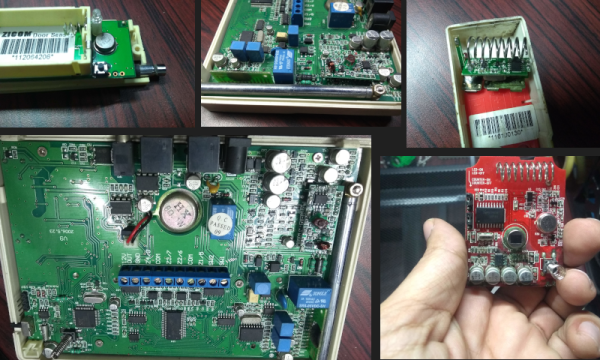
I have a home alarm system that has me wondering if I can make it better with my maker Kung-fu. Recently we had to replace our system, so I took the time to dissect the main controller, the remote sensors, and all the bits that make a home security system work.

To be precise, the subject of today’s interrogation is a Zicom brand Home Alarm that was quite famous a decade ago. It connects to a wired telephone line, takes inputs from motion, door, and gas sensors, and will make quite a racket if the system is tripped (which sometimes happened accidentally). Even though no circuits were harmed in the making of this post, I assure you that there are some interesting things that will raise an eyebrow or two. Lets take a look.

Continue reading “Teardown: The Guts Of A Digital Sentry”

What Can You Learn From An Eggbot?

An eggbot is probably the easiest introduction to CNC machines that you could possibly hope for, at least in terms of the physical build. But at the same time, an eggbot can let you get your hands dirty with all of the concepts, firmware, and the toolchain that you’d need to take your CNC game to the next level, whatever that’s going to be. So if you’ve been wanting to make any kind of machine where stepper motors move, cut, trace, display, or simply whirl around, you can get a gentle introduction on the cheap with an eggbot.

Did we mention Easter? It’s apparently this weekend. Seasonal projects are the worst for the procrastinator. If you wait until the 31st to start working on your mega-awesome New Year’s Dropping Laser Ball-o-tron 3000, it’s not going to get done by midnight. Or so I’ve heard. And we’re certainly not helping by posting this tutorial so late in the season. Sorry about that. On the other hand, if you start now, you’ll have the world’s most fine-tuned eggbot for 2020. Procrastinate tomorrow!

I had two main goals with this project: getting it done quickly and getting it done easily. That was my best shot at getting it done at all. Secondary goals included making awesome designs, learning some new software toolchains, and doing the whole thing on the cheap. I succeeded on all counts, and that’s why I’m here encouraging you to build one for yourself.

Continue reading “What Can You Learn From An Eggbot?”

Next Week Is KiCon: Come For The Talks, Stay For The Parties

KiCad is the electronic design automation software that lives at the intersection of electronic design and open source software. It’s seen a huge push in development over the last few years which has grown the suite into a mountain of powerful tools. To help better navigate that mountain, the first ever KiCad conference, KiCon, is happening next week in Chicago and Hackaday is hosting one of the afterparties.

The two days of talks take place on April 26th and 27th covering a multitude of topics. KiCad’s project leader, Wayne Stambaugh, will discuss the state of the development effort. You’ll find talks on best practices for using the software as an individual and as a team, how to avoid common mistakes, and when you should actually try to use the auto-router. You can learn about automating your design process with programs that generate footprints, by connecting it through git, and through alternate user interfaces. KiCad has 3D modeling to make sure your boards will fit their intended enclosures and talks will cover generating models in FreeCAD and rendering designs in both Fusion360 and Blender. Dust off your dark arts with RF and microwave design tips as well as simulating KiCad circuits in SPICE. If you can do it in KiCad, you’ll learn about it at KiCon.

Of course there’s a ton of fun to be had as interesting hackers from all over the world come together in the Windy City. Hackaday’s own Anool Mahidharia and Kerry Scharfglass will be presenting talks, and Mike Szczys will be in the audience. We anticipate an excellent “lobby con” where the conversations away from the stages are as interesting as the formal talks. And of course there are afterparties!

  • Friday 4/26 Pumping Station: One, the popular Chicago hackerspace now celebrating its 10 year anniversary, is hosting an afterparty (details TBA)
  • Saturday 4/27: Hackaday is hosting an after party at Jefferson Tap from 6-8:30. We’re providing beverages and light food for all who attended the conference.

If you still don’t have a ticket to KiCon, you better get one right now. We’re told that you can count what’s left on two hands. Supplyframe (Hackaday’s parent company) is a sponsor of KiCon, and we have two extra tickets that came with that sponsorship. We like seeing a diverse community at these events and have saved these tickets for people from under-represented groups (such as for example women, LGBT+, and people of color) in the hardware world. Email us directly for the tickets, your information will remain confidential.

We’re looking forward to seeing everyone next week!