Hackaday Links Column Banner

Hackaday Links: November 3, 2019

Depending on how you look at it, the Internet turned 50 years old last week. On October 29, 1969, the first message was transmitted between two of the four nodes that made up ARPANET, the Internet’s predecessor network. ARPANET was created after a million dollars earmarked for ballistic missile defense was diverted from the Advanced Research Projects Agency budget to research packet-switched networks. It’s said that ARPANET was designed to survive a nuclear war; there’s plenty of debate about whether that was a specific design goal, but if it was, it certainly didn’t look promising out of the gate, since the system crashed after only two characters of the first message were sent. So happy birthday, Internet, and congratulations: you’re now old enough to start getting junk mail from the AARP.

Good news for space nerds: NASA has persuaded Boeing to livestream an upcoming Starliner test. This won’t be a launch per se, but a test of the pad abort system intended to get astronauts out of harm’s way in the event of a launch emergency. The whole test will only last about 90 seconds and never reach more than 1.5 kilometers above the White Sands Missile Range test site, but it’s probably a wise move for Boeing to be as transparent as possible at this point in their history. The test is scheduled for 9:00 AM Eastern time — don’t forget Daylight Savings Time ends this weekend in most of the US — and will air on NASA Television.

Speaking of space, here’s yet another crowd-sourced effort you might want to consider getting in on if you’re of an astronomical bent. The Habitable Exoplanet Hunting Project is looking for a new home for humanity, and they need more eyes on the skies to do it. An introductory video explains all about it; we have to admit being surprised to learn that the sensitive measurements needed to see exoplanets transiting their stars are possible for amateur astronomers, but it seems doable with relatively modest equipment. Such are the advances in optics, CCD cameras, and image processing software, it seems. The project is looking for exoplanets within 100 light-years of Earth, perhaps on the hope that a generation ship will have somewhere to go to someday.

Space may be hard, but it’s nothing compared to running a hackerspace right here on Earth. Or at least it seems that way at times, especially when those times include your building collapsing, a police raid, and being forced to operate out of a van for months while searching for a new home, all tragedies that have befallen the Cairo Hackerspace over the last few years. They’re finally back on their feet, though, to the point where they’re ready to host Egypt’s first robotics meetup this month. If you’re in the area, stop by and perhaps consider showing off a build or even giving a talk. This group knows a thing or two about persistence, and they’ve undoubtedly got the coolest hackerspace logo in the world.

And finally, no matter how bad your job may be, it’s probably not as bad as restoring truck batteries by hand. Alert reader [rasz_pl] tipped us off to this video, which shows an open-air shop in Pakistan doing the dirty but profitable work of gutting batteries and refurbishing them. The entire process is an environmental and safety nightmare, with used electrolyte tossed into the gutter, molten lead being slung around by the bucketful, and not a pair of safety glasses or steel-toed shoes (or any-toed, for that matter) to be seen. But the hacks are pretty cool, like pouring new lead tabs onto the plates, or using a bank of batteries to heat an electrode for welding the plates together. We’ve talked about the recyclability of lead-acid batteries before and how automated plants can achieve nearly 100% reuse; there’s nothing automated here, though, and the process is so labor-intensive that only three batteries can be refurbished a day. It’s still fascinating to watch.

Continue reading “Hackaday Links: November 3, 2019” →

Eth0 Autumn 2019: Tiny Camp, Creative Badge

The Dutch organisation eth0 has run a series of informal small camps over the years, never with an attendance too far into three figures, and without pre-planned events or entertainment. What happens is at the instigation of the attendees, and the result is a weekend of much closer socialising and working together on projects than the large camps where you spend your time running around to catch everything.

The largest of hacker camps offer all the lights, robots, tschunk, and techno music you can stomach; they can be a blast but also overwhelming. I made my way eth0 over the past week weekend, enjoying the more intimate size and coming away having made friendships from spending time with great people at a large private camping hostel near Lichtenvoorde. This is in the far east of the country near the German border, to which in the company of a British hardware hacker friend I traveled in the tiny European hatchback. Netherlands roads are so easy to navigate!

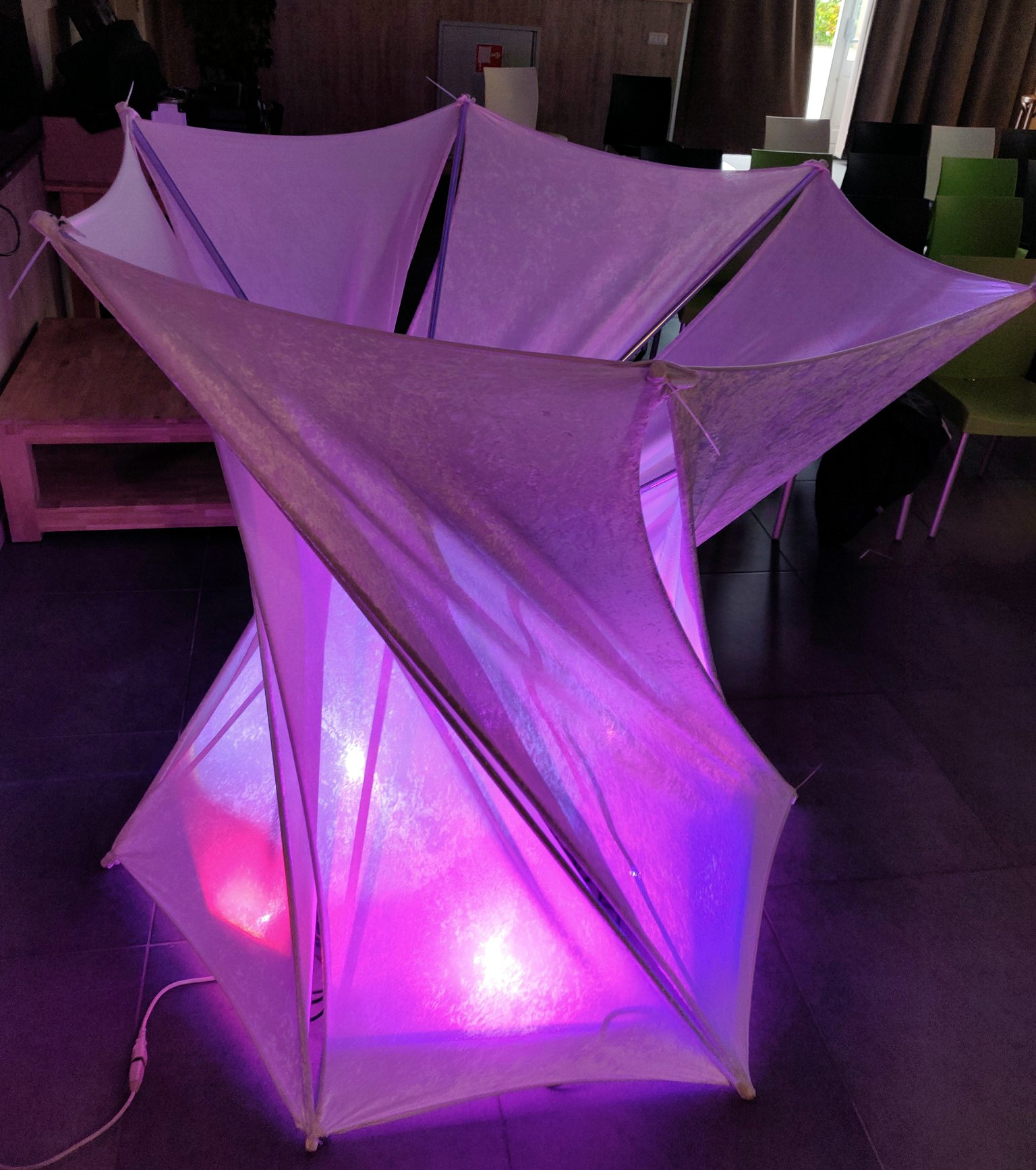
A prototype tensegrity structure. Image: Igor Nikolic.

At the event was the usual array of activities, though since it was a restricted photography affair I’m short on wider shots that would include people. This year’s hit came from surplus flipdot displays from retired German buses, with plenty of glitches as their quirks were figured out by our friends Lucy Fauth and Jana Marie Hemsing. Something tells me I’ll be seeing a lot of those fluorescent circles in the future.

I’d brought along the nucleus of a textile village, and RevSpace in the Hague had added their embroidery machine to my overlocker and sewing machines. Its operator was Boekenwuurm from Hackalot in Eindhoven who was kind enough to embroider a Wrencher for me, and now I want one of these 600-Euro machines even if I can’t afford one. She and RevSpace’s Igor Nikolic were experimenting with inflatables and tensegrity structures, creating prototypes with an eye to more impressive installations at future camps.

An entertaining tale of a couple of days hanging out with friends in the Netherlands countryside could probably be spun into a reasonable tale, but there was something more interesting still at this camp. It had a badge, courtesy of the prolific badge.team Dutch badge crew. It didn’t come with their trademark ESP32 firmware though, instead in keeping with the budget of the event it was a prototyping board on which attendees could create their own badges. What came forth from that was extremely impressive, and continued after the event.

Continue reading “Eth0 Autumn 2019: Tiny Camp, Creative Badge” →

The 3D Printers, Scanners, And Art Robots Of Maker Faire Rome

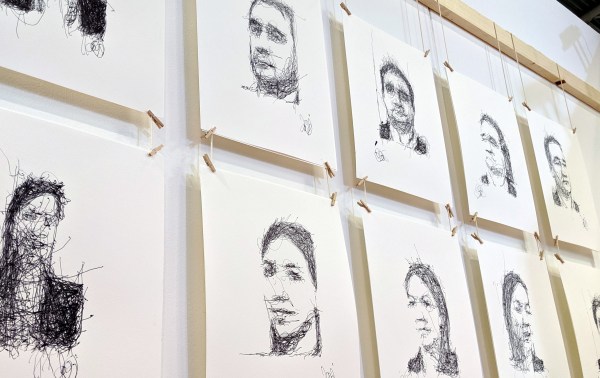
How is it possible that a robot can sketch both better and worse than I can at the same time, and yet turn out an incredible work of art? Has 3D-scanning really come so far that a simple camera and motorized jig can have insane resolution? These are the kinds of questions that were running through my mind, and being answered by the creators of these brilliant machines, at Maker Faire Rome.

There was a high concentration of robots creating art and 3D printing on display and the Faire, so I saved the best examples just for this article. But you’ll also find hacks from a few groups of clever students, and hardware that made me realize industrial controllers can be anything but boring. Let’s take a look!

Continue reading “The 3D Printers, Scanners, And Art Robots Of Maker Faire Rome” →

DSP Spreadsheet: Frequency Mixing

Circuit simulation and software workbooks like Matlab and Jupyter are great for being able to build things without a lot of overhead. But these all have some learning curve and often use clever tricks, abstractions, or library calls to obscure what’s really happening. Sometimes it is clearer to build math models in a spreadsheet.

You might think that spreadsheets aren’t built for doing frequency calculation and visualization but you’re wrong. That’s exactly what they’re made for — performing simple but repetative math and helping make sense of the results.

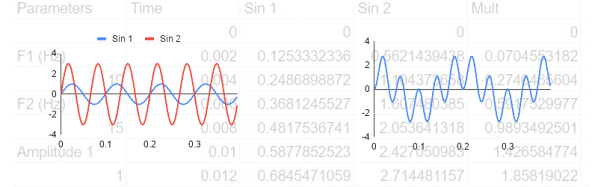
In this installment of the DSP Spreadsheet series, I’m going to talk about two simple yet fundamental things you’ll need to create mathematical models of signals: generating signals and mixing them. Since it is ubiquitous, I’ll use Google Sheets. Most of these examples will work on any spreadsheet, but at least everyone can share a Google Sheets document. Along the way, we’ll see a neat spreadsheet trick I should probably use more often.

Continue reading “DSP Spreadsheet: Frequency Mixing” →

Hackaday Podcast 042: Capacitive Earthquakes, GRBL On ESP32, Solenoid Engines, And The TI-99 Space Program

Hackaday Editors Elliot Williams and Mike Szczys talk turkey on the latest hacks. Random numbers, art, and electronic geekery combine into an entropic masterpiece. We saw Bart Dring bring new life to a cool little multi-pen plotter from the Atari age. Researchers at UCSD built a very very very slow soft robot, and a broken retrocomputer got a good dose of the space age. A 555 is sensing earthquakes, there’s an electric motor that wants to drop into any vehicle, and did you know someone used to have to read the current time into the telephone ad nauseam?

Take a look at the links below if you want to follow along, and as always tell us what you think about this episode in the comments!

Take a look at the links below if you want to follow along, and as always, tell us what you think about this episode in the comments!

Direct download (60 MB or so.)

Continue reading “Hackaday Podcast 042: Capacitive Earthquakes, GRBL On ESP32, Solenoid Engines, And The TI-99 Space Program” →

This Week In Security: Project Zero’s IPhone, BBC The Onion, Rooting Androids, And More

The always interesting Project Zero has a pair of stories revolving around security research itself. The first, from this week, is all about one man’s quest to build a debug iPhone for research. [Brandon Azad] wanted iOS debugging features like single-stepping, turning off certain mitigations, and using the LLDB debugger. While Apple makes debug iPhones, those are rare devices and apparently difficult to get access to.

[Brandon] started looking at the iBoot bootloader, but quickly turned his attention to the debugging facilities baked into the Arm chipset. Between the available XNU source and public Arm documentation, he managed to find and access the CoreSight debug registers, giving him single-step control over a core at a time. By triggering a core halt and then interrupting that core during reset, he was able to disable the code execution protections, giving him essentially everything he was looking for. Accessing this debug interface still requires a kernel level vulnerability, so don’t worry about this research being used maliciously.

The second Google Zero story that caught my eye was published earlier in the month, and is all about finding useful information in unexpected places. Namely, finding debugging symbols in old versions of Adobe Reader. Trying to understand what’s happening under the hood of a running application is challenging when all you have is a decompiler output. Adobe doesn’t ship debug builds of Reader, and has never shipped debug information on Windows. Reader has been around for a long time, and has supported quite a few architectures over the years, and surprisingly quite a few debug builds have been shipped as a result.

How useful could ancient debugging data be? Keep in mind that Adobe changes as little as possible between releases. Some code paradigms, like enums, tend to be rather static as well. Additional elements might be added to the end of the enum, but the existing values are unlikely to change. [Mateusz Jurczyk], the article’s author, then walks us through an example of how to take that data and apply it to figuring out what’s going on with a crash. Continue reading “This Week In Security: Project Zero’s IPhone, BBC The Onion, Rooting Androids, And More” →

Saintcon Badge Is An Enigma No More

Through the weekend Twitter has been a-titter with news coming out of Saintcon, the annual security conference in Provo, Utah. Now that the weekend is over we can finally get our hands on full hardware and software sources for the curvy, LED-covered badge we’ve been salivating over and a write up by its creators [compukidmike] and [bashNinja]. Let’s dive in and see what’s waiting!

Design

This year’s badge is designed to represent a single tooth on a single rotor of an Enigma machine. The full function of an Enigma machine is quite complex, but an individual device has three rotors with 26 teeth each (one for each letter) as well as a keypad for input and a character display to show each enciphered letter. For reference, the back of the badge has a handy diagram of a badge’s place in the Enigma system.

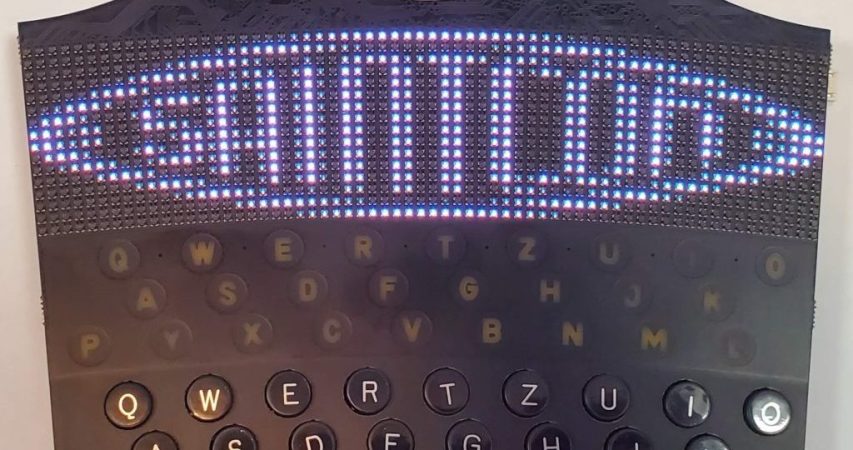
Reminiscent of the WWII device which the badge design recalls, each unit includes a full QWERTZ keyboard (with labeled keys!) and RGB “lampboard” for individual character output, but unlike the original there’s also a curved 16 x 64 RGB LED display made from those beguiling little ~1mm x 1mm LEDs. All in, the device includes 1051 LEDs! Combined with the unusually non-rectilinear shape of the badge and the Enigma-style Saintcon logo it makes for an attractive, cohesive look.

Continue reading “Saintcon Badge Is An Enigma No More” →