Hackaday Links Column Banner

Hackaday Links: February 17, 2019

There is a population of retrocomputing enthusiasts out there, whose basements, garages, and attics have been taken over by machines of years past. Most of the time, these people concentrate on one make; you’re an Apple guy, or you’re a Commodore guy, or you’re a Ford guy, or you’re a Chevy guy. The weirdos drive around with an MSX in the trunk of an RX7. This is the auction for nobody. NASA’s JPL Lab is getting rid of several tons of computer equipment, all from various manufacturers, and not very ‘vintage’ at all. Check out the list. There are CRT monitors from 2003, which means they’re great monitors that weigh as much as a person. There’s a lot of Sun equipment. If you’ve ever felt like cleaning up a whole bunch of trash for JPL, this is your chance. Grab me one of those sweet CRTs, though.

Last week, we published something on the ‘impossible’ tech behind SpaceX’s new engine. It was reasonably popular — actually significantly popular — and got picked up on Hacker News and one of the Elon-worshiping subreddits. Open that link in one tab. Now, open this link in another. Read along as a computer voice reads Hackaday words, all while soaking up YouTube ad revenue. What is our recourse? Does this constitute copyright infringement? I dunno; we don’t monetize videos on YouTube. Thanks to [MSeifert] for finding this.

Wanna see something funny? Check out the people in the comments below who are angry at a random YouTuber stealing Hackaday content, while they have an ad blocker on.

Teenage Engineering’s OP-1 is back in production. What is it and why does it matter? The OP-1 is a new class of synthesizer and sampler that kinda, sorta looks like an 80s Casio keyboard, but packed to the gills with audio capability. At one point, you could pick one of these up for $800. Now, prices are at about $1300, simply because production stopped for a while (for retooling, we’re guessing) and the rumor mill started spinning. The OP-1 is now back in production with a price tag of $1300. Wait. What? Yes, it’s another case study in marketing: the best way to find where the supply and demand curves cross is to stop production for a while, wait for the used resellers to do their thing, and then start production again with a new price tag that people are willing to pay. This is Galaxy Brain-level business management, people.

What made nerds angry this week? Before we get to that, we’re gonna have to back track a bit. In 2016, Motherboard published a piece that said PC Gaming Is Still Way Too Hard, because you have to build a PC. Those of us in the know realize that building a PC is as simple as buying parts and snapping them together like an expensive Lego set. It’s no big deal. A tech blog, named Motherboard, said building a PC was too hard. It isn’t even a crack at the author of the piece at this point: this is editorial decay.

And here we are today. This week, the Internet reacted to a video from The Verge on how to build a PC. The original video has been taken down, but the reaction videos are still up: here’s a good one, and here’s another. Now, there’s a lot wrong with the Verge video. They suggest using a Swiss army knife for the assembly, hopefully one with a Philips head screwdriver. Philips head screwdrivers still exist, by the way. Dual channel RAM was completely ignored, and way too much thermal compound was applied to the CPU. The cable management was a complete joke. Basically, a dozen people at The Verge don’t know how to build a PC. Are the criticisms of incompetence fair? Is this like saying [Doug DeMuro]’s car reviews are invalid because he can’t build a transmission or engine, from scratch, starting from a block of steel? Ehhh… we’re pretty sure [Doug] can change his own oil, at least. And he knows to use a screwdriver, instead of a Swiss army knife with a Philips head. In any event, here’s how you build a PC.

Hackaday writers to be replaced with AI. Thank you [Tegwyn] for the headline. OpenAI, a Musk and Theil-backed startup, is pitching a machine learning application that is aimed at replacing journalists. There’s a lot to unpack here, but first off: this already exists. There are companies that sell articles to outlets, and these articles are produced by ‘AI’. These articles are mostly in the sports pages. Sports recaps are a great application for ML and natural language processing; the raw data (the sports scores) are already classified, and you’re not looking for Pulitzer material in the sports pages anyway. China has AI news anchors, but Japan has Miku and artificial pop stars. Is this the beginning of the end of journalism as a profession, with all the work being taken over by machine learning algorithms? By vocation, I’m obligated to say no, but I have a different take on it. Humans can write better than AI, and the good ones are nearly as fast. Whether or not the readers care if a story is accurate or well-written is another story entirely. It will be market forces that determine if AI journalists take over, and if you haven’t been paying attention, no one cares if a news story is accurate or well written, only if it caters to their preexisting biases and tickles their confirmation bias.

Of course, you, dear reader, are too smart to be duped by such a simplistic view of media engagement. You’re better than that. You’re better than most people, in fact. You’re smart enough to see that most media is just placating your own ego and capitalizing on confirmation bias. That’s why you, dear reader, are the best audience. Please like, share, and subscribe for more of the best journalism on the planet.


Understanding Math Rather Than Merely Learning It

There’s a line from the original Star Trek where Khan says, “Improve a mechanical device and you may double productivity, but improve man and you gain a thousandfold.” Joan Horvath and Rich Cameron have the same idea about improving education, particularly autodidacticism or self-learning. They share what they’ve learned about acquiring an intuitive understanding of difficult math at the Hackaday Superconference and you can watch the newly published video below.

The start of this was the pair’s collaboration on a book about 3D printing science projects. Joan has a traditional education from MIT and Rich is a self-taught guy. This gave them a unique perspective from both sides of the street. They started looking at calculus — a subject that scares a lot of people but is really integral (no pun intended) to a lot of serious science and engineering.

You probably know that Newton and Leibniz struck on the fundamentals of calculus about the same time. The original papers, however, were decidedly different. Newton’s approach was more physical and less mathematical. Leibniz used formal logic and algebra. Although both share credit, the Leibniz notation won out and is what we use today.

Continue reading “Understanding Math Rather Than Merely Learning It” →

Airbus To Halt Production Of The A380; Goodbye To An Engineering Triumph

Eleven years ago, the Airbus A380 entered commercial service with Singapore Airlines. In the time since then it has become the queen of the skies. It’s a double-decker airliner, capable of flying 550 passengers eight thousand nautical miles. Some configurations of the A380 included private suites. Some had a shower. This is the epitome of luxury, a dream of flying with long-stemmed glasses, a movie, and a pleasant dream in mid-air.

Now, after the cancellation of A380 orders by Emirates, Airbus has announced it will end production of this massive, massive plane. No, it’s not the last flight of the Concorde, but it is the beginning of the end of an era. The biggest and most impressive planes just aren’t economical; it’s possible to fly three 787s across the globe for a single flight of an A380. The skies won’t fall silent, but soon the A380 will be no more.

Continue reading “Airbus To Halt Production Of The A380; Goodbye To An Engineering Triumph” →

Hackaday Podcast 006: Reversing IPod Screens, Hot Isotopes, We <3 Parts, And Biometric Toiletseats

What’s the buzz in the hackersphere this week? Hackaday Editors Elliot Williams and Mike Szczys recap their favorite hacks and articles from the past seven days. In Episode Six we cover an incredible reverse engineering effort Mike Harrison put in with iPod nano replacement screens. We dip our toes in the radioactive world of deep-space power sources, spend some time adoring parts and partsmakers, and take a very high-brow look at toilet-seat technology. In our quickfire hacks we discuss coherent sound (think of it as akin to laminar flow, but for audio), minimal IDEs for embedded, hand-tools for metalwork, and the little ESP32 bot that could.

Links for all discussed on the show are found below. As always, join in the comments below as we’ll be watching those as we work on next week’s episode!

Take a look at the links below if you want to follow along, and as always, tell us what you think about this episode in the comments!

Direct download (60 MB or so.)

Continue reading “Hackaday Podcast 006: Reversing IPod Screens, Hot Isotopes, We <3 Parts, And Biometric Toiletseats” →

New Part Day: A RISC-V CPU For Eight Dollars

RISC-V is the new hotness, and companies are churning out code and announcements, but little actual hardware. Eventually, we’re going to get to the point where RISC-V microcontrollers and SoCs cost just a few bucks. This day might be here, with Seeed’s Sipeed MAix modules. it’s a RISC-V chip you can buy right now, the bare module costs eight US dollars, there are several modules, and it has ‘AI’.

Those of you following the developments in the RISC-V world may say this chip looks familiar. You’re right; last October, a seller on Taobao opened up preorders for the Sipeed M1 K210 chip, a chip with neural networks. Cool, we can ignore some buzzwords if it means new chips. Seeed has been busy these last few months, and they’re now selling modules, dev boards, and peripherals that include a camera, mic array, and displays. It’s here now, and you can buy one. If it seems a little weird for Seeed Studios to get their hands on this, remember: the ESP8266 just showed up on their web site one day a few years ago. Look where we are with that now.

The big deal here is the Sipeed MAix-I module with WiFi, sold out because it costs nine bucks. Inside this module is a Kendryte K210 RISC-V CPU with 8MB of on-chip SRAM and a 400MHz clock. This chip is also loaded up with a Neural Network Processor, an Audio Processor with support for eight microphones, and a ‘Field Programmable IO array’, which sounds like it’s a crossbar on the 48 GPIOs on the chip. Details and documentation are obviously lacking.

In addition to a chip that’s currently out of stock, we also have the same chip as above, without WiFi, for a dollar less. It’ll probably be out of stock by the time you read this. There’s a ‘Go Suit’ that puts one of these chips in an enclosure with a camera and display, and there’s a microphone array add-on. There’s a binocular camera module if you want to play around with depth sensing.

The first time we heard of this chip, it was just a preorder on Taobao. It told us two things: RISC-V chips are coming sooner than we expected, and you can do preorders on Taobao. Seeed has a history of bringing interesting chips to the wider world, and if you want a RISC-V chip right now, here you go. Just be sure to tell us what you did with it.

Supercon 2018: Mike Szczys And The State Of The Hackaday

Every year at Superconference, Editor-in-Chief Mike Szczys gets the chance to talk about what we think are the biggest, most important themes in the Hackaday universe. This year’s talk was about science and technology, and more importantly who gets to be involved in building the future. Spoiler: all of us! Hackaday has always stood for the ideal that you, yes you, should be taking stuff apart, improving it, and finding innovative ways to use, make, and improve. To steal one of Mike’s lines: “Hackaday is an engine of engagement in engineering fields.”

Continue reading “Supercon 2018: Mike Szczys And The State Of The Hackaday” →

New Part Day : A Sensor Chip For 3D Color X-Ray Imaging

We all know CERN as that cool place where physicists play with massive, superconducting rings to smash atoms and subatomic particles to uncover secrets of matter in the Universe. To achieve this aim, they need to do a ton of research in other areas, such as development of special particle detectors.

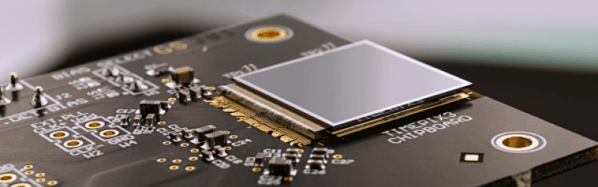
While such developments are essential to the core research needs of the Centre, they also lead to spinoff applications for the benefit of society at large. One such outcome has been the Medipix Collaborations – a family of read-out chips for particle imaging and detection that can count single photons, allowing X-rays and gamma rays to be converted to electrical signals. It may not be possible for us hackers to get our hands on these esoteric sensors, but these devices are pretty interesting and deserve a closer look. Medipix sensors work like a camera, detecting and counting each individual particle hitting the pixels when its electronic shutter is open. This enables high-resolution, high-contrast, noise hit free images – making it unique for imaging applications.

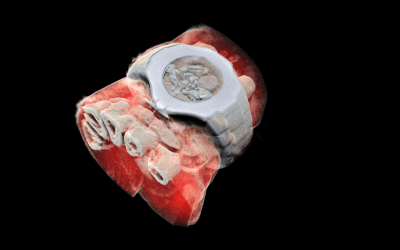
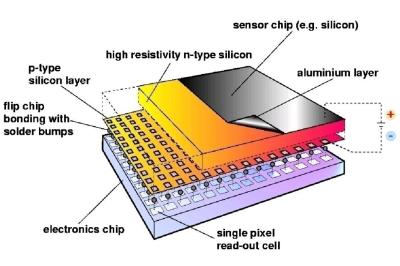
Some months back, CERN announced the first 3D color X-ray of a human made possible using the Medipix devices. The result is a high-resolution, 3D, color image of not just living structures like bones, muscular tissues and vessels, but metal objects too like the wrist watch, seen in the accompanying photograph. The Medipix sensors have been in development since the 1990’s and are presently in their 4th “generation”. Each chip consists of a top semiconducting sensor array, made from gallium arsenide or cadmium telluride. The charge collected by each pixel is transported to the CMOS ASIC electronics via “bump bonds”. The integration is vertical, with each sensing pixel connected via the bump bond to an analog section followed by a digital processing layer. Earlier versions were limited, by technology, in their tiling ability for creating larger matrices of multiple sensors. They could be abutted on three sides only, with the fourth being used for on-chip peripheral logic and wire-bond pads that permit electronic read-out. The latest Medipix4 Collaboration, still under some development, eliminates this short coming. Through-silicon-via (TSV) technology provides the possibility of reading the chips through copper-filled holes that bring the signals from the front side of the chip to its rear. All communication with the pixel matrix flows through the rear of the chip – the peripheral logic and control elements are integrated inside the pixel matrix.
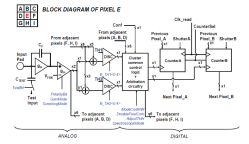
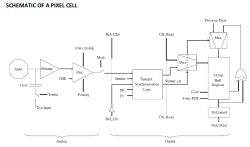
The Analog front end consists of a pre-amplifier followed by a window discriminator which has upper and lower threshold levels. The discriminator has four bits for threshold adjustment as well as polarity sensing. This allows the capture window to be precisely set. The rest of the digital electronics – multiplexers, shift registers, shutter and logic control – helps extract the data.
Further development of the Medipix (Tech Brief, PDF) devices led to a separate version called Timepix (Tech Brief, PDF). These new devices, besides being able to count photons, are capable of two additional modes. The first mode records “Time-Over-Threshold”, providing rough analog information about the energy of the photon. It does this by counting clock pulses for the duration when the signal stays above the discrimination levels. The other mode, “Time of Arrival”, measures arrival time of the first particle to impinge on the pixel. The counters record time between a trigger and detection of radiation quanta with energy above the discrimination level, allowing time-of-flight applications in imaging.

Besides medical imaging, the devices have applications in space, material analysis, education and of course, high energy physics. Hopefully, in a few years, hackers will lay their hands on these interesting devices and we can get to know them better. At the moment, the Medipix website has some more details and data sheets if you would like to dig deeper. For an overview on the development of such single photon detectors, check out this presentation from CERN – “Single X-Ray Photon Counting Systems: Existing Systems, Systems Under Development And Future Trends” (PDF).