Hackaday Links Column Banner

Hackaday Links: February 4th, 2018

Here’s something remarkably displeasant. Can you cook a steak with glue? [Dom] and [Chris] from ExplosiveDischarge have cooked a steak using a huge, huge amount of two-part epoxy. The chemistry behind this is just the exothermic reaction when two-part epoxy kicks off, and yes, the steak (a very thin cut) was sufficiently wrapped and protected from the hot sticky goo. What were the results? An overcooked steak, actually. This isn’t a sous vide setup where the temperature ramps up to 50°C and stays there — the temperature actually hit 80°C at its peak. There are a few ways to fix this, either by getting a thicker cut of steak, adding some bizarre water cooling setup to keep the temperature plateaued at a reasonable temperature.

This is your weekly reminder for the Repairs You Can Print contest.

We’ve got a twofer for awesome remote-controlled hovering stuff. The first is a 1:8 scale Harrier. This plane designed and built by [Joel Vlashof] will be a reasonably accurate model of a Harrier, capable of VTOL. It’s built around a huge 130mm EDF, powered by 2x6s lipos, and stabilized with a kk2.1 flight controller with VTOL software. This is as accurate a Harrier that you’re going to get in such a small format, and has the cool little spinny vanes that allow the beast to transition from vertical to horizontal flight.

Want some more cool hovering things? [Tom Stanton] is building a remote controlled Chinook. Yes, that helicopter with two main rotors. The usual way of doing this is with proper helicopter control systems like collectives and Jesus nuts. [Tom]’s building this version with standard quadcopter technology, mounting a motor to a servo, and doubling it up, and mounting it on a frame. In effect, this RC Chinook is the tail boom of a tricopter doubled up on a single frame. It does fly, and he’s even built a neat foamboard body for it.

SpaceX’s Falcon Heavy is going to do something next Tuesday, sometime in the afternoon, east coast time. Whatever happens, it’s going to be spectacular.

Hey, it’s time for a poll. I need to decide between ‘tide pod’ and ‘solo jazz’. For what I’m doing, the cost and effort are the same, I just need to know which is more aesthetic, cool, or whatever. Right now it’s 50:50. One must be crowned victorious!

Here’s the stupidest thing you’re going to see all year. That’s someone looping a quadcopter in front of a Frontier A320 (Probably. Seems too big for a 319 and too small for a 321) on approach. This guy is 3.6 miles East of runway 25L at McCarran Internation in Las Vegas, at an altitude far above the 400-foot limit. Judging from the video and the wingspan, this quad came within 200 feet of a plane carrying at least 150 people. It’s the stupidest thing you’ve ever seen, so don’t do it. It’ll be great to see the guy responsible for this in jail.

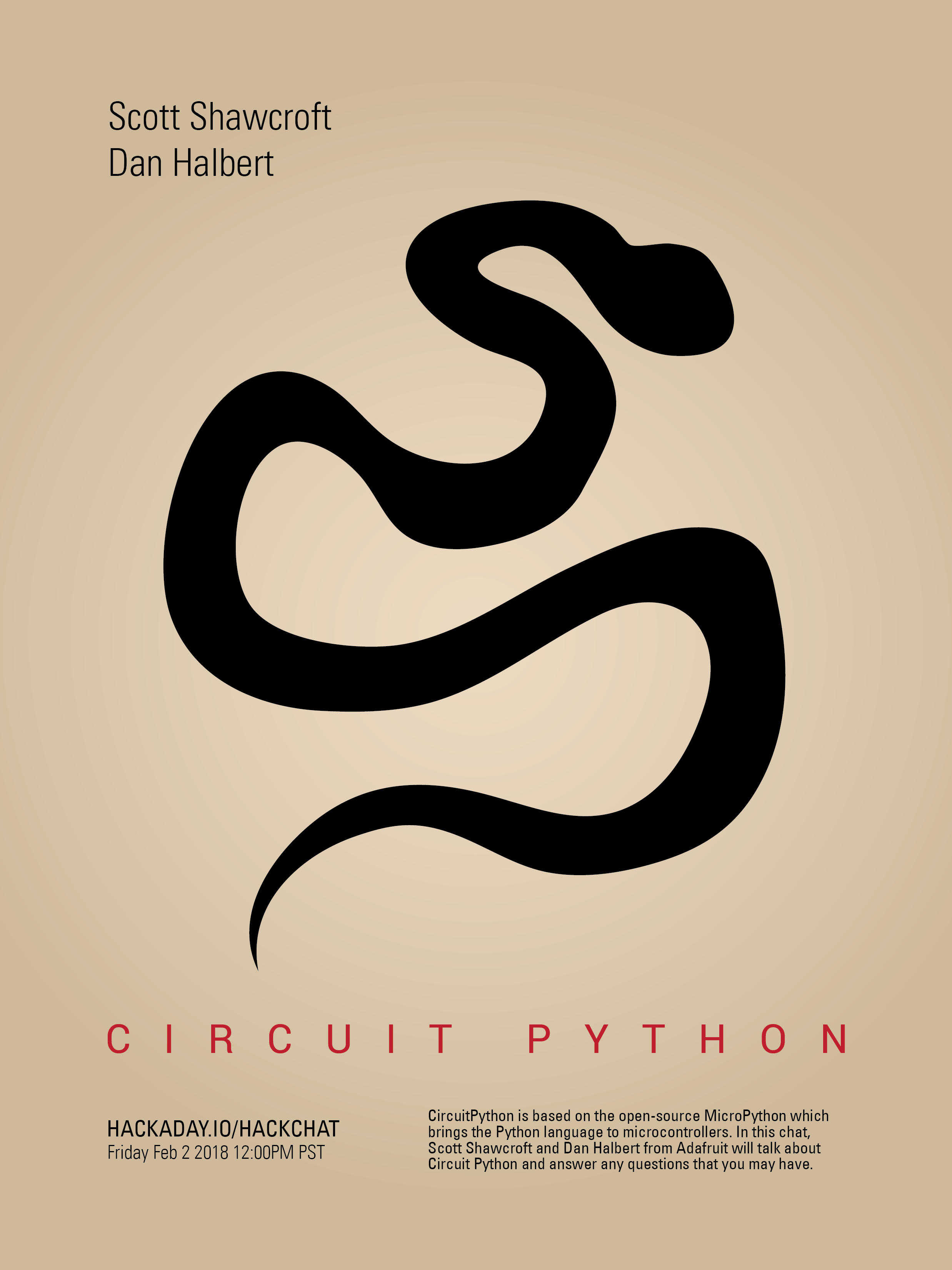
Friday Hack Chat: Circuit Python

Back in the olden days, if you wanted to learn how to program a computer, you used the BASIC interpreter stored in ROM. This is how an entire generation of devs learned how to program. Now, home computers do not exist, there is no programming language stored in ROM, and no one should inflict JavaScript on 8-year-olds. What is the default, My First Programming Language™ today? Python. And now it’s on microcontrollers.

For this week’s Hack Chat on hackaday.io, we’re going to be talking all about Circuit Python. Circuit Python is based on the Open Source MicroPython, a Python 3 interpreter that implements a subset of the Python language on microcontrollers and other constrained environments. It is the spiritual successor of BASIC on every computer: MicroPython has an interactive prompt, arbitrary precision integers, closures, lists, and more. All of this fits on a microcontroller with 256 kB of code space and 16 k of RAM.

Our guests for this week’s Hack Chat will be [Scott Shawcroft] and [Dan Halbert] from Adafruit. [Scott] started working on MicroPython with Adafruit in September 2016 and has led the renamed CircuitPython effort ever since. [Dan] started working on CircuitPython in early 2017 and joined Adafruit in August of that year. [Dan], by the way, is the original author of the ‘more’ command in UNIX.

For this Hack Chat, we’re going to be talking about CircuitPython, its history, current boards that support the project, and the end goals for CircuitPython. We’ll be talking about future plans, what will be supported in the future, and asking any technical questions about CircuitPython.

join-hack-chat

Our Hack Chats are live community events on the Hackaday.io Hack Chat group messaging. This Hack Chat is going down Friday, February 2nd at noon, Pacific time. Time Zones got you down? Here’s a handy countdown timer!

Click that speech bubble to the left, and you’ll be taken directly to the Hack Chat group on Hackaday.io.

You don’t have to wait until Friday; join whenever you want and you can see what the community is talking about.

Making The Case For Open Source Medical Devices

Engineering for medical, automotive, and aerospace is highly regulated. It’s not difficult to see why: lives are often at stake when devices in these fields fail. The cost of certifying and working within established regulations is not insignificant and this is likely the main reason we don’t see a lot of work on Open Hardware in these areas.

Ashwin K. Whitchurch wants to change this and see the introduction of simple but important Open Source medical devices for those who will benefit the most from them. His talk at the Hackaday Superconference explores the possible benefits of Open Medical devices and the challenges that need to be solved for success.

Continue reading “Making The Case For Open Source Medical Devices”

New Part Day: I2C In, Charlieplexed LEDs Out

It seems that most of the electrical engineering covered on Hackaday concerns exactly one problem domain: how to blink a bunch of LEDs furiously. There are plenty of LED drivers out there, but one of the more interesting in recent memory came from ISSI in the form of a chip that turns I2C into a Charlieplexed LED array. You may have seen this chip — the IS31FL3731 — in the form of an Adafruit LED matrix and some stupid thing some idiot made, but with it you’re only ever going to get 144 LEDs in an array, not enough if you want real blinky bling.

Now ISSI has released a more capable chip that turns I2C into many more Charlieplexed LEDs. The IS31FL3741 will drive up to 351 LEDs in a 39×9 matrix, or if you’re really clever, an 18×18 single color LED matrix.

Features of this chip include reverse/short detection for each individual LED, 8-bit PWM, dimming functions, a de-ghosting feature that guarantees a LED is either on or off, a configurable row/column matrix, and a few other handy tools that you would like to see in a LED matrix driver chip. The most impressive chip in this series will be available for under $2/piece in quantities of 2500, although unlike the IS31FL3731, it appears this new chip will only be available in a QFN package.

Speaking from experience, this is a really great chip for driving a whole boatload of LEDs, provided you have a pick and place machine. Yes, you can hand-solder a QFN and several hundred 0402 LEDs, but I wouldn’t recommend it. I really, really wouldn’t recommend it. That said, this is the perfect chip for maximum blinky bling, and the press material from ISSI gives us the great idea of using one of these chips as the backlight controller for RGB LED mechanical keyboards. That’s a great application, and the chip is pretty cheap, too.

You can check out ISSI’s blinky demo video of this chip below.

Continue reading “New Part Day: I2C In, Charlieplexed LEDs Out”

Hackaday Links Column Banner

Hackaday Links: January 28, 2018

In case you haven’t heard, we have a 3D printing contest going on right now. It’s the Repairs You Can Print Contest. The idea is simple: show off how you repaired something with a 3D printer. Prizes include $100 in Tindie credit, and as a special prize for students and organizations (think hackerspaces), we’re giving away a few Prusa i3 MK3 printers.

[Drygol] has made a name for himself repairing various ‘home’ computers over the years, and this time he’s back showing off the mods and refurbishments he’s made to a pile of Amiga 500s. This time, he’s installing some new RAM chips, fixing some Guru Meditations by fiddling with the pins on a PLCC, adding a built-in modulator, installing a dual Kickstart ROM, and installing a Gotek floppy adapter. It’s awesome work that puts all the modern conveniences into this classic computer.

Here’s an FPGA IoT Controller. It’s a Cyclone IV and a WiFi module stuffed into something resembling an Arduino Mega. Here’s the question: what is this for? There are two reasons you would use an FPGA, either doing something really fast, or doing something so weird normal microcontrollers just won’t cut it. I don’t know if there is any application of IoT that overlaps with FPGAs. Can you think of something? I can’t.

Tide pods are flammable.

You know what’s cool? Sparklecon. It’s a party filled with a hundred pounds of LEGO, a computer recycling company, a plasmatorium, and a hackerspace, tucked away in an industrial park in Fullerton, California. It’s completely chill, and a party for our type of people — those who like bonfires, hammer Jenga, beer, and disassembling fluorescent lamps for high voltage transformers.

A few shoutouts for Sparklecon. The 23b Hackerspace is, I guess, the main host here, or at least the anchor. Across the alley is NUCC, the National Upcycled Computing Collective. They’re a nonprofit that takes old servers and such, refurbishes them, and connects them to projects like Folding@Home and SETI@Home. This actually performs a service for scientists, because every moron is mining Bitcoin and Etherium now, vastly reducing the computational capabilities of these distributed computing projects. Thanks, OSH Park, for buying every kind of specialty pizza at Pizza Hut. I would highly encourage everyone to go to Sparklecon next year. This is the fifth year, and it’s getting bigger and better every time.

The Coolest Electronic Toys You’ll See At NAMM

Winter NAMM is the world’s largest trade show for musical instrument makers. It is a gear head’s paradise, filled to the brim with guitars, synths, amps, MIDI controllers, an impossibly loud section filled with drums, ukuleles, and all sorts of electronic noisemakers that generate bleeps and bloops. Think of it as CES, only with products people want to buy. We’re reporting no one has yet stuffed Alexa into a guitar pedal, by the way.

As with all trade shows, the newest gear is out, and it’s full of tech that will make your head spin. NAMM is the expression of an entire industry, and with that comes technical innovation. What was the coolest, newest stuff at NAMM? And what can hackers learn from big industry? There’s some cool stuff here, and a surprising amount we can use.

Continue reading “The Coolest Electronic Toys You’ll See At NAMM”

Gertrude Elion, DNA Hacker

Some people become scientists because they have an insatiable sense of curiosity. For others, the interest is born of tragedy—they lose a loved one to disease and are driven to find a cure. In the case of Gertrude Elion, both are true. Gertrude was a brilliant and curious student who could have done anything given her aptitude. But when she lost her grandfather to cancer, her path became clear.

As a biochemist and pharmacologist for what is now GlaxoSmithKline, Gertrude and Dr. George Hitchings created many different types of drugs by synthesizing natural nucleic compounds in order to bait pathogens and kill them. Their unorthodox, designer drug method led them to create the first successful anti-cancer drugs and won them a Nobel Prize in 1988.

Continue reading “Gertrude Elion, DNA Hacker”