Review: Voltera V-One PCB Printer

Back in Feburary, I was one of the first people to throw some cash at the Voltera V-One circuit board printer on Kickstarter. With an anticipated delivery date of Q4 2015, I sat back and waited. This week, my V-One arrived!

I’ll preface this article by pointing out that I do know the folks at Voltera as we went to university together. That being said, I did put down my own cash for the device, so I’ve bought the right to be critical. I also have no relationship with their company. In this article, we’ll go through unboxing and printing, then get into a review of the V-One based on what we’ve seen so far.

Continue reading “Review: Voltera V-One PCB Printer”

ON Semiconductor Acquires Fairchild

In the continuing process of semiconductor companies buying each other up, ON Semiconductor has acquired Fairchild Semiconductor for $2.4 Billion.

ON Semi and Fairchild’s deal is only the latest in a long line of mergers and acquisitions. We’ve recently seen Dialog’s buyout of Atmel, Avago’s purchase of Broadcom,  NXP and Freescale’s merger, and soon might see TI buy Maxim. We’re currently in the great time of acquisition, with nearly $100 Billion flowing from company to company in just a few months.

Companies have cash to spend and costs to cut. This latest deal is expected to save $150 Million in annual costs.

Fairchild has a long and storied history in the semiconductor industry, with the first integrated circuit produced in a Fairchild lab in Palo Alto. [Bob Widlar] made Fairchild his home until famously leaving for National Semiconductor in 1965. Somewhat ironically, Fairchild Semiconductor was bought by National Semiconductor in 1987.

ON Semiconductor’s history is not nearly as interesting, being spun off of Motorola’s semiconductor business in 1999. Although ON’s main line of business was discrete components, ON also has a catalog of quite a few power management ICs.

Unfortunately, because ON Semi bought Fairchild and not the other way around, we’re stuck with what is probably the worst logo in the entire semiconductor industry: drop-shadowed balls are so mid-90s!

Simple Devices Protecting Our Water System

We are all used to turning on the faucet and having clean, drinkable water on demand. But think about what happens afterwards in your home: that water is used to wash dishes or water lawns and many other uses that render it undrinkable. What stops this nasty water from flowing back into your pipes and out of your kitchen faucet? A backflow preventer. This simple, but vital, part of your plumbing turns your water pipes into one-way systems that give out clean, drinkable water. This isn’t just about making your water taste nice: backflow preventers protect your water supply from things like brain-eating amoeba and E Coli that could kill.

Continue reading “Simple Devices Protecting Our Water System”

Hackaday Links: November 15, 2015

There are a surprising number of Raspberry Pis being used in industrial equipment. This means the Arduino is left behind, but no longer. There’s your PLCs that use Arduinos.

A few weeks ago, Google introduced a machine intelligence and computer vision technique that made the world look psychedelic. Now, this library is available. On another note, head mounted displays exist, and a sufficiently creative person could mash these two things together into a very, very cool project.

Welcome to Kickstarter! Kickstarter is an uphill battle. People will doubt you because you don’t have a ‘target audience’ or ‘the rights to this franchise’ or ‘any talent whatsoever’, but that’s what crowdfunding is for!

Several years ago, Apple shipped a few million 17″ iMacs with defective displays. They’re still useful computers, though, especially if you can find a replacement LCD. Apple, in all its wisdom, used a weird connector for this LCD. Here’s the adapter board, and this adapter will allow displays running up to 1920×1200.

[Jan] has earned a reputation of building some very cool synths out of single ARM chips. His previous build was a Drumulator and now he’s shrinkified it. He’s put four drum sounds, pitch CV, and audio out on an 8-pin DIP ARM.

YouTube gives you cadmium! [AvE], recently got 100,000 subscribers on his YouTube channel. Apparently, YouTube sends you a terrible belt buckle when you manage to do that. At least he did it without playing video games and screaming.

Hacklet 84 – Alarm Clocks

The stereotypical hardware hacker is a creature of the night. Some of us do our best work in the wee hours. The unfortunate side effect of this is that we have a hard time getting up in the morning. Sometimes life demands a hacker be up-and-at-em before noon though. In these cases, the only solution is an alarm clock. This week’s Hacklet features some of the best alarm clock projects on Hackaday.io!
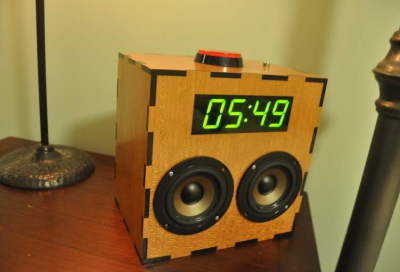
mercyWe start with [hberg32] and Merciless Pi Alarm Clock. Merciless is a good name for this Raspberry Pi based clock. We have to say it’s quite snazzy with its laser cut case and large seven segment LED face. When the alarm goes off though, this Pi bites back.

Titanium drivers powered by a 20 watt amplifier will wake even the heaviest sleepers. If that’s not enough, [hberg32] added a bed shaker to vibrate you out of the sack. The snooze button only works 3 times, after that you can press all you want, the music will still play. As if that wasn’t enough, this clock even has a pressure sensor. If you get back in bed, the alarm starts up again. Truly fitting of the name “merciless”.
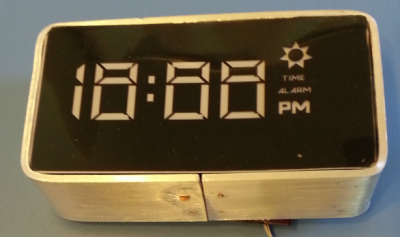
irss[Ceady] took the kinder, gentler route with Integrated Room Sunrise Simulator. This alarm clock simulates dawn, gently waking the user up. A Lutron Maestro series wireless dimmer allows the sunrise simulator to slowly increase the room’s light level over a period of 10 minutes, allowing [Ceady] to wake up silently.

The clock itself uses an ATmega168 for control. [Ceady] spent a considerable amount of time testing out different methods of creating a seven segment LED display. When casting with cornstarch and resin didn’t do the trick, he went to commercial LED diffuser film from Inventables. The film proved to be just what he was looking for.
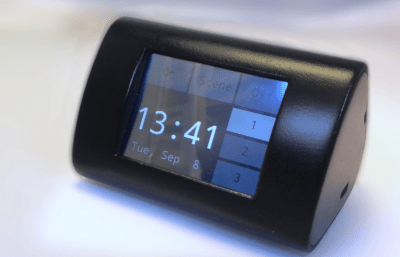
chumby2Next up is [Spiros Papadimitriou] with DIY Chumby-lite. Taking inspiration from [Bunnie Huang] and the Chumby project, [Spiros] created a friendly alarm clock with a touchscreen LCD. Much like the Chumby, this clock packs a WiFi module.

In this case though, the WiFi module is an ESP8266, whose on-board Xtensa microcontroller runs the whole show. [Spiros] programmed his Sparkfun ESP8266 Thing in C++. To keep costs down, [Spiros] left out anything unnecessary – like a real-time clock module. The Chumby-lite uses NTP to stay regular. The reductions paid off – this clock can be built for around $13.00, not including the very nice 3D printed case.
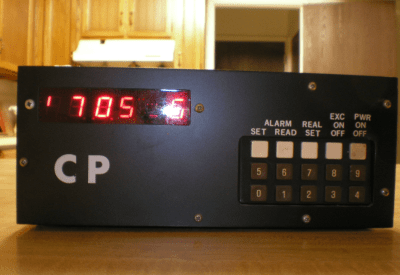
1983[Wanderingmetalhead] takes us all way back to 1983 with his 7 Day Alarm Clock. 32 years ago, this was [wanderingmetalhead’s] first embedded system project. As the name implies, this clock stores a different wake time for each day of the week. Actual numeric entry sure beats the old “hold two buttons and watch the numbers spin” system.

This is an oldie. The system is based upon a Motorola (which became Freescale, and is now NXP) 6802 micro. The code was written in assembly and cross-assembled on an Apple II. A 3.58MHz colorburst crystal divided down to 60 Hz provides the time base. This setup wasn’t perfect, but good down to a about a minute a month. The whole project lived and worked in an old amplifier case, where it dutifully woke [wanderingmetalhead] each day for 17 years.

If you want to see more alarm clock projects, check out our new alarm clocks list! If I didn’t wake up early enough to catch your project, don’t be shy, just drop me a message on Hackaday.io. That’s it for this week’s Hacklet. As always, see you next week. Same hack time, same hack channel, bringing you the best of Hackaday.io!

Retrotechtacular: A Mechanical UART

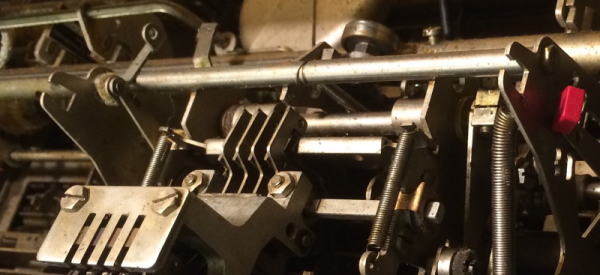
We’ve heard it said that no one invented the old mechanical Teletype. One fell from the sky near Skokie, Illinois and people just duplicated them. It is true these old machines were similar to a modern terminal. They sent and received serial data using a printer instead of a screen. But inside, they were mechanical Rube Goldbergs, not full of the electronic circuits you’d think of today.

Teletype was the best-known name, but there were other mechanical monster terminals out there. [Carsten] recently took some pictures of his 99 pound Olivetti mechanical terminal. According to him, there’s only one electronic component within: a bistable solenoid that reads the data. Everything else is mechanical and driven with a motor that keeps everything at the right baud rate (110 baud).

Like the Teletype, it is a miracle these things were able to work as well as they did. Lacking a microcontroller, the terminals could respond to an identity request by spinning a little wheel that had teeth removed to indicate which letters to send (TeleType used a similar scheme). Things that are simple using today’s electronics (like preventing two keys pressed at once from being a problem) turned out to be massive design challenges for these old metal monsters.

Turns out that when [Carsten] last fired the terminal up, a capacitor finally gave up its magic smoke. He plans to fix it, though, and as long as it isn’t a mechanical problem, we bet he will.

We’ve talked about Teletypes a few times in the past, including using them for text messaging and even Twitter.

Hackaday Dictionary: The Global Positioning System (GPS)

One of the fundamental technologies of modern gadgets is the Global Positioning System (GPS). Using signals from satellites orbiting the earth, a GPS receiver can pin down its location with remarkable accuracy: the latest generation of Civilian Navigation Signals (CNAV) sent by the US GPS system has an accuracy of less than half a meter (about 3 feet). These signals also contain the time, accurate to within milliseconds, which makes it perfect for off-line dataloggers and systems that require very accurate timing. That’s a powerful combination that has made GPS one of the main technologies behind the mobile revolution, because it lets gadgets know where (and when) they are.

Continue reading “Hackaday Dictionary: The Global Positioning System (GPS)”