Hacklet 45 – Reverse Engineering Projects

Sooner or later, all of us end up putting on our reverse engineering hats and digging in to a device. It might be that you’re trying to keep an old piece of equipment running – the manufacturer is long defunct, and parts are no longer available. It might be that sweet new router with locked down firmware. Or, it might just be that you’re curious. Whatever the reason, reverse engineering is a rewarding endeavor. Some of our favorite reverse engineering projects read like spy novels. Instead of cloak and dagger, it’s encryption and soldering iron. This week’s Hacklet focuses on some of the best reverse engineering projects on Hackday.io!

c02We start with [Henryk Plötz] and Reverse-Engineering a low-cost USB CO₂ monitor. Carbon monoxide detection and measurement devices are household safety items these days, and have become rather cheap. Carbon dioxide measuring devices are less common, and as expected, more expensive. [Henryk] found a device for around 80€ which did what he needed. The included USB connector was supposedly just for power, but when plugging it in, the device enumerated on his Linux box. The accompanying windows software displayed live data from the detector, but there wasn’t much information on the protocol. Time to bust out Ida pro, and go to town on that software! [Henryk] did battle with his CO₂ monitor”s software and was justly rewarded.

mavrickNext up is [Bob Blake] and Reverse Engineering the Maverick ET-732. [Bob] loves barbecue, but hates to babysit his smoker. Thankfully there are wireless temperature sensors out there built just for that purpose, but they have limited range and you can’t have multiple receivers around the house. [Bob] aimed to fix all of that by sending his Maverick wireless thermometer data to the web, so he could check in on his cooking from anywhere. First he had to reverse engineer the protocol used by the sensor. A spectrum analyzer told [Bob] that the sensor transmit frequency was  433.92 MHz, which is common for low-cost transmitters like this. [Bob] actually had some compatible receivers at his office, so he was quickly able to capture some data with his Saleae logic analyzer. The real fun came in figuring out exactly how the data was organized!

hmdA chance Ebay sale netted [Technics] a sweet head mounted magnifier, but no way to control it. Reverse engineering a Life Optics M5 documents [Technics] efforts to get his new headgear working. The Life Optics M5 is actually a re-branded version of the Leica HM500 head mounted zoom microscope. These devices were originally designed for medical use. They provide a stereo view to the surgeon or dentist using them, as well as sending a video feed to be displayed for the rest of the team to use or record. Cracking open the M5’s head-mounted box revealed several modules, but no obvious means of controlling zoom or focus. Scoping out a few of the mystery wires did reveal what looks to be a 9600 baud serial data stream though. This is a brand new project, and we’re waiting for [Technics] next update to see if he gets to do some soldering with his new toy!


biosBIOS password protection – it’s the bane of any used laptop buyer’s existence. Sometimes removing these passwords are as easy as popping out the CMOS battery, other times, not so much. [q3k] found themselves in the latter situation with a bundle of Toshiba R100 laptops. and no way to start them up. [q3k] didn’t give up though – they broke out the soldering iron and started Reverse engineering Toshiba R100 BIOS. The R100 is a Pentium M era machine – old but still usable for many hacking purposes. Dumping the ROM BIOS of the laptop didn’t yield the information [q3k] needed, so they moved on to the TLCS-870 controller, and built a really nice board with a Xilinx Spartan6 FPGA to help with the effort. It turns out that the 870 is just used for power management. – [q3k] has now turned their attention to a Renesas microcontroller which might be just the droid they are looking for!

We think that reverse engineering projects are pretty darn cool, so we’ve created a Reverse Engineering List to keep them all organized.

That’s it for this Hacklet, As always, see you next week. Same hack time, same hack channel, bringing you the best of Hackaday.io!

Caption CERN Contest Week 13

Week 12 of the Caption CERN Contest and the strange stringed scientific instrument it brought along are both history. As always, thank you for your captions! They provided quite a few chuckles in the busy week gearing up for our Hackathon. We’re still not sure exactly what is being built here – Our best guess is it’s some sort of detector for emissions. But what sort of emissions? Was CERN looking for electric fields, magnetic fields, or something else entirely? It’s interesting to note that just as the photographer’s flash reflected in all 5 layers of wire, an RF signal would bounce off the rear reflector and strike the wires.

The Funnies:

  • “Ooh, it’s so beautiful, is this a harp?”
    “Close, it is for HAARP” – [Federico Churca-Torrusio]
  • “Bones was right this thing will scatter your molecules across space.”- [scott galvin]
  • “Eight years of schooling and two post doctoral fellowships just so I can make quilts. I should have been a dentist.” – [Narfnezzle Nickerbots]

The winner for this week is [THX1082] with “CERN’s early attempts at developing “String theory”. They’re doing it wrong. [THX1082] will be at his next hackerspace meeting wearing a CRT Android T-Shirt From The Hackaday Store!

Week 13: Coffee time at CERN!

cern-13-smEvery week we get at least one caption explaining that the strange piece of equipment included in that week’s image is a coffee maker. I thought it would only be right to include this shot of CERN’s real coffee nook, and a scientist about to enjoy a fresh cup of liquid “get ‘er done”. I have to thank CERN’s photographer for grabbing this slice of life shot!

It’s worth taking the time to check out the high res JPEG direct from CERN, as you can really zoom in on the post cards and photographs in the background. One even says “Tout va tres bien” – which Google translates to “Everything is going very well”. Some jokes never get old!

Add your humorous caption as a comment to this project log. Make sure you’re commenting on the contest log, not on the contest itself.

As always, if you actually have information about the image or the people in it, let CERN know on the original image discussion page.

Good Luck!

$50k In Play: Giving Away 50 LightBlue Bean This Week

This week we’re awarding a LightBlue Bean board to 50 projects entered in The Hackaday Prize.

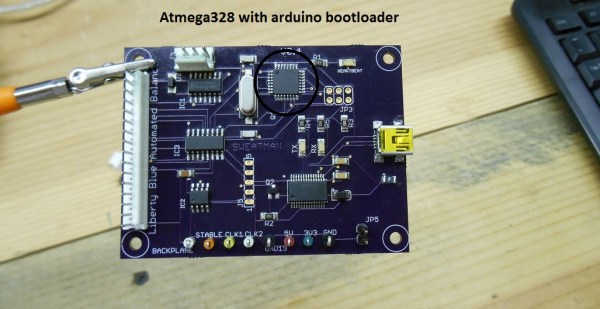
We love this little board so much we put it in our store. It brings a microcontroller that has plenty of room and peripherals (and is quite well-known… the ATmega328) with the connectivity of Bluetooth Low Energy. If you’re planning on building something that needs processing power and connectivity with smartphones this is a good place to start. And this week you might just score one as part of the 2015 Hackaday Prize.

We’ll be looking for entries that are getting ready for the physical build and need connectivity. The best way to let us know your project should be one of the fifty winners is to post a new project log with your construction plans and how the Bean (or BTLE) would fit into that plan. Submit your build by next Wednesday (5/6) and you’re in the running!

We’re giving away $50,000 in prizes, 1/10 of the total Hackaday Prize pool during the build phase going on right now.

Last Week’s 30 Winners

OSHpark-coupon-prize

Last week we were looking for great entries in need of circuit boards and boy, did we find a lot of them. Judging is super hard. We looked at all the entries and ended up with these 30 winners. Each will receive $50 to use for custom PCB manufacturing from OSH Park. We expect to see a lot more purple boards popping up on entry pages in the coming weeks! Congratulations to all winners. Each project creator will find prize info as a message on Hackaday.io.


The 2015 Hackaday Prize is sponsored by:

3D Printering: Laser Cutting 3D Objects

3D printing can create just about any shape imaginable, but ask anyone who has babysat a printer for several hours, and they’ll tell you 3D printing’s biggest problem: it takes forever to produce a print. The HCI lab at Potsdam University has some up with a solution to this problem using the second most common tool found in a hackerspace. They’re using a laser cutter to speed up part production by a factor of twenty or more.

Instead of printing a 3D file directly, this system, Platener, breaks a model down into its component parts. These parts can then be laser cut out of acrylic or plywood, assembled, and iterated on much more quickly.

You might think laser-cut parts would only be good for flat surfaces, but with techniques like kerf bending, and stacking layer upon layer of material on top of each other, just about anything that can be produced with a 3D printer is also possible with Platener.

To test their theory that Platener is faster than 3D printing, the team behind Platener downloaded over two thousand objects from Thingiverse. The print time for these objects can be easily calculated for both traditional 3D printing and the Platener system, and it turns out Platener is more than 20 times faster than printing more than thirty percent of the time.

You can check out the team’s video presentation below, with links to a PDF and slides on the project’s site.

Thanks [Olivier] for the tip.

Continue reading “3D Printering: Laser Cutting 3D Objects”

Hackaday Retro Edition: TRS Wiki

1977 was a special year for computing history; this year saw the release of the 8085 following the release of the Z80 a year before. Three companies would launch their first true production computers in 1977: Apple released the Apple II, Commodore the PET 2001, and Tandy / Radio Shack the TRS-80 Model I. These were all incredibly limited machines, but at least one of them can still be used to browse Wikipedia.

[Pete]’s TRSWiki is a Wikipedia client for the TRS-80 Model I that is able to look up millions of articles in only uppercase characters, and low resolution (128×48) graphics. It’s doing this over Ethernet with a very cool Model I System Expander (MISE) that brings the lowly Trash-80 into the modern era.

The MISE is capable of booting from CF cards, driving an SVGA display and connecting to 10/100 Ethernet. Connecting to the Internet over Ethernet is one thing, but requesting and loading a web page is another thing entirely. There’s not much chance of large images or gigantic walls of text fitting in the TRS-80’s RAM, so [Pete] is using a proxy server on an Amazon Web Services box. This proxy is written in Java, but the code running on the TRS-80 is written entirely in Z80 assembly; not bad for [Pete]’s first project in Z80 assembly.


vt100normal The Hackaday Retro Edition is our celebration of old computers doing something modern, in most cases loading the old, no CSS or Javascript version of our site.

If you have an old computer you’d like featured, just load up the retro site, snap some pictures, have them developed, and send them in.

Retrotechtacular: Radar Jamming

It’s been said that the best defense is a good offense. When aloft and en route to deliver a harmful payload to the enemy, the best defense is to plan your approach and your exit carefully, and to interfere with their methods of detection. If they can’t find you, they can’t shoot you.

As of May 1962, the United States military was using three major classifications of radar jamming technology as described in this week’s film: the AN/ALQ-35 multiple target repeater, the AN/ALQ-55 communications link disrupter, and the AN/ALQ-41 and -51 track breakers. The most important role of these pieces of equipment is to buy time, a precious resource in all kinds of warfare.

The AN/ALQ-35 target repeater consists of a tuner, pulse generator, transmitter, and control panel working in concert to display multiple false positives on the enemy’s PPI scopes. The unit receives the incoming enemy pulse, amplifies it greatly, repeats it, and sends them back with random delays.

The AN/ALQ-55 comm disrupter operates in the 100-210MHz band. It distinguishes the threatening enemy communication bands from those of beacons and civilians, evaluates them, and jams them with a signal that’s non-continuous, which helps avoid detection.

Finally, the AN/ALQ-41 and -51 track breakers are designed to break enemy lock-on and to give false information. It provides simultaneous protection against pulse ranging, FM-CW, conical, and monopulse radar in different ways, based on each method’s angle and range.

Continue reading “Retrotechtacular: Radar Jamming”

Hackaday Links Column Banner

Hackaday Links: April 26, 2015

In case you haven’t heard, we’re giving away a trip to space. We have $50,000 to promote giving away a trip to space too, and this week we’re giving away some OSH Park gift cards. If you have a project that’s held together with hot glue on a 40-year-old piece of perf board, add a project log describing how you need some free PCBs.

A few months ago, some guy in Texas found the original molds for the Commodore 64C, the Plus/4 and the 128. That discovery turned into one of the best examples of what Kickstarter can do. Now, new keycaps are being manufactured with an Indiegogo campaign. If you’re waiting on your C64c case to be pressed out of a mold, this is not the time to think about the sunk cost fallacy. They’re not Cherry MX compatible, but they will work with just about every version of the C64. Not bad for under €20.

The UK has a fabulously rich history of ancient melee weapons, ranging from the flail to the mace and a bunch of odd bladed weapons used by the Scots. This tradition was passed down to the UK mains plug, the single most painful plug to step on. Apple just released a USB charger with a folding UK mains plug and [oliver] did a teardown on it.

For St. George’s Day in Catalonia, there’s a tradition of giving roses to women, and books to men. [Nixieguy] has all the books he could want, and would prefer to receive a rose. Bucking tradition, he made himself a rose from a punch card. It’s the closest he’s going to get to ‘@}-\—’. A few years ago, he carved a rose out of a 10mm LED.

Finally, a decent tutorial on how to grow your own SMD components.

Need to take apart a cellphone? Use acetone! Need the phone to work after you take it apart? Ummmm….

The Dayton Hamvention is just three weeks away! Yes, the same weekend as the Bay Area Maker’s Faire, which means most of the Hackaday crew will be elsewhere, but I hear [Chris Gammell] will be there putting Parts.io stickers on everything. By the way, I’m looking for a Tek PM203 Personality Module for a 68000 64-pin PDIP.