Retrotechtacular: Automotive Suspension Is All About Waves

In addition to driving home the need for Steadicam or Optical Image Stabilization, this eighty-year-old video illustrates some elegant solutions the automotive industry developed in their suspension systems. Specifically, this Chevrolet video from 1938 is aimed at an audience that values science and therefore the reel boils down the problem at hand using models that will remind you of physics class.
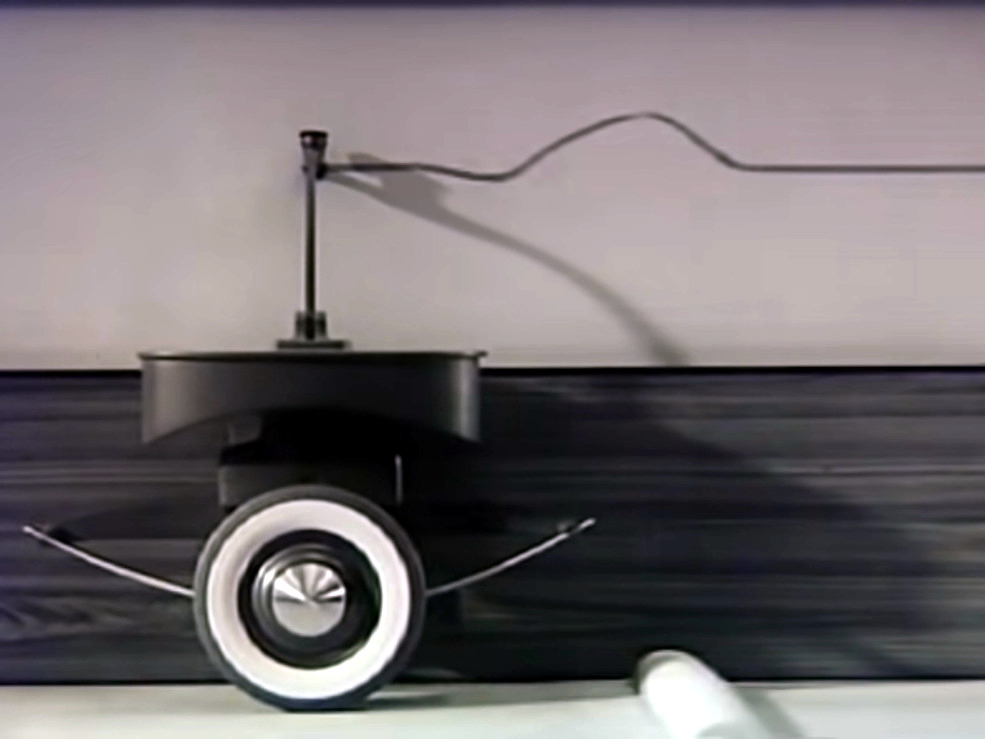
Model of a wheel with a leaf spring records the effect of a bump on a piece of paper above

The problem is uneven ground — the “waves in the Earth’s surface” — be it the terrain in an open field, a dirt road, or even a paved parkway. Any vehicle traveling those surfaces will face the challenge of not only cushioning for rough terrain, but accounting for the way a suspension system itself reacts to avoid oscillation and other negative effects. In the video this is boiled down to a 2-dimensional waveform drawn by a model which begins with a single tire and evolves to include a four wheeled vehicle with different suspension systems in the front and the rear.

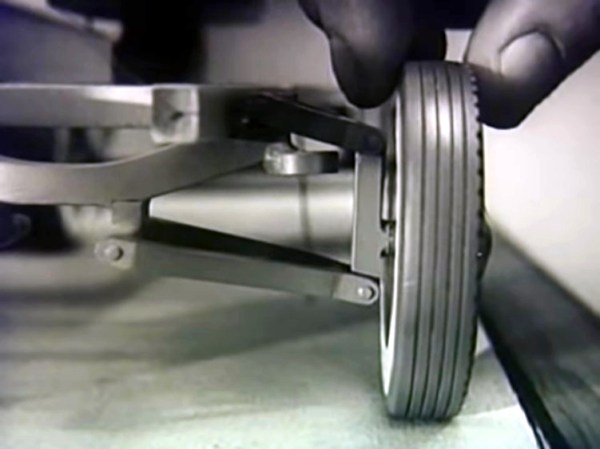
Perhaps the most illuminating part of the video is the explanation of how the car’s front suspension actually works. The wheels need to be able to steer the vehicle, while the suspension must also allow the tire to remain perpendicular to the roadway. This is shown in the image at the top of this article. Each wheel has a swing arm that allows for steering and for vertical movement of the wheel. A coil spring is used in place of the leaf springs shown in the initial model.

You probably know what’s coming next. The springs are capable of storing and releasing energy, and left to their own devices, they’ll dissipate the energy of a bump by oscillating. This is exactly what we don’t want. The solution is to add shock absorbers which limit how the springs perform. The waveforms drawn by the model encountering bumps are now tightly constrained to the baseline of flat ground.

This is the type of advertising we can wholeheartedly get behind. Product engineers of the world, please try to convince your marketing colleagues to show us the insides, tell us why the choices were made, and share the testing that helps users understand both how the thing works and why it was built that way. The last eighty years have brought myriad layers of complexity to most of the products that surround us, but human nature hasn’t changed; people are still quite curious to see the scientific principles in action all around us.

Make sure you don’t bomb out of the video before the very end. A true bit of showmanship, the desktop model of a car is recreated in a full-sized Chevy, complete with “sky-writing smoke” to draw the line. I don’t think it’s a true analog, but it’s certainly the kind of kitsch I always look for in a great Retrotechtacular subject.

Continue reading “Retrotechtacular: Automotive Suspension Is All About Waves”
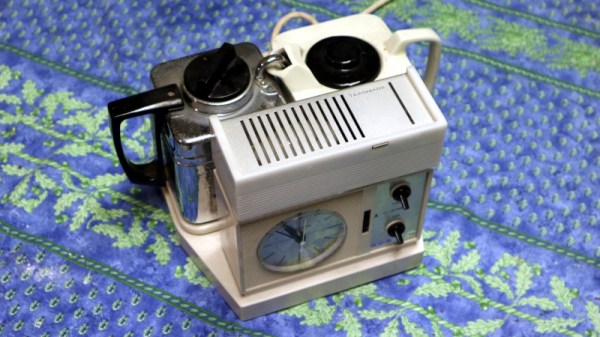
Retrotechtacular: Teasmade

We’re used to our domestic appliances being completely automated in 2020, but not so long ago they were much simpler affairs. Not everything required a human to run it though, an unexpected piece of electromechanical automation could be found in British bedrooms. This is the story of the Goblin Teasmade, an alarm clock with a little bit extra.

Continue reading “Retrotechtacular: Teasmade”

Retrotechtacular: Mechanical Arithmetic For The Masses

Last month we carried a piece looking at the development of the 8-bit home computer market through the lens of the British catalogue retailer Argos and their perennial catalogue of dreams. As an aside, we mentioned that the earliest edition from 1975 contained some of the last mechanical calculators on the market, alongside a few early electronic models. This month it’s worth returning to those devices, because though they are largely forgotten now, they were part of the scenery and clutter of a typical office for most of the century.

The Summa's internals, showing the register on the right and the type wheels on the left.
The Summa’s internals, showing the register on the right and the type wheels on the left.

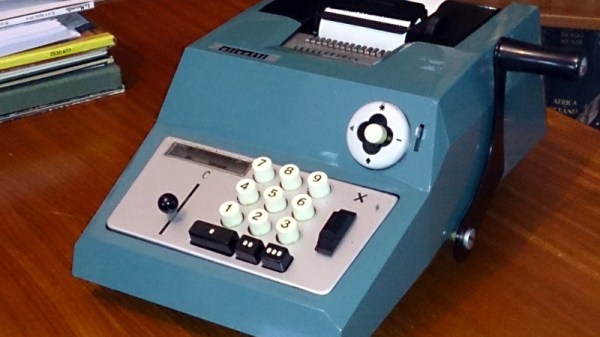
Somewhere in storage I have one of the models featured in the catalogue, an Olivetti Summa Prima. I happened upon it in a dumpster as a teenager looking for broken TVs to scavenge for parts, cut down a pair of typewriter ribbon reels to fit it, and after playing with it for a while added it to my store of random tech ephemera. It’s a compact and stylish desktop unit from about 1970, on its front is a numerical keypad, top is a printer with a holder for a roll of receipt paper and a typewriter-style rubber roller, while on its side is a spring-loaded handle from which it derives its power. It can do simple addition and subtraction in the old British currency units, and operating it is a simple case of punching in a number, pulling the handle, and watching the result spool out on the paper tape. Its register appears to be a set of rotors advanced or retarded by the handle for either addition or subtraction, and its printing is achieved by a set of print bars sliding up to line the correct number with the inked ribbon. For me in 1987 with my LCD Casio Scientific it was an entertaining mechanical curiosity, but for its operators twenty years earlier it must have represented a significant time saving.

The history of mechanical calculators goes back over several hundred years to Blaise Pascal in the 17th century, and over that time they evolved through a series of inventions into surprisingly sophisticated machines that were capable of handling financial complications surprisingly quickly. The Summa was one of the last machines available in great numbers, and even as it was brought to market in the 1960s its manufacturer was also producing one of the first desktop-sized computers. Its price in that 1975 Argos catalogue is hardly cheap but around the same as an electronic equivalent, itself a minor miracle given how many parts it contains and how complex it must have been to manufacture.

We’ve put two Summa Prima videos below the break. T.the first is a contemporary advert for the machine, and the second is a modern introduction to the machine partially narrated by a Brazilian robot, so consider translated subtitles. In that second video you can see something of its internals as the bare mechanism is cranked over for the camera and some of the mechanical complexity of the device becomes very obvious. It might seem odd to pull a obsolete piece of office machinery from a dumpster and hang onto it for three decades, but I’m very glad indeed that a 1980s teenage me did so. You’re probably unlikely to stumble upon one in 2019, but should you do so it’s a device that’s very much worth adding to your collection.

Continue reading “Retrotechtacular: Mechanical Arithmetic For The Masses”

Retrotechtacular: The Gyro-X

In the 1950s, American automobiles bloomed into curvaceous gas-guzzlers that congested the roads. The profiles coming out of Detroit began to deflate in the 1960s, but many bloat boats were still sailing the streets. For all their hulking mass, these cars really weren’t all that stable — they still had issues with sliding and skidding.

One man sought to fix all of this by re-imagining the automobile as a sleek torpedo that would scream down the road and fly around turns. This man, Alex Tremulis, envisioned the future of the automobile as a two-wheeled, streamlined machine, stabilized by a gyroscope. He called it the Gyro-X.

Continue reading “Retrotechtacular: The Gyro-X”

Retrotechtacular: The Art Of The Foundry

Mention the term “heavy industry” and the first thing to come to mind might well be the metal foundry. With immense machines and cauldrons of molten metal being shuttled about by crane and rail, the image of the foundry is like a scene from Dante’s Inferno, with fumes filling a vast impersonal factory, and sparks flying through the air. It looks like a dangerous place, as much to the soul as to the body, as workers file in each day to suffer mindlessly at the hearths and ladles, consumed in dirty, exhausting work even as it consumes them.

Things are not always as they appear, of course. While there’s no doubting the risks associated with working in a foundry such as the sprawling Renfrew works of Babcock and Wilcox Ltd. in the middle of the previous century, as the video below shows the work there was anything but mindless, and the products churned out by the millions from this factory and places like it throughout the world were critical to today’s technology.

Continue reading “Retrotechtacular: The Art Of The Foundry”

Retrotechtacular: 934 MHz CB Radio

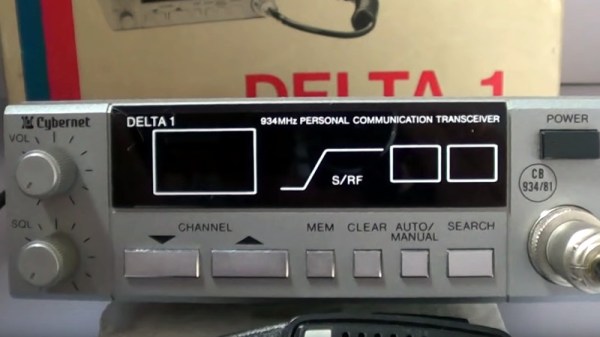
The radio spectrum is carefully regulated and divided up by Governments worldwide. Some of it is shared across jurisdictions under the terms of international treaties, while other allocations exist only in individual countries. Often these can contain some surprising oddities, and one of these is our subject today. Did you know that the UK’s first legal CB radio channels included a set in the UHF range, at 934 MHz? Don’t worry, neither did most Brits. Behind it lies a tale of bureaucracy, and of a bungled attempt to create an industry around a barely usable product.

Hey, 2019, Got Your Ears On?

Did this car make you want a CB radio? Stuurm [CC BY-SA 3.0]
Mention CB radio in 2019 it’s likely that the image conjured in the mind of the listener will be one from a previous decade. Burt Reynolds and Jerry Reed in Smokey and the Bandit perhaps, or C. W. McCall’s Convoy. It may not be very cool in the age of WhatsApp, but in the 1970s a CB rig was the last word in fashionable auto accessories and a serious object of desire into which otherwise sane adults yearned to speak the slang of the long-haul trucker.

If you weren’t American though, CB could be a risky business. Much of the rest of the world didn’t have a legal CB allocation, and correspondingly didn’t have access to legal CB rigs. The bombardment of CB references in exported American culture created a huge demand for CB though, and for British would-be CBers that was satisfied by illegally imported American equipment. A vibrant community erupted around UK illegal 27 MHz AM CB in the late 1970s, and Government anger was met with campaigning for a legal allocation. Brits eventually got a legal 27 MHz allocation in November 1981, but the years leading up to that produced a few surprises.

Continue reading “Retrotechtacular: 934 MHz CB Radio”

Retrotechtacular: The Speaking Clock Goes Silent

It used to be that time was a lot more relative than it is today. With smartphones synced to GPS and network providers’ clocks, we all pretty much have access to an authoritative current time, giving few of us today the wiggle room to explain a tardy arrival at work to an impatient boss by saying our watch is running slow.

Even when that excuse was plausible, it was a bit weak, since almost every telephone system had some sort of time service. The correct time was but a phone call away, announced at first by live operators then later by machines called speaking clocks. Most of these services had been phased out long ago, but one, the speaking clock service in Australia, sounded for the last time at the end of September.

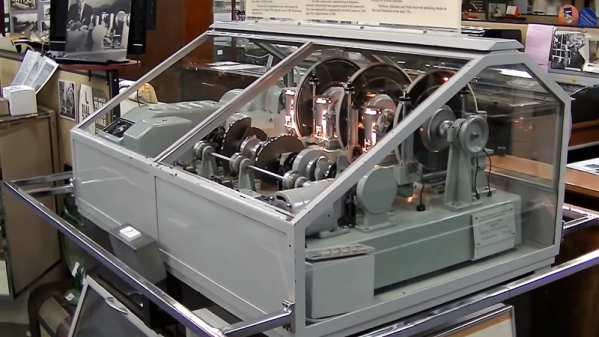
While the decommissioned machine was just another beige box living in a telco rack, the speaking clocks that preceded it were wonderfully complex electromechanical devices, and perfect fodder for a Retrotechtacular deep-dive. Here’s a look at the Australian speaking clock known as “George” and why speaking clocks were once the highest of technology.

Continue reading “Retrotechtacular: The Speaking Clock Goes Silent”