Retrotechtacular: The Transistor (1953 Film)

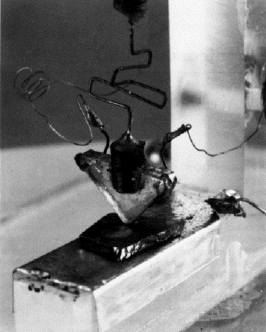
If we cast our minds back to the early years of the transistor, the year that is always quoted is 1947, during which a Bell Labs team developed the first practical germanium point-contact transistor. They would go on to be granted the Nobel Prize for their work in 1956, but the universal adoption of their invention was not an instantaneous process. Instead there would be a gradual change from vacuum to solid state that would span the 1950s and the 1960s, and even in the 1970s you might still have found mainstream devices on sale containing vacuum tubes.

First point contact transistor via kasap3

To speed up this process, Bell Labs made every effort to publicize their invention. Thus we come to our subject today, their 1953 publicity film The Transistor, in which the electronics industry of the era is described and how each part of it might revolutionize by the transistor is laid out.

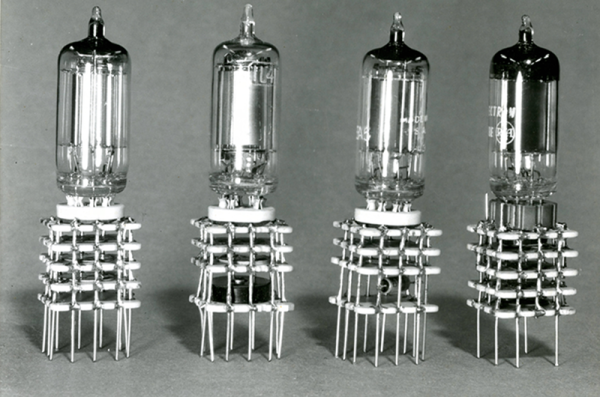
We start with a look at a selection of electronic components, among which are a few transistors. The point contact device is already described as superceded by the junction transistor, but as well as those two we are shown a phototransistor and a junction tetrode, a now-obsolete design that had two base connections.

Unexpectedly we don’t dive straight into the world of transistors, but take a look back at the earlier years of the century to the development of vacuum electronics. We’re taken through the early development  and operation of vacuum tubes, then their use in long-distance radio communications, through the advent of electronics in mass entertainment, and finally into the world of radar and microwave links. Only then do we return to the transistor, with a posed shot of [John Bardeen], [William Shockley], and [Walter Brattain] hard at work in a lab. The merits of the transistor as opposed to the tube are then set out, though we can’t help wondering whether they have confused a milliwatt and a microwatt when they describe the transistor as requiring only a millionth of a watt to operate.

Continue reading “Retrotechtacular: The Transistor (1953 Film)”

Retrotechtacular: Farming Implements In 1932

Few people would deny that farming is hard work. It always has been, and it probably always will be no matter how fancy the equipment gets. In 1932, farming was especially grueling. There was widespread drought throughout the United States, which gave rise to dust bowl conditions. As if those two things weren’t bad enough, the average income of the American farmer fell to its lowest point during the Depression, thanks to the Smoot-Hawley Tariff Act.

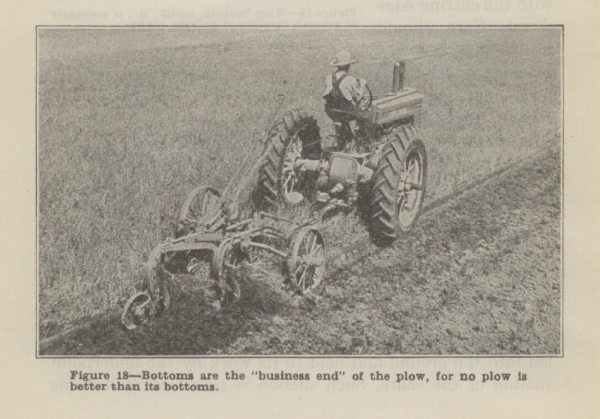
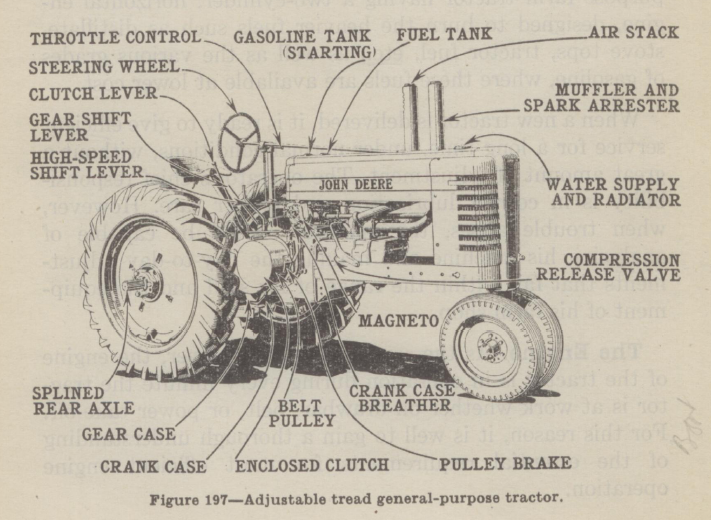
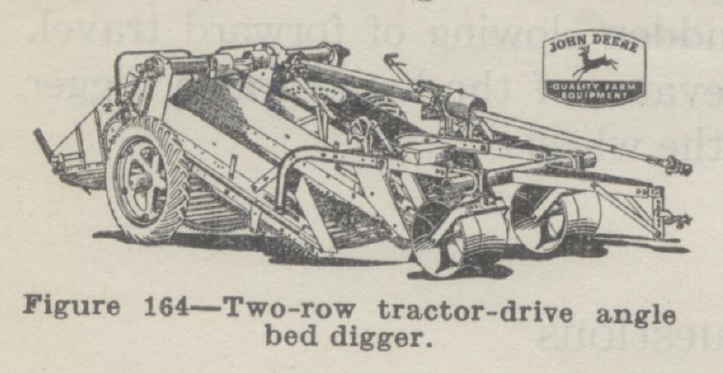
Even so, crop farming was still a viable and somewhat popular career path in 1932. After all, knowing how to grow food is always going to get you elected into your local post-apocalyptic council pretty quickly. As such, the John Deere Equipment Company released the 19th edition of their classic book, The Operation, Care, and Repair of Farm Machinery. This book covers all of the various equipment a crop farmer needed to get from plough to bounty. The text gives equal consideration to horse-driven and tractor-driven farming implements, and there’s an entire chapter dedicated to tractor engine maintenance.

According to its preface, this book was used as an agricultural text in schools and work-study programs. It offers a full course in maintaining the all the (John Deere) equipment needed to work the soil, plant crops, cultivate, harvest, and manure in all parts of the country. The Operation, Care, and Repair of Farm Machinery was so well-received that John Deere kept the book in publication for over thirty years. The 28th edition and final edition came out in 1957. We wonder why they would have stopped putting it out after all that time. Maybe it wasn’t profitable enough, or the company decided to phase out the shade tree tractor mechanic.

So why should you delve into a sorely outdated textbook about farm equipment? Well, it’s straightforwardly written and easy to learn from, whether you’re trying or not. You should check it out if you’re even remotely curious about the basics of farming. If for no other reason, you should go for the beautiful hand-drawn illustrations and stay for the interesting tables and charts in the back. Did you know that a gallon of milk weighs 8.6 pounds?

Continue reading “Retrotechtacular: Farming Implements In 1932”

A Touchscreen From 1982, That Could Kill With A Single Finger Press

Over the pond here in the UK we used to have a TV show called Tomorrow’s World, It was on once a week showing all the tech we would have been using in 10 years time (or so they said). In 1982 they ran with a story about a touch screen computer. Perhaps not what you would recognize today as a touchscreen but given the date and limited technology someone had come up with a novel idea for a touchscreen that worked sort of.

It was a normal CRT screen but around the edges where photodiodes pointing inwards as if to make an invisible infrared touch interface just half an inch in front of the screen. Quite impressive technology giving the times. As they go through the video showing us how it works a more sinister use of this new-fangled touch screen computer rears its ugly head, They turned it into a pretty cool remote-controlled gun turret complete with a motorized horizontal and vertical axis upon which an air pistol was placed along with a camera. You could see an image back from the camera on the screen, move the gun around to aim the weapon, then with a single finger press on the screen, your target has been hit.

Continue reading “A Touchscreen From 1982, That Could Kill With A Single Finger Press”

Retrotechtacular: Tinkertoy And Cordwood In The Pre-IC Era

It is widely accepted that Gutenberg’s printing press revolutionized thought in Europe and transformed the Western world. Prior to the printing press, books were rare and expensive and not generally accessible. Printing made all types of written material inexpensive and plentiful. You may not think about it, but printing–or, at least, printing-like processes–revolutionized electronics just as much.

In particular, the way electronics are built and the components we use have changed a lot since the early 1900s when the vacuum tube made amplification possible. Of course, the components themselves are different. Outside of some specialty and enthusiast items, we don’t use many tubes anymore. But even more dramatic has been how we build and package devices. Just like books, the key to lowering cost and raising availability is mass production. But mass producing electronic devices wasn’t always as easy as it is today.

Continue reading “Retrotechtacular: Tinkertoy And Cordwood In The Pre-IC Era”

Retrotechtacular: The Last Main Line

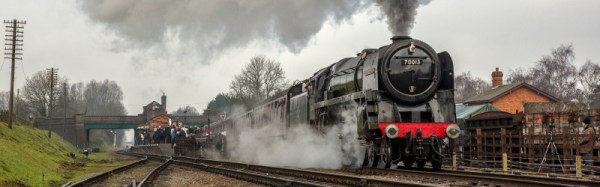
If you were to nominate a technology from the 19th century that most defined it and which had the greatest effect in shaping it, you might well settle upon the railway. Over the century what had started as horse-drawn mining tramways evolved into a global network of high-speed transport that meant travel times to almost anywhere in the world on land shrank from months or weeks to days or hours.

For Brits, by the end of the century a comprehensive network connected almost all but the very smallest towns and villages. There had been many railway companies formed over the years to build railways of all sizes, but these had largely conglomerated into a series of competing companies with a regional focus. Each one had its own main line, all of which radiated out from London to the regions like the spokes of a wheel.

A Ruston steam navvy excavating near Wembley, London. S.W.A.Newton/Leicestershire County Council (Fair use)

By the 1890s there was only one large and ambitious railway company left that had not built a London main line. The Great Central Railway’s heartlands lay in the North Midlands and the North of England, yet had never extended southwards. In the 1890s they launched their ambitious scheme to build  their London connection, an entirely new line from their existing Nottingham station to a new terminus at Marylebone, in London.

Since this was the last of the great British main lines, and built many decades after its rivals, it saw the benefit of the century’s technological advancement. Gone were the thousands of navvies (construction workers, from “Navigational”) digging and moving soil and rock by hand, and in their place the excavation was performed using the latest steam shovels. The latest standards were used in its design, too, with shallow curves and gradients, no level crossings, and a wider Continental loading gauge in anticipation of a future channel tunnel to France This was a high-speed railway built sixty years before modern high-speed trains, and nearly ninety years before the Channel Tunnel was opened.

Continue reading “Retrotechtacular: The Last Main Line”

Retrotechtacular: ERNIE

Wherever you may live in the world, who do you wish to smile upon you and deliver good fortune? You may be surprised to discover that for a significant number of Brits this role is taken by someone called [Ernie].

What, [Jim Henson]’s Ernie from Sesame Street‘s famous duo Bert and Ernie? Sadly not, because the owner of a [Rubber Duckie] can’t offer you the chance of a million quid every month. Instead, [Ernie] is a computer that has been anthropomorphised in the national imagination. More properly referred to as E.R.N.I.E, for Electronic Random Number Indicator Equipment, he is the machine that picks the winning bond numbers for the Premium Bonds, a lottery investment scheme  run by the British Government.

Brits have been able to buy £1 bonds, up to 50,000 of them today, since the 1950s, and every month they are entered into a drawing from which ERNIE picks the winners. The top two prizes are a million pounds, but for most bond holders the best they can hope for is the occasional £25 cheque. Premium Bonds are often bought for young children so a lot of Brits will have a few, often completely forgotten. Prizes never expire, so if you are the holder of old bonds you should consider asking National Savings and Investments whether anything is owed to you.

The Great Grandfather of Premium Bond Drawings

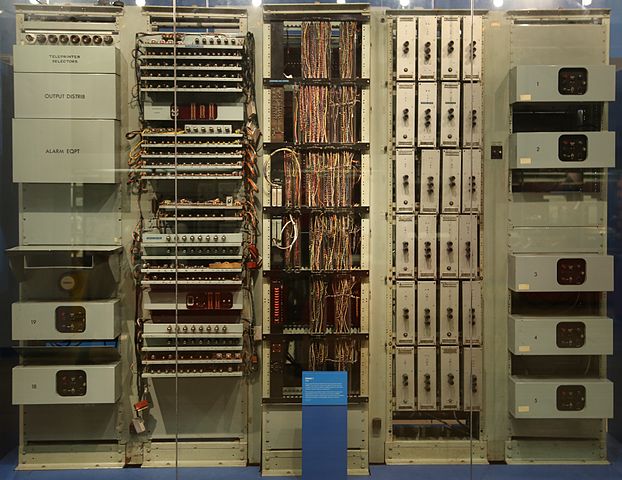
The original 1957 ERNIE, now in the collection of the Science Museum, London. Geni [CC BY-SA 4.0-3.0-2.5-2.0-1.0, via Wikimedia Commons.
The current ERNIE is the fourth-generation model, but our attention today is on its 1950s ancestor. In a way it’s the most interesting of the machines because it has an unusual pedigree, being a creation of the Post Office Research Station, at Dollis Hill, London. As such it came from the lab of the Colossus engineer [Tommy Flowers], and is described as being a descendant of the now-famous but then still top-secret first digital computer used by the World War Two codebreakers. It’s thus a fascinating study for the student of computer history as well as for its role in British postwar social history, because it represents the only glimpse (had they known it at the time) that the British public had of the technology that had helped them so much a decade earlier.

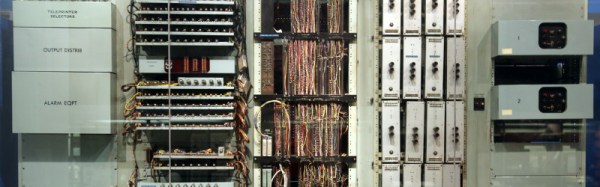
A significant effort was made to ensure that the draw was truly random, and the solution employed by [Flowers] and his team was thoroughly tested before each draw. The thermionic noise generated across a neon tube was sampled, and this random voltage delivered the truly random numbers used to generate the winning bond numbers. The machine’s construction is extremely reminiscent of its wartime predecessor, however it is as well to bear in mind that it owes this to the standard racking and paint used in British telephone exchanges of the day. Gone though are the octal tubes, and in their place are their more familiar miniature successors.

We have two films for you showing this incarnation of ERNIE in action. The first is a National Savings promotional film which explains ERNIE’s purpose, while the second shows us the Minister of the time starting the first draw. Believe it or not, this was a cause of major national excitement at the time.

Continue reading “Retrotechtacular: ERNIE”

Retrotechtacular: The Best Pendulum Clock

Would you believe a pendulum clock that can keep time accurately to within one second per year? If you answered “yes”, you’ve either never tried to regulate a pendulum clock yourself, or you already know about the Shortt Clock. Getting an electromechanical device to behave so well, ticking accurately to within 0.03 parts per million, is no mean feat, and the Shortt clock was the first timekeeping device that actually behaves more regularly than the Earth itself. Continue reading “Retrotechtacular: The Best Pendulum Clock”