A Low-Cost Modular High Altitude Balloon Tracker With Mesh Networked Sensors

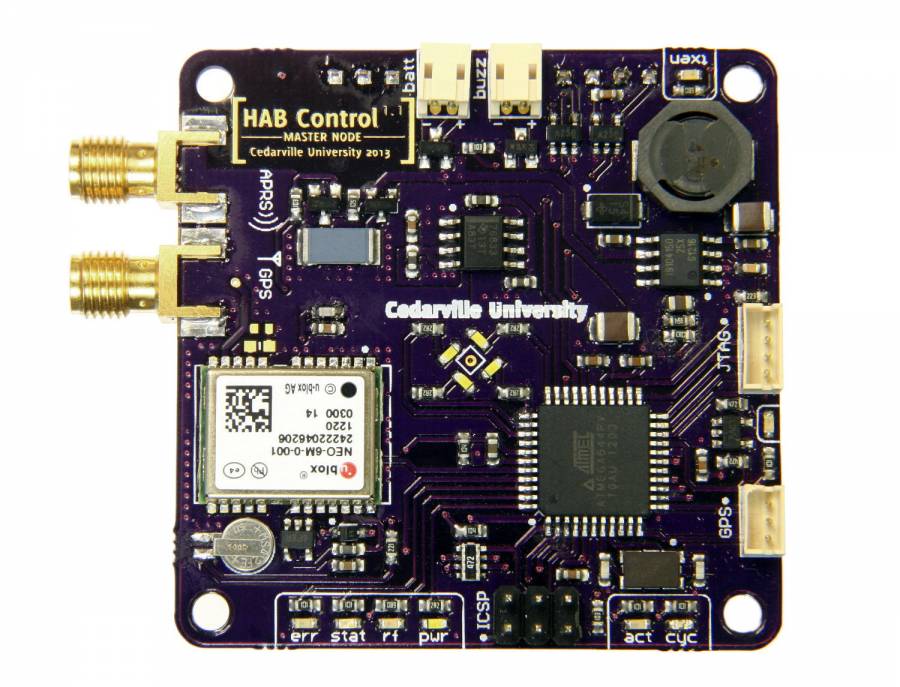
[Ethan] just tipped us about a project he and a few colleagues worked on last year for their senior design project. It’s a low-cost open hardware/software high altitude balloon tracker with sensors that form a mesh network with a master node. The latter (shown above) includes an ATmega644, an onboard GPS module (NEO-6M), a micro SD card slot, a 300mW APRS (144.39MHz) transmitter and finally headers to plug an XBee radio. This platform is therefore in charge of getting wireless data from the slave platforms, storing it in the uSD card while transmitting the balloon position via APRS along with other data. It’s interesting to note that to keep the design low-cost, they chose a relatively cheap analog radio module ($~40) and hacked together AFSK modulation of their output signal with hardware PWM outputs and a sine-wave lookup table.

The slave nodes are composed of ‘slave motherboards’ on which can be plugged several daughter-boards: geiger counters, atmospheric sensors, camera control/accelerometer boards. If you want to build your own system, be sure to check out this page which includes all the necessary instructions and resources.
Making Logic With Inductors

NOR

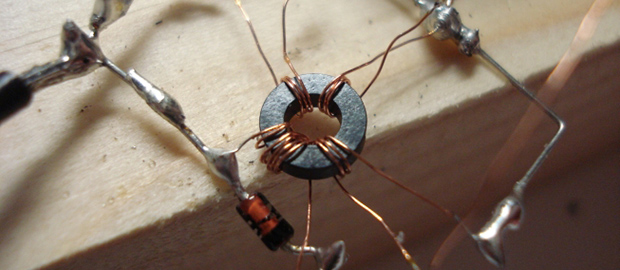
We’ve seen NAND and NOR logic gates – the building blocks of everything digital – made out of everything from marbles to Minecraft redstone. [kos] has outdone himself this time with a logic circuit we’ve never seen before. It’s based on magnets and induction, making a NOR gate out of nothing but a ferrite core, some wire, and a diode.

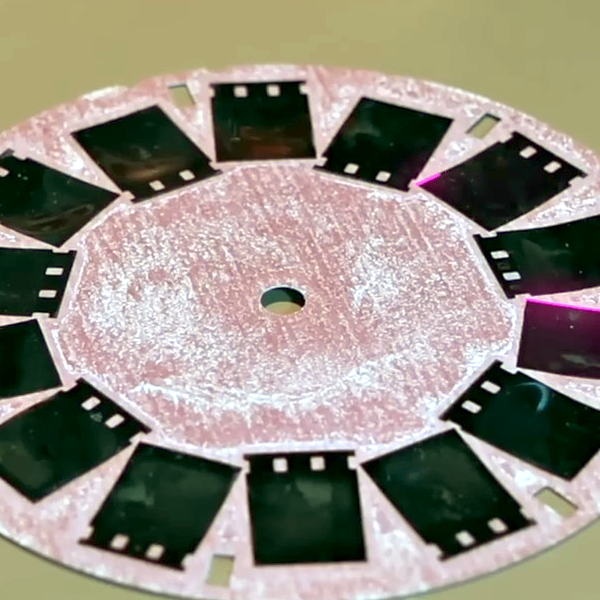
The theory of operations for this magnetic NOR gate goes as follows: If two of the input windings around the core have current passing in different directions, the fields cancel out. This could either be done by positive or negative voltages, or by simply changing the phase of the winding. To keep things simple, [kos] chose the latter. The truth table for a simple two-input, one-output gate gets pretty complicated (or exceedingly cool if you’d like to build a trinary computer), so to get absolute values of 1 and 0, a separate ‘clock’ winding was also added to the core.

One thing to note about [kos]’ gate is its innovation on techniques described in the relevant literature. Previously, these kinds of magnetic gates were built with square ferrites, while this version can work with any magnetic core.

While this isn’t a very practical approach towards building anything more complex than a memory cell, it is an exercise of what could have been in an alternate universe where tube technology and the transistor just didn’t happen.

Nearspace Environmental Chamber

vacuum

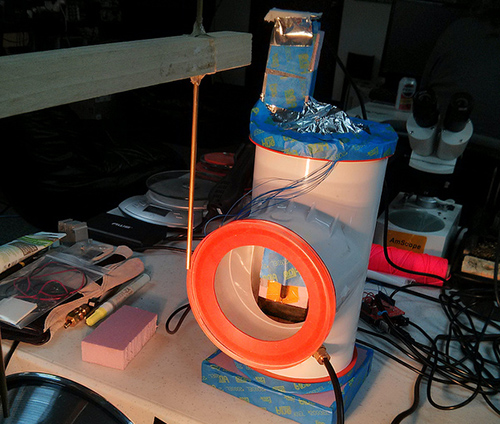
If you’re going to send some hardware up to 100,000 feet, where atmospheric pressure is 1% of what we enjoy on the surface and temperatures swing down to where Fahrenheit and Celsius don’t matter anymore, you might want to do a bit of testing to make sure everything works before launch. With a few bits of PVC, though, that’s a piece of cake.

There were several environmental conditions to take into consideration; the near vacuum experienced by high altitude balloons would be replicated by a refrigerator compressor, the increased solar flux is simulated by a light bulb, and the cold temperatures provided by a chunk of dry ice.

For a proper high altitude, low temperature environmental chamber the test payload should be cooled down via radiation with tubes filled with liquid nitrogen embedded in the walls. This is the NASA way of doing things, but for the budget of $200, [arko]’s chamber simulates a high altitude environment just fine.

Continue reading “Nearspace Environmental Chamber”

Building A Better Serial Camera

If your next project does anything with cameras or machine vision, you’ll probably be looking at something like a USB webcam attached to an ARM board or a netbook. Sometimes, though, that setup blows will blow your budget – power or otherwise – out of the water. For small projects, you’re limited to small, serial-accessible cameras, and in that domain you really don’t have a lot of choices.

[Ibrahim] realized the cheapest serial cameras are about $35, and with basic image processing that cost skyrockets up to about $100. He set out to build his own alternative, and ended up with an awesome serial camera module that should only cost about $15 in quantity.

The module is built around an STM32F4 microcontroller running at 168 MHz. This micro has a DCMI port to which a OV9650 camera is attached. The resolution ends up being 1280×1024, far better than other serial cameras.

Already [Ibrahim] has the hardware working and a few demo apps. He has a real time color tracking demo (video below) up and running and a machine vision repo for his tiny camera. Now if we could only get a few of these boards on Tindie.

Continue reading “Building A Better Serial Camera”

Reverse Engineering The Sony Ericsson Vivaz High Resolution 640 X 360 Cellphone LCD

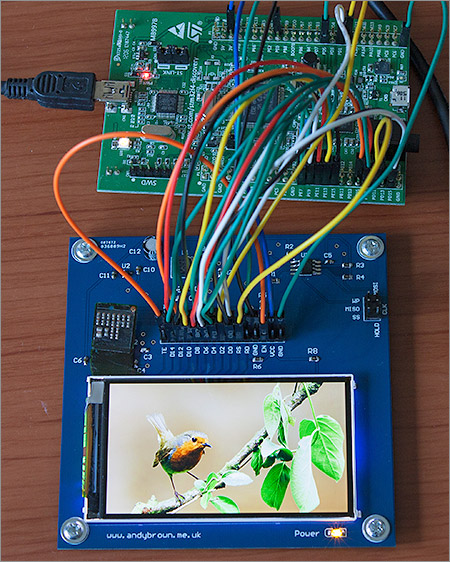
In our opinion, reverse engineering may be one of the best ways to tease your brain. [Andy] just did that by reverse engineering the Sony Ericsson Vivaz high resolution LCD (cached copy here). In his (very) nicely written article, [Andy] explains all the steps that led him to the result shown in the picture above. He started by finding the repair manual of the Vivaz, to discover that the display could be interfaced with 8080 type parallel signals. That meant that he could use a standard microcontroller without high speed buses to interface with it, in this case the STM32F4. Next in his adventure, [Andy] ordered the appropriate connector and took a more educated guess for the onboard microcontroller. A long Google search brought up the R61523 from Renesas. So he designed his breakout board, got it produced and a few hours later a nice picture was being shown on the LCD. He even took the time to compare the original display with the clone he found on the webs, and modified his graphics library to support this display.

RFID Door Access Robot

RFID Door orbot

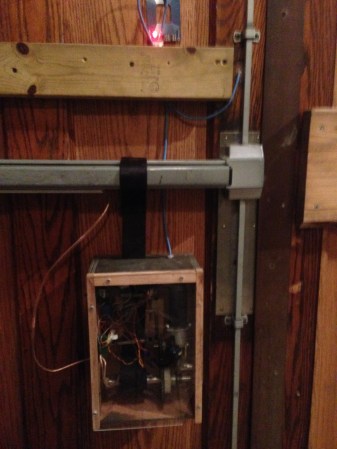
We love hackerspaces. Some of the most innovative solutions come from them thanks to having like-minded people all hanging out in the same place. Just take a look at this awesome RFID door system from the Lansing Makers Network that doesn’t require any modification of the door.

The majority of the mechanism was previously a model draw bridge that the space purchased from a surplus store — it just needed a bit of hacking. Almost all members of the space had some part in the project, whenever the build hit a snag, another member always had the right solution. It works by using a windshield motor that tightens a seatbelt around the push-bar latch of the door — the beauty of the system is it is completely non-damaging to the door, and the door works exactly the same as before. The whole system is controlled by RFID tags, which the members have as keys to the space.

It’s an awesome project and [Brian] has written a really great write-up on it, which also happens to segue nicely into the topic of hackerspaces. He describes hackerspaces as

the Wikipedia of real life, and everything else here [tools, equipment, resources] is just the lure that pulls us all together.

Stick around after the break to see the mechanism in action!

Continue reading “RFID Door Access Robot”

Wireless Encryption Between Galileo And A MSP430

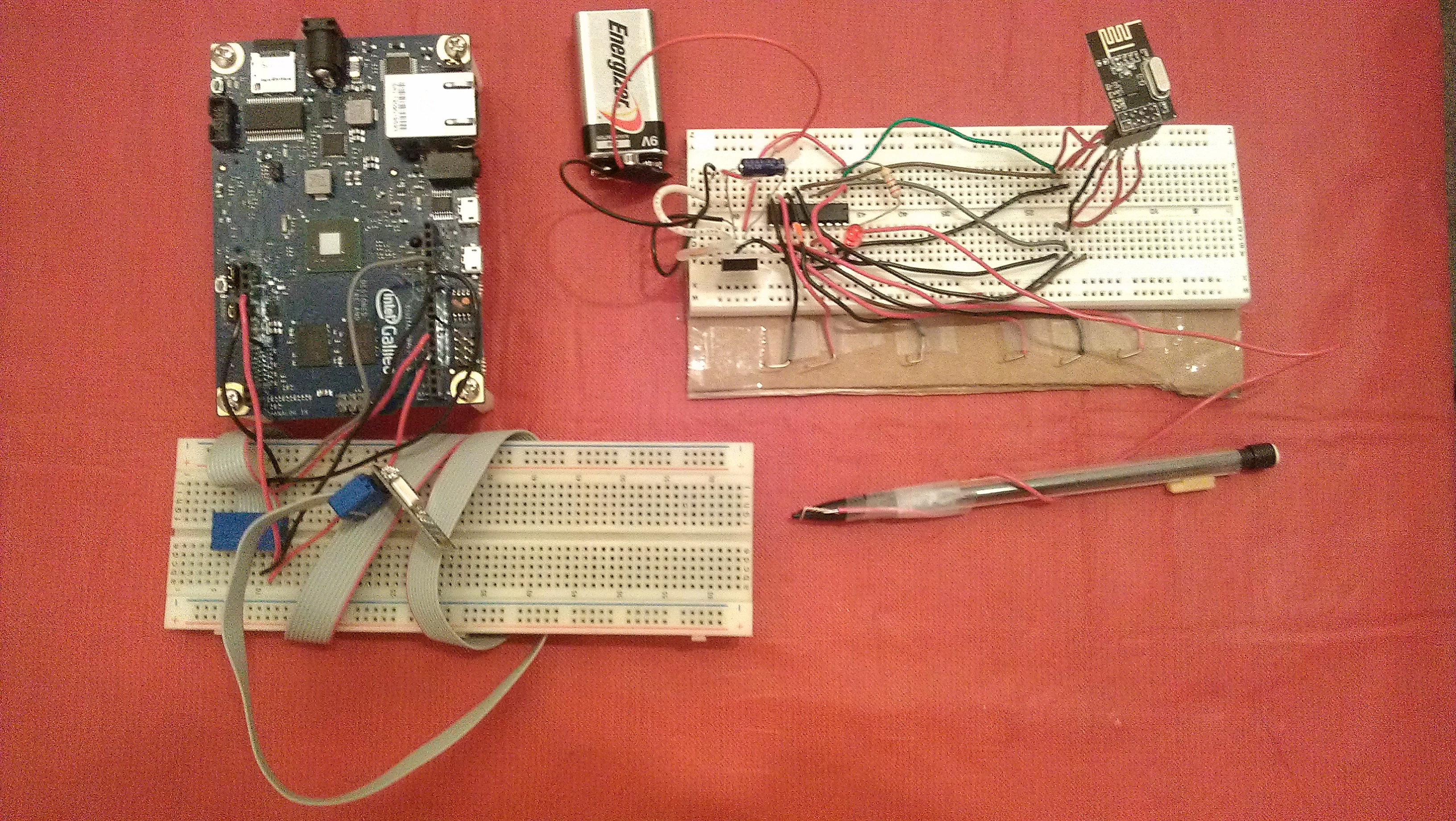
[Mark] recently finished his latest project, where he encrypts wireless communications between the new Intel Galileo and a Texas Instruments MSP430. The wireless interfaces used are the very common nRF24L01+ 2.4GHz transceivers, that had a direct line of sight 15 feet range during [Mark]’s tests. In his demonstration, the MSP430 sends an encrypted block of data representing the state of six of its pins configured as inputs. This message is then received by a sketch running on the Galileo and stored in shared memory. A python script then wakes up and is in charge of decrypting the message. The encryption is done using AES-128bits in Electronic Codebook mode (ECB) and semaphores are used to prevent simultaneous accesses to the received data. As it is the first project using an Intel Galileo we received, don’t hesitate to send us a tip if you found other ones.