Ridiculously Automated Dorm Room

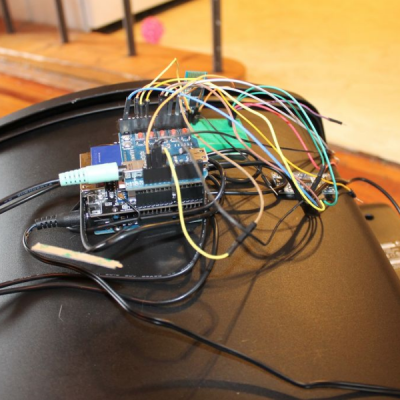
Take three NRF24L0+ radios, two Arduino Nanos, and a Raspberry Pi. Add a bored student and a dorm room at Rice University. What you get is the RRAD: Rice Ridiculously Automated Dorm. [Jordan Poles] built a modular system inspired by BRAD (the Berkeley Ridiculously Automated Dorm).

RRAD has three types of nodes:

  • Actuation nodes – Allows external actuators like relays or solenoids
  • Sensory nodes – Reports data from sensors (light, temperature, motion)
  • Hub nodes – Hosts control panel, records data, provides external data interfaces

Continue reading “Ridiculously Automated Dorm Room”

Don’t Shovel Snow; Build An Epic Melt System!

When [Ronald Walters] was building a new house, he decided he didn’t want to shovel snow anymore. So he built a snow melt system under his new driveway. He knew the system would be expensive to operate, but he reasoned it was cheaper than back surgery and much cheaper than having a heart attack.

The system uses PEX pipe on rebar and insulation that is all set down before the concrete in the driveway. An instant-on water heater produces the heat that melts the snow and ice off [Ronald’s] driveway with no shoveling required. The working fluid includes anti-freeze, of course, and there is a set of pumps, flow valves, and flow meters to keep everything flowing when the system is in operation.

Continue reading “Don’t Shovel Snow; Build An Epic Melt System!”

Man Shoots Lamp

What do you get when you mix together all of the stuff that you can get for cheap over eBay with a bit of creativity and some PVC pipe? [Austiwawa] gets a table lamp, remote-controlled by a toy gun, that turns off and falls over when you shoot it. You’ve got to watch the video below the break.

This isn’t a technical hack. Rather it’s a creative use of a bunch of easily available parts, with a little cutting here and snipping there to make it work. For instance, [Austiwawa] took a remote control sender and receiver pair straight off the rack and soldered some wires to extend the LED and fit it inside the toy gun. A relay module controls the lamp, and plugs straight into the Arduino that’s behind everything. Plug and play.

Which is not to say the lamp lacks finesse. We especially like the screw used as an end-of-travel stop for the servo motor, and the nicely fabricated servo bracket made from two Ls. And you can’t beat the fall-over-dead effect. Or can you? Seriously, though, great project [Austiwawa]!

Continue reading “Man Shoots Lamp”

Finally, A Power Meter Without Nixies

We’ve had quite a spate of home-brew energy meters on the tip line these days, and that probably reflects a deep inner desire that hackers seem to have to quantify their worlds. Functionally, these meters have all differed, but we’ve noticed a distinct stylistic trend toward the “Nixies and wood” look. Ironically, it is refreshing to see an energy meter with nothing but a spartan web interface for a change.

Clearly, [Tomasz Salwach] had raw data in mind as a design goal, and his Raspberry Pi-based meter delivers. After harvesting current sensing transformers from a bucket of defunct power meter PC boards, [Tomasz] calibrated them with a DIY oscilloscope and wired them and the voltage sensors up to an STM32 Nucleo development board. Data from the MCU goes to the Pi for processing and display as snazzy charts and GUI elements served internally. [Tomasz] was kind enough to include a link to his meter in his tip line post, but asked that we not share it publicly lest HaD readers love the Pi to death. But we can assure you that it works, and it’s kind of fun to peek in on the power usage of a house in Poland in real time.

It’s a nice project that does exactly what it set out to do. But if you missed the recent spate of Nixie-based displays, check out this front hallway meter or this one for a solar-power company CEO’s desk.

Custom Siri Automation With HomeKit And ESP8266

Knowing where to start when adding a device to your home automation is always a tough thing. Most likely, you are already working on the device end of things (whatever you’re trying to automate) so it would be nice if the user end is already figured out. This is one such case. [Aditya Tannu] is using Siri to control ESP8266 connected devices by leveraging the functionality of Apple’s HomeKit protocols.

HomeKit is a framework from Apple that uses Siri as the voice activation on the user end of the system. Just like Amazon’s voice-control automation, this is ripe for exploration. [Aditya] is building upon the HAP-NodeJS package which implements a HomeKit Accessory Server using anything that will run Node.

Once the server is up and running (in this case, on a raspberry Pi) each connected device simply needs to communicate via MQTT. The Arduino IDE is used to program an ESP8266, and there are plenty of MQTT sketches out there that may be used for this purpose. The most recent example build from [Aditya] is a retrofit for a fiber optic lamp. He added an ESP8266 board and replaced the stock LEDs with WS2812 modules. The current version, demonstrated below, has on/off and color control for the device.

Continue reading “Custom Siri Automation With HomeKit And ESP8266”

Wink Hub Connects To SmartThings

As home automation grows more and more popular by the day, the free market is taking notice and working to supply the demand. The Wink Hub is a part of this current trend. It’s a device that allows many of your wireless devices to talk to one another. Things like lights, thermostats, door locks, garage doors…and many other devices can all connect to the hub. Typically, you use a program on your phone or tablet to control these devices. But because this is a closed source gadget, it can’t connect to everything, until now. A hacker was not only able to root the device, but he also gained the ability to connect to devices it was never designed to connect to.

[Michael] was able to get root and take control of some of the devices used with one of Wink’s main competitors – SmartThings. The process is not for the faint of heart and requires at least a yellow belt in Linux-Fu. [Michael] points out that you should use a Wink Hub that you don’t care about as the possibility of bricking it is there if something goes wrong.

We’ve seen a few instances of rooting the Wink and are happy to see these hacks maturing. It’s a shame the thing is locked down since the multiple radios make the hardware capable of being a great cross-platform hub. For legacy and better user experience, cross-platform operation is paramount. The industry isn’t moving in that direction… Phillips recently removed support for devices outside the Hue family. But the community wants this functionality and their push back led to a hasty reversal of Phillips’ changes. Hackers like [Michael] are showing what your home could be like if connected devices were free to interact with one another.

Internet Of Things In Five Minutes

If you’re looking for the quickest way to go from zero to voice-controlled home automation system, you should spend five minutes checking out [Hari Wiguna]’s project on Hackaday.io where he connects up IoT gadgets and services into a functioning lightswitch. (Video below the break.)

6166971452133983621[Hari] demonstrates how to set up a complex chain: Amazon Echo to IFTTT to Adafruit.io as a data broker, which is then polled by an ESP8266 unit in his home that controls his X10 setup. (Pshwew.) But each step along the way is designed to be nearly plug-and-play, so it’s really a lot like clicking Lego blocks together. [Hari]’s video is a nice overview.

There’s only one catch if you’re going to replicate this yourself: the X10 system that’s used for the last mile. Unless you have one of these setups already, you’re on your own for controlling the outlets that turn the lights on and off. For price and hackability, we suggest the common 433MHz wireless outlet switches and pairing them with cheap 433MHz transmitters, available at eBay for around $1. We’ve seen a lot of hacks of these systems — they’re quite common both in the US and Europe.

We’ve also covered [Hari]’s projects before: both his self-learning TV remote and a sweet Halloween hack. His video production skills are excellent. We’re in awe of how much info he crams into his YouTube videos.