AVR Programming 03: Reading And Compiling Code

In the last installment of our tutorial series we built a simple circuit on a breadboard and programmed an ATmega168 to make it run. That proves that you know how to follow directions, but the eureka moments of doing everything yourself are on the way. This time around you will get down and dirty with the datasheet, learning where each line of the sample code came from, and give your recently installed compiler a test drive. We will:

  • Talk about bitwise operators and how they work when coding for microcontrollers
  • Discuss C code shorthand
  • Review the sample code from Part 2 and talk about what each line of code does
  • Learn to compile code

If this is the first you’ve heard about our AVR Programming series, head back to Part 1 and start from the beginning. Otherwise, take a deep breath and we’ll being after the break.

Series roadmap:

Continue reading “AVR Programming 03: Reading And Compiling Code”
70 LED Matrix In A Jack-o-lantern

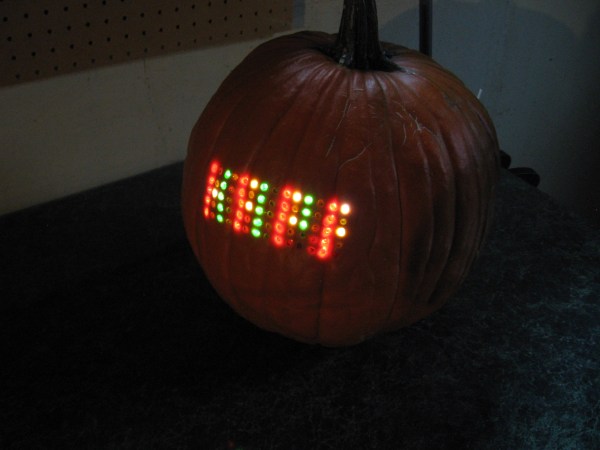
What takes eight hours to solder and uses more shrink tubing that you thought imaginable? An LED matrix installed in a real pumpkin. When I mentioned that we’d like the LED pumpkin in last Friday’s post scaled up to a full LED matrix I had no idea it would be me doing the work. But [Caleb] and I thought it might be just the thing to present for the hacker’s favorite holiday.

Installed in the autumn vegetable is a marquee made from a 5×14 matrix of light emitting diodes. I spaced them by printing out a grid on the computer, taping it to the pumpkin, and drilling 70 holes in the front of the thing. The real trouble came when inserting all of the LEDs from the inside; each of them has four wires soldered to it, creating a net of black wiring. Above you can see it turned out great. This is a shot of it scrolling the message HAPPY HALLOWEEN.

Join us after the break for video of this prop. But we’re not just sharing the finished product. I’ll take you through the build process. Along the way you’ll learn the design considerations that go into an LED matrix and how you can use these techniques to build your own in any size and configuration you desire.

Continue reading “70 LED Matrix In A Jack-o-lantern”

AVR Programming 02: The Hardware

You may be able to write the most eloquent code in the history of embedded systems but without a way to run it on the hardware it will be worthless. In this installment of the tutorial series we will:

  • Look at some of the available AVR programmer options
  • Place the microcontroller on a breadboard and connect it to a power supply and a programmer.
  • Use programming software to send some example code to the microcontroller

If you missed Part 1 take a few minutes to review that portion of the tutorial and then join us after the break.

Series roadmap:

Continue reading “AVR Programming 02: The Hardware”

AVR Programming 01: Introduction

We love looking at hardcore electronics projects with a beefy microcontroller and hundreds, if not thousands, of lines of code at its center. But everyone needs to get there somehow.

This tutorial series aims to make you comfortable programming the Atmel AVR line of microcontrollers. Whether you’ve never touched a microcontroller before, or you’ve cut your teeth with dozens of Arduino projects, this will help you get right down to the hardware and give you the confidence to build anything.

Series roadmap:

Continue reading “AVR Programming 01: Introduction”

Spy Video TRAKR: Software And First Hack

Our initial view of the Spy Video TRAKR “App BUILDR” site had us believing this would be an internet-based code editor and compiler, similar to the mbed microcontroller development tools. Delving deeper into the available resources, we’re not entirely sure that’s an accurate assessment — TRAKR may well permit or even require offline development after all. Regardless of the final plan, in the interim we have sniffed out the early documentation, libraries and standalone C compiler and have beaten it into submission for your entertainment, in order to produce our first TRAKR hack!

Continue reading “Spy Video TRAKR: Software And First Hack”

So You Want To Make A Command Line Interface

[Keba] not only asked Answeres.HackaDay.com, but also sent us an email as follows.

“Can you make a basic guide to designing a good Command Line User Interface?”

Wouldn’t you know the luck, I’m currently working on a Command Line type interface for a project of mine. While after the jump I’ll be walking through my explanation, it should be noted that the other replies to Answers.HackaDay.com are also great suggestions.

Continue reading “So You Want To Make A Command Line Interface”

How-to: Launchpad Programming With Linux

When TI released their Launchpad development board at the end of June it generated a lot of Buzz. Here’s a package that delivered a programmer, debugger, two microcontrollers, and some accessories for less than five bucks (including shipping). They even provided a choice of two software suites but only for users running Windows who don’t mind proprietary software. If you’re looking to go another way you should consider trying out the open source alternative MSPGCC. After the break we’ll take a look at getting the tool-chain up and running in a Linux environment.

Continue reading “How-to: Launchpad Programming With Linux”