How-To: Web Server On A Business Card (Part 1)

For years, Microchip PIC microcontrollers dominated; PIC16F84 hacks and projects are everywhere. The 8-bit 16F and 18F lines are supported by several coding environments and easy-to-build serial port programmers. Microchip’s 16-bit PIC24F is cheaper, faster, and easier to work with, but largely absent from hacks and projects.

We recently used a Microchip PIC24F microcontroller in a mini web server project, but didn’t find many introductory references to link to. In this article we’ll cover some PIC 24F basics: support circuitry and programming options. We’ll also talk about our favorite features, and how we figured them out. Our next article will outline a web server on a business card based on the PIC 24F.

Continue reading “How-To: Web Server On A Business Card (Part 1)”

How-to: Thermite Hard Drive Destruction

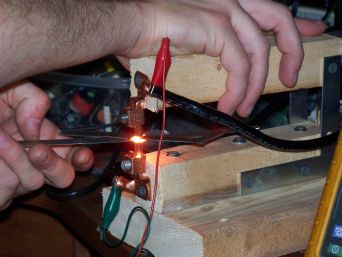
After the overwhelming response to the Hackit we posted about automated hard drive destruction last fall, we finally decided to test out some thermite hard drive destruction ourselves. This has been done on The Screen Savers but they did not show up close results of the platters. So, aluminum and black iron oxide were procured through eBay, and until it arrived we watched some YouTube videos that showed a lot of fire and no real results. We decided to see what it would take to completely obliterate a drive.

With the amount of personal data stored on your computer, we all understand the importance of destroying the data that is stored on the platters of a hard drive before disposing of it. There are many ways to destroy a hard drive; software, physical disassembly, drills, hammers, magnets/electromagnets, and acid, but none are quite as outrageous and dangerous as thermite. That’s what we’re going to do here today. Follow along for pictures and videos of the results.

Continue reading “How-to: Thermite Hard Drive Destruction”

How-To: Hack A ThingamaKIT

The ThingamaKIT is an anthropomorphic analog synthesizer kit from Bleep Labs. Using “LEDacles”, photoresistors, knobs, and switches, it generates interesting high pitched vocalizations. Bleep Labs sent us a review unit and this article shares our experiences building and using the kit. We’ve also included a tutorial on making some hacks, modifications, and circuit bends to it. Skip to the end to see a video of our hacked kit in action.

Continue reading “How-To: Hack A ThingamaKIT”

How-To: The Hacker’s Soldering Station


A good soldering station and fume extractor is a must for anyone interested in hacking and modding, but not everyone can afford the expensive professional models on the market. This How-To and the tips within it will guide you through the process of building an inexpensive homebrew fume hood complete with built-in time and temperature controlled soldering station and all the soldering tools you need.

Continue reading “How-To: The Hacker’s Soldering Station”

How-To: Etch A Single Sided PCB

Making a PCB is very simple; it does not consume a lot of time and the results look professional. After reading this How-To and watching the step by step video, you will be able to make your own PCB in your workshop using just a few inexpensive materials.

Many people use protoboard and point-to-point wire everything, but needing multiple copies of the same circuit is the reason that forces many away from using protoboard. After making your first circuit board, you might not point-to-point wire anything again!

Continue reading “How-To: Etch A Single Sided PCB”

How-To: Make An RGB Combination Door Lock (Part 2)


In part 1 we showed you how to build your own prototype RGB keypad. Today we’ll show off some new ideas we worked on to create the project and turn it from prototype to fully functional battle station er door lock.

Continue reading “How-To: Make An RGB Combination Door Lock (Part 2)”

How-To: Make An RGB Combination Door Lock (Part 1)


Part 2 can be found here

Putting a custom designed electronic lock on your space seems like a geek right of passage. For our latest workspace, we decided to skip the boring numbered keypad and build a custom RGB backlit keypad powered by an Arduino. Instead of typing in numbers, your password is a unique set of colors. In today’s How-To, we’ll show you how to build your own and give you the code to make it all work.

Continue reading “How-To: Make An RGB Combination Door Lock (Part 1)”