Tales Of A Cheap Chinese Laser Cutter

The star turn of most hackspaces and other community workshops is usually a laser cutter. An expensive and fiddly device that it makes much more sense to own collectively than to buy yourself.

This isn’t to say that laser cutters are outside the budget of the experimenter though, we’re all familiar with the inexpensive table-top machines from China. Blue and white boxes that can be yours for a few hundred dollars, and hold the promise of a real laser cutter on your table.

Owning one of these machines is not always smooth sailing though, because their construction and choice of components are often highly variable. A thorough check and often a session of fixing the non-functional parts is a must before first power-on.

[Extreme Electronics] bought one, and in a series of posts documented the process from unboxing to cutting. Starting with a full description of the machine and what to watch for out of the box, then a look at the software. A plugin for Corel Draw was supplied, along with a dubious copy of Corel Draw itself. Finally we see the machine in operation, and the process of finding the proper height for beam focus by cutting an inclined plane of acrylic.

The series rounds off with a list of useful links, and should make interesting reading for anyone, whether they are in the market for a cutter or not.

These cutters/engravers have featured here before many times. Among many others we’ve seen one working with the Mach3 CNC software, or another driven by a SmoothieBoard.

Speakers Make A LASER Scanning Microscope

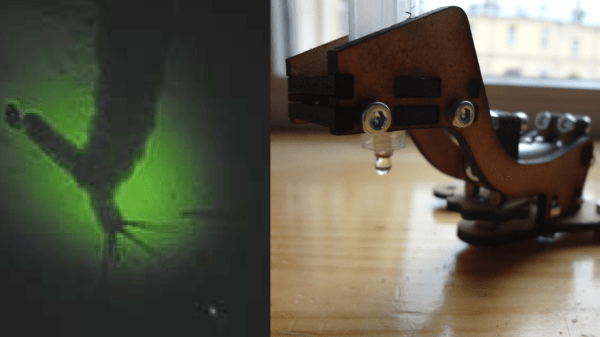
We’ve seen a lot of interest in LSM (LASER Scanning Microscopes) lately. [Stoppi71] uses an Arduino, a CD drive, and–of all things–two speakers in his build. The speakers are used to move the sample by very small amounts.

The speakers create motion in the X and Y axis depending on the voltage fed to them via a digital analog converter. [Stoppi71] claims this technique can produce motion in the micron range. His results seem to prove that out. You can see a video about the device, below.

Continue reading “Speakers Make A LASER Scanning Microscope”

CheetahBeam: More Proof That Cats Are Your Overlord

We don’t know what cats see when they see a red laser beam, but we know it isn’t what we see. The reaction, at least for many cats — is instant and extreme. Of course, your cat expects you to quit your job and play with it on demand. While [fluxaxiom] wanted to comply, he also knew that no job would lead to no cat food. To resolve the dilemma, he built an automated cat laser. In addition to the laser module, the device uses a few servos and a microcontroller in a 3D printed case. You can see a video, below. Dogs apparently like it too, but of course they aren’t the reason it was built.

If you don’t have a 3D printer, you can still cobble something together. The microcontroller is an Adafruit Pro Trinket, which is essentially an Arduino Pro Mini with some extra pins and a USB port.

Continue reading “CheetahBeam: More Proof That Cats Are Your Overlord”

Amazing 3D-Scanner Teardown And Rebuild

0_10ea1b_776cdc71_origPour yourself a nice hot cup of tea, because [iliasam]’s latest work on a laser rangefinder (in Russian, translated here) is a long and interesting read. The shorter version is that he got his hands on a broken laser security scanner, nearly completely reverse-engineered it, got it working again, put it on a Roomba that was able to map out his apartment, and then re-designed it to become a tripod-mounted, full-room 3D scanner. Wow.

The scanner in question has a spinning mirror and a laser time-of-flight ranger, and is designed to shut down machinery when people enter a “no-go” region. As built, it returns ranges along a horizontal plane — it’s a 2D scanner. The conversion to a 3D scanner meant adding another axis, and to do this with sufficient precision required flipping the rig on its side, salvaging the fantastic bearings from a VHS machine, and driving it all with the surprisingly common A4988 stepper driver and an Arduino. A program on a PC reads in the data, and the stepper moves another 0.36 degrees. The results speak for themselves.

This isn’t [iliasam]’s first laser-rangefinder project, naturally. We’ve previously featured his homemade parallax-based ranger for use on a mobile robot, which is equally impressive. What amazes us most about these builds is the near-professional quality of the results pulled off on a shoestring budget.

Continue reading “Amazing 3D-Scanner Teardown And Rebuild”

Foldable Dymaxion Globe

Some time back, we posted about [Gavin]’s laser-cut/3D printed Dymaxion Globe — if you haven’t read about it yet, you should check it out. [noniq] loved the idea, and like a true hacker, built and shared an improved Foldable Dymaxion Globe. It can snap together to form an icosahedron globe, or it can be laid flat to form a map.

Duct tape, stoppers and magnet holders

Like the original, [noniq]’s version is laser cut and engraved, and uses some 3D printed parts. But it does away with the fasteners (that’s 60 pairs of nuts and bolts), and instead uses neodymium magnets to make all the triangle pieces snap together to form the icosahedron globe. The hinges are simply some pieces of gaffer-tape.

This design improvement creates a cleaner globe and also addresses some of the concerns posted in the comments of the earlier build. The design files are available for download on [noniq]’s blog — you need to 3D print some magnet holders and stopper plates, and laser cut the 20 triangle tiles. The stopper plates help ensure that the angle between tiles when it is put together is limited to 138 degrees, making it easier to assemble the globe.

Check out the video after the break to hear the satisfying “thunk” of neodymium magnets snapping together.

Continue reading “Foldable Dymaxion Globe”

Convert That Cheap Laser Engraver To 100% Open-Source Toolchain

laserweb-on-cheap-laser-squareLaserWeb is open-source laser cutter and engraver software, and [JordsWoodShop] made a video tutorial (embedded below) on how to convert a cheap laser engraver to use it. The laser engraver used in the video is one of those economical acrylic-and-extruded-rail setups with a solid state laser emitter available from a variety of Chinese sellers (protective eyewear and any sort of ventilation or shielding conspicuously not included) but LaserWeb can work with just about any hardware, larger CO2 lasers included.

LaserWeb is important because most laser engravers and cutters have proprietary software. The smaller engravers like the one pictured above use a variety of things, and people experienced with larger CO2 laser cutters may be familiar with a piece of software called LaserCut — a combination CAD program and laser control that is serviceable, but closed (my copy even requires a USB security dongle, eww.)

LaserWeb allows laser engravers and cutters to be more like what most of us expect from our tools: a fully open-source toolchain. For example, to start using LaserWeb on one of those affordable 40 W blue-box Chinese laser cutters the only real hardware change needed is to replace the motion controller with an open source controller like a SmoothieBoard. The rest is just setting up the software and enjoying the added features.

Continue reading “Convert That Cheap Laser Engraver To 100% Open-Source Toolchain”

Laser Cutting A Wooden Dymaxion Globe

Everyone knows that globes are cool — what else would you use as the centerpiece of your library/study? But, sadly, making your own isn’t a simple process. Even if you had a large (preferably hollow) sphere to work with, you’d still have to devise a clever way of printing the map in sections that can be glued to the curved surface. Wouldn’t it be easier if you could just laser cut flat sections, and assemble them to form a faceted “globe?”

Well, it is, and you can! Because, [Gavin] over at tinkerings.org (a Hackaday favorite) has created the files to do just that! This map projection, originally designed by the very interesting Buckminster Fuller, is designed to be either laid flat or three-dimensionally on an icosahedron (a 20-sided polyhedron). That makes it perfect for laser cutting, as each of the 20 faces can be cut from flat stock.

600px-fuller_projection_with_tissot27s_indicatrix_of_deformation

Continue reading “Laser Cutting A Wooden Dymaxion Globe”