Building A Monitor Light Bar For Better Productivity

If you’re intending to work at your desk for long periods of time, good lighting is a must, as it can help stave off eye strain and mental fatigue. It was a desire for more comfortable productivity that drove [Jade] to whip up a monitor-mounted lighting system for her workstation.

The build uses an ESP32 to run the show, with a rotary encoder for manual control and firmware that allows the monitor light to be neatly integrated with Home Assistant. The light itself comes from light strips that feature both warm white and cold white LEDs. Simple MOSFETs are used to control the brightness of the LEDs and which of the warm and cold LEDs are activated at any time. Everything is wrapped up in a 3D printed housing that neatly sits on top of the monitor with the aid of a simple printed clamp. The LED strips also have a nice soft glow thanks to a strip of diffuser material that [Jade] snatched from an old television.

We love a good lighting build, from the work-focused to the creative and beautiful.

Continue reading “Building A Monitor Light Bar For Better Productivity”
This LED Strip Clock Aims To Make Your Next One Easier, Too

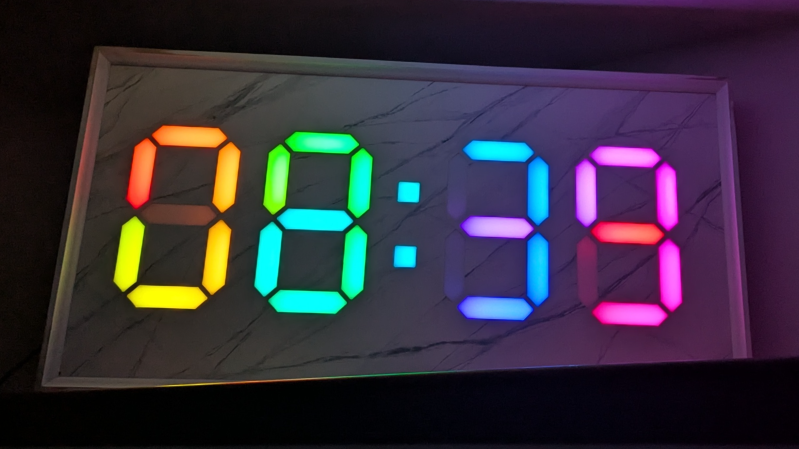
At first glance, it may look like [Rybitski]’s 7-segment RGB LED clock is something that’s been done before, but look past the beautiful mounting. It’s not just stylishly framed; the back end is just as attentively executed. It’s got a built-in web UI, MQTT automation, so Home Assistant integration is a snap, and allows remote OTA updates, so software changes don’t require taking the thing down and plugging in a cable.

Continue reading “This LED Strip Clock Aims To Make Your Next One Easier, Too”

Driving WS2812Bs With Pure Logic

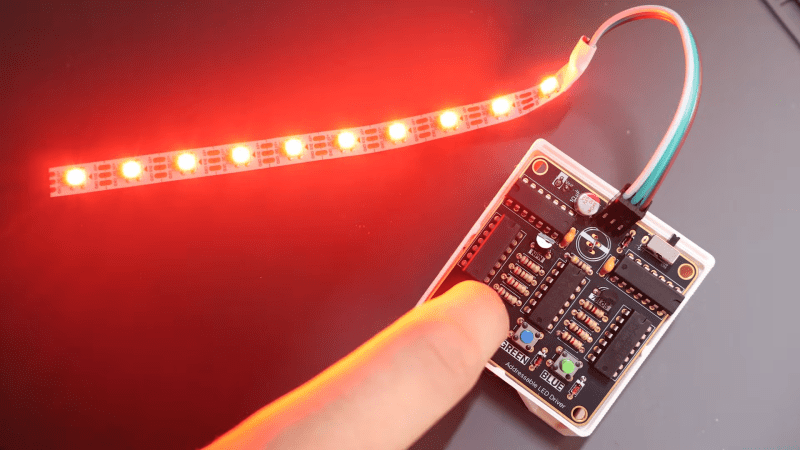
The WS2812B has become one of the most popular addressable LEDs out there. They’re easy to drive from just about any microcontroller you can think of. But what if you don’t have a microcontroller at all? [Povilas Dumcius] decided to try and drive the LEDs with raw logic only.

The project consists of a small board full of old-school ICs that can be used to drive WS2812Bs in a simplistic manner. A 74HC14 Schmitt trigger oscillator provides the necessary beat for this tune, generating an 800 kHz clock to keep everything in time and provide the longer pulse trains that represent logic one to a WS2812B. A phase-shifted AND gate generates the shorter pulses necessary to indicate logic zero. Meanwhile, a binary counter cycles through 24 bits (8 per R, G, and B) to handle color. Pressing each one of the three push-buttons allows each color channel to be activated or deactivated as desired. It can make the strip red, green, or blue, or combine the channels if you press multiple buttons at once. That’s all the control you get—it would take a bit more logic to enable variable levels of each channel. Certainly within the realms of possibility, though.

We’ve featured some other nifty tricks for driving WS2812Bs in unconventional ways, like using DMA hardware or even I2S audio outputs. If you’ve got your own tricks, don’t hesitate to notify the tipsline.

Continue reading “Driving WS2812Bs With Pure Logic”

Building An Interactive Climbing Wall

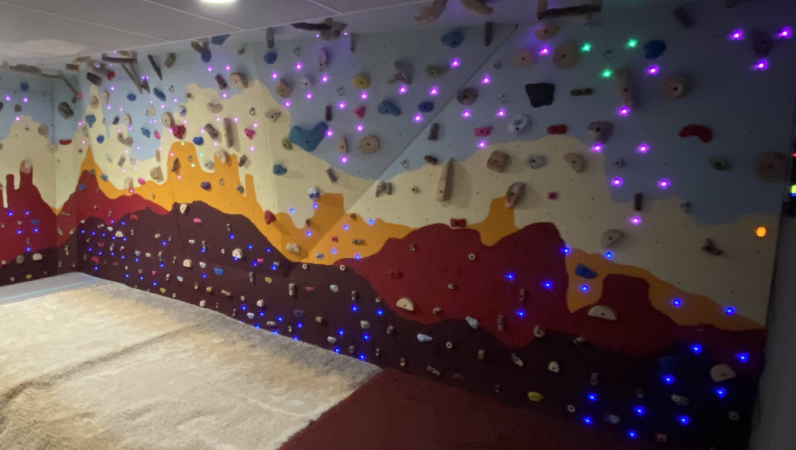
Climbing is a cool sport. With that said, like everything, it’s even better if you integrate lots of glowing colorful LEDs. To that end, [Superbender] worked up this fun climbing wall that features interactive lighting built right in.

Structurally, there’s nothing too wild going on here. It’s a wood-framed climbing structure that stands 10 meters long and 2.5 meters high, and can be covered in lots of climbing holds. It’s the electronic side of things where it gets fun. An Arduino Due is installed to run the show, hooked up with a small TFT display and some buttons for control. It’s then hooked up to control a whole bunch of LEDs and some buttons which are scattered all across the wall. It’s also paired with an Arduino Nano which runs sound feedback, and a 433 MHz remote for controlling the system at a distance.

[Superbender] uses the lighting for fun interactive games. One example is called Hot Lava, where after each climbing pass, more holds are forbidden until you can’t make the run anymore. Chase the Blues is another fun game, where you have to climb towards a given hold, at which point it moves and you have to scamper to the next one.

We’ve featured similar projects before from other inventive climbers.

Continue reading “Building An Interactive Climbing Wall”

Modded Lightbox Makes For Attractive LED Matrix Display

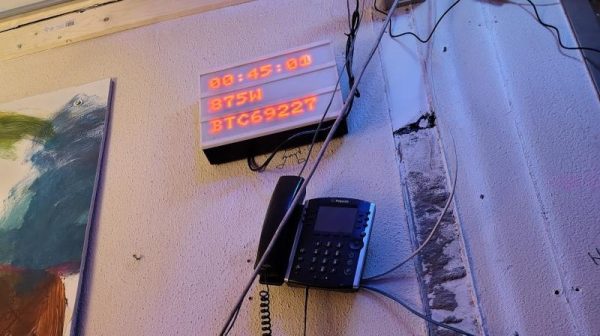
If you’ve been to a wedding or a downtown coffee shop in the last 10 years, you’ve probably seen those little lightboxes that are so popular these days. They consist of letters placed on a plastic frame in front of a dim white light, and they became twee about five minutes after your hipster friend first got one. However, they can also make a neat basis for an LED display, as [Folkert van Heusden] demonstrates. 

The build is straightforward enough, using daisy chains of 32×8 LED matrix modules, two each for the three rows of the lightbox. This provides for a 24 character textual display, or a total display resolution of 64 x 24 pixels. An ESP8266 is used to command the matrixes, which are run by MAX7219 display controllers. Thanks to the microcontroller’s onboard wireless hardware, the display can be addressed in a number of ways, such as using the LedFX DDP protocol or [Folkert’s] Pixel Yeeter python library. Files are on GitHub for the curious.

Quite a few of these exist out in the wild — [Folkert] has built a variety of modded lightboxes over the years with varying internals. The benefit of the lightbox is that it effectively acts as a handy housing for LED matrixes and supporting electronics, while also providing a neat diffuser effect. The lightboxes are also readily wall mountable and generally look more like an intentional piece of signage than most things we might homebrew in the lab.

We’ve featured similar-looking builds before, like this public transit display that was hacked for custom use. If you’re building your own public information boards or other nifty LED displays, don’t hesitate to notify the tipsline!

A Candle-Powered Light

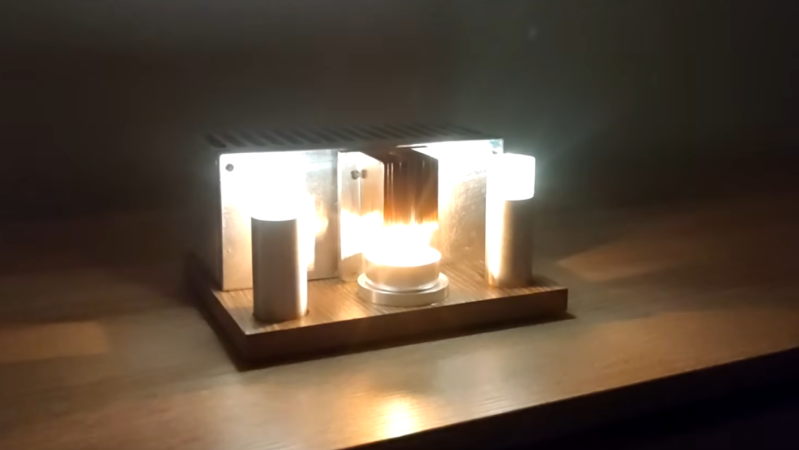
For a little over two thousand years, the primary light sources after the sun had set were oil lamps and candles. This was well before the age of fossil fuels, so these oil lamps were often fueled with a labor-intensive agricultural product like olive oil. Candles were similarly difficult to make, made from tallow, beeswax, or even butter. Labor and materials costs aside, though, there’s a surprising amount of energy in these fuels and [Maciej Nowak Projects] has a generator that help these ancient light sources generate some electricity on the side.

The generator is based around a piece of technology called a thermoelectric generator (TEG), which produces a voltage potential when placed in a temperature gradient. These aren’t new technologies, but their typically low efficiencies limit where they can be effectively used. In this case, however, [Maciej Nowak] has gone to great effort to boost this efficiency as high as possible by using a huge radiator on the cool side of the TEG and another one on the hot side, which in this case is heated by a small tea candle. The electricity produced is sent to a tiny DC converter which regulates the voltage to 3.3V, which then powers two custom-built pedestal lamps on either side of the TEG, each with a high-efficiency LED mounted to a custom-made circuit board.

Although this is certainly not the first time a TEG has been set up to run a small lighting system, we do appreciate this one for its polish, design, and high efficiency. It would make a fitting addition to anyone’s emergency power outage kit as it really increases the amount of available light produced from any given candle. When taken to the extreme, though, thermoelectric generators can be made to produce a surprising amount of energy, provided they are placed in the right environment.

Continue reading “A Candle-Powered Light”

Exclamation Point Indicates Worthy Notifications

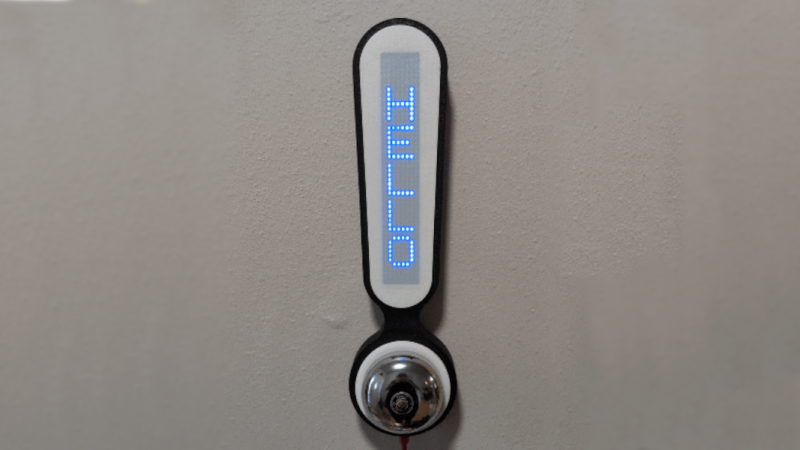
As far as punctuation goes, the exclamation mark is perhaps the most eye-catching of the bunch. That’s why [Conrad Farnsworth] thought this form would be perfect for his Home Assistant notifier build. 

The key to this build is the large bi-color printed housing in the shape of an exclamation mark. It makes for an attractive wall-hanging, but it also perfectly serves the purpose [Conrad] had in mind. Inside the enclosure is an ESP32, hooked up to a string of 16×8 LED matrixes which are commanded over I2C. These sit behind a white panel in the enclosure to nicely diffuse the light and make their output more readable. The ESP32 displays notifications on the LEDs that are fed from Home Assistant, such as when the mailbox sensor is triggered or if a vehicle is detected in the driveway. There’s also a bell on the unit to provide audible notifications, which us dinged with a solenoid fired via a 2N2222 transistor switching a 12 volt supply from a boost converter.

It’s a neat build that fits nicely into [Conrad]’s daily life and appears to have some genuine utility. If you’re looking for other ways to neatly display notifications where you can see them, you might consider whipping yourself up a smart mirror.

Continue reading “Exclamation Point Indicates Worthy Notifications”