Aquarium Automation Keeps The Fish Fed And The Lights On

fish-tank-automator

Anyone who owns a fish tank knows that a good amount of care is required to keep fish happy, healthy, and most of all – alive. [Vicente Jiménez] usually has no problem keeping up on the day to day maintenance such as feeding and switching the tank light, but he wanted to automate these processes for times when he can’t be home to take care of the fish (Translation).

His aquarium automation project is meant to cover three separate parts of the operation: light control, feeding, and pump regulation during feeding times. [Vincente] picked up an STM8L Discovery board to control his system, which enabled him to easily control the automation of all three.

He constructed the feeding mechanism using an old cassette player motor, which turns his food drum (an old film canister), twice a day at specified feeding times. Before the drum is turned to dispense food, the STM8L turns off the aquarium’s pump via a relay to ensure it doesn’t get clogged in the process. During the day he keeps the tank illuminated, but once night falls, the microcontroller shuts the lights off so the fish can get their rest.

There’s no video of the system in action, but [Vincente] has detailed its construction pretty thoroughly in his blog, so be sure to check it out if you are in need of something similar.

Conway’s Game Of Life In HD

We’re going to have to take [Mike’s] word for it that he built Conway’s Game of Life with high-definition video output. That’s because this screenshot is his only proof and it looks a bit fuzzy to us. But we are interested in the project which used an FPGA to generate a 1080p VGA output of the classic programming challenge.

One of the biggest benefits of using an FPGA for this application is the hardware’s parallel processing ability. For every frame of the game, the area around each living cell must be analyzed to produce the next evolutionary step. Most of the time this means processing all of the pixels in the playing area, which is the case here. [Mike] is using VHDL to program a Papilio Plus which has a Spartan 6 chip on it. He separated his code into the different components when writing about it. This makes it easy to find the chunks relating to the game if that’s what you’re interested in. If you just want to see how he implemented the VGA interface that’s well documented as well.

If you’re not familiar, Conway’s Game of Life has simple rules regarding when a cell will live, die, or be reborn. As [Mike] points out, every programmer should give it a shot at some point. We’ve seen many iterations from the very large to the very small.

Board Lets You Know When To Hold ’em; Know When To Fold ’em

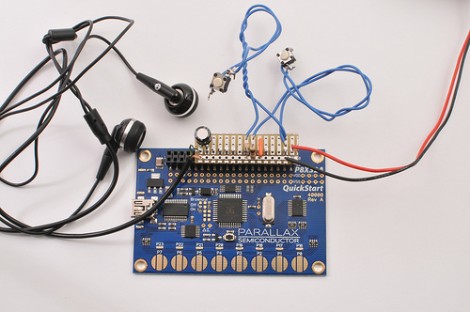
Don’t mind me, I’m just listening to some tunes during our poker game. Well, that and getting some electronic coaching about poker odds. This board lets you wiggle your toes to input the upcards, and those in your hand. After each entry the gadget will tell you your odds of winning the hand. Take it easy with this kind of stuff, if Rounders was at all realistic, getting caught cheating is a painful mistake.

The thing we find interesting about the system is that it doesn’t use a stored odds database. Instead, the Propeller chip runs a simulation of 1000 hands of poker based on the cards you have entered and uses the results to calculate the odds. [Nick] says that this runs quickly because he’s using multiple cores for the calculations, and it cuts down on the data that the device needs to have on board. Right now the feedback uses a text-to-speech generated voice, but you can customize the audio clips if you’d like. Check out a demo of the device in the clip after the break.

Not looking to get the beat down for cheating? Here’s a poker tournament timer that we assure you is on the up-and-up. Continue reading “Board Lets You Know When To Hold ’em; Know When To Fold ’em”

Experimenting With 8-bit Graphics

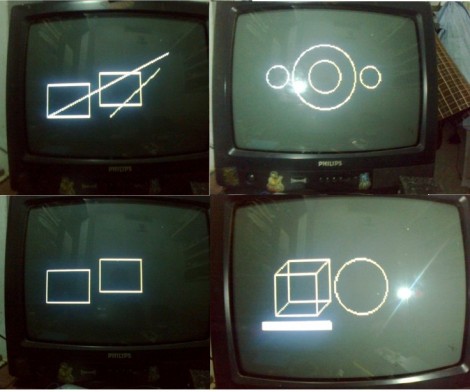
[Vinod] has done a lot of work with microcontrollers, but this is his first try at displaying graphics using composite video. He had a small PAL television on hand, and an ATmega32 which just needs a stable clock source and a few resistors to get things going.

There are a lot of other hacks around that use composite video out with microcontrollers. But this is a ground-up approach which will help you understand the concepts behind these graphics. [Vinod] started by calculating the possible resolution. He needs to hold a frame buffer in memory, and since his chip has just 2 kilobytes of SRAM this will be the limiting factor. He settled on a display area of 128 by 64 pixels. This divides evenly by 8 so he’s not wasting any bits, and it totals 1k, leaving half of the SRAM for use in calculating the shapes which populate the buffer. An interrupt service routine runs ever 64 microseconds to feed data for each line of the display.

With the scanning in place, he moved on to fill the frame buffer. Two functions are used, one which sets a pixel the other clears a pixel. He compares these to using a pencil and an eraser. By calling these functions from his main program he is able to draw lines, boxes, and circles. A bit of creative looping and he’ll have animations as well, but that’s a concept for a different post.

Veronica Gets VRAM And Its Own Boot Logo

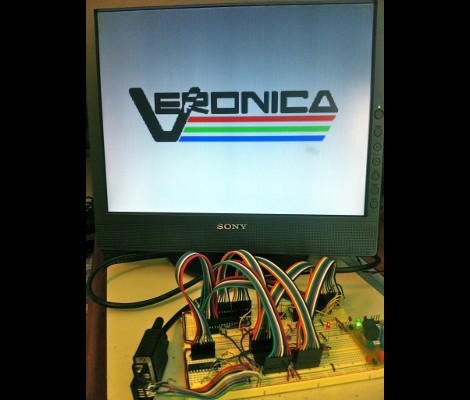
[Quinn Dunki] just reported in on the latest iteration in her computer project which is called Veronica. This time she added RAM to increase the VGA performance of her build. Like just about every other part of the project, [Quinn] knew what she wanted to do, but had to overcome a lot of issues along the way.

The goal is to implement a 256×240 display with 8-bit color depth. [Quinn] says this is on par with game console technology from the 1980’s. The problem is that the 10MHz AVR controller can’t really keep up with the scan rate of this size of display. The answer is to add RAM which stores all of the color data, the microcontroller will simply advance the address pointer on the memory chips to match the sync rate of the VGA output.

After hooking up her hardware design she gets a screen full of uninitialized pixel data. But moving from there to the final product seen above was quite frustrating. It turns out that noise on the breadboard was most of the problem, further compounded by entire breadboard row which wasn’t contacting the wires to make the temporary connections. A bit of jockeying for position and by Jove, she’s got a boot screen.

That breadboard sure has become crowded since her first VGA experiments.

Resizable ARM Dev Board; Just Take Some Off The Top

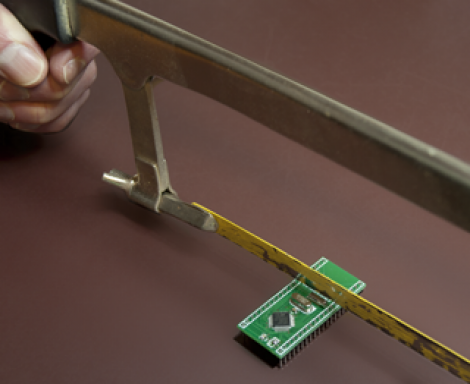
[Bob Alexander’s] most recent project is a hack saw resizable ARM breakout board. He wanted to start using more ARM microcontrollers in his projects and went for a breadboard friendly design. It uses a 40-pin dip package, but if you need the horsepower but not the I/O you can literally cut it down to size. We might recommend grabbing some tin snips, which can cut through a PCB like butter, but to each his own.

The board is based around an STM32 chip. You’ll find a crystal oscillator for the system clock, and a clock crystal if you need it. On the other side of the chip he included a footprint for a voltage regulator. This setup provides a remarkable range of input voltages, accepting from 2 to 3.6 volts without the regulator, and up to 16 volts if the regulator is present. He designed a package footprint that can be easily bridged if there’s no SMD part there. Just make sure you insulate that pad if you are using one with a conductor on the bottom. He explains this in detail in his writeup.

You’ll need a programmer to work with the board. He uses an STM32 Discovery Board for this but there are quite a few other options out there too.

Apartment Entry Morse-code Lock

[Bozar88] lives in an apartment building that has a buzzer at the front security door. Guests find your name on the panel next to that door, and press a button to ring the phone just inside the entry of each apartment unit. He decided to extend the built-in capabilities by adding a morse-code entry password which unlocks the security entrance automatically (translated).

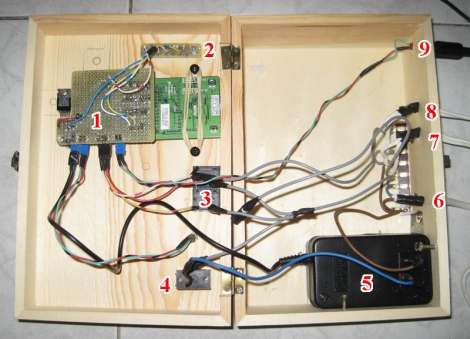
He designed a circuit and etched his own board which fits nicely inside of the wall-mounted phone. It uses an ATtiny2313 to implement the coding functions. The device attaches to the intercom line in order to detect incoming button presses from the entry panel. There’s some protection here to keep the signal at or below 5V. The output is two-fold. The microcontroller can drive the microphone line using a transistor, which gives the user audio feedback when the code is entered. To unlock the door an opt-isolated triac (all in one package) makes the connection to actuate the electronic strike on the entry door.

The video after the break is not in English, but it’s still quite easy to understand what is being demonstrated.

Continue reading “Apartment Entry Morse-code Lock”