A Structural PVC Cyr Wheel

PVC is a great building material that can be used for everything from yurts and geodesic domes to pressure vessels. One thing we haven’t seen a lot of is bending PVC pipe. [Lou] wanted to build a Cyr wheel for his daughter, and instead of shelling out five hundred big ones for an aluminum version, he build one out of PVC using techniques usually reserved for woodworking.

A Cyr Wheel is usually a large aluminum hoop built for acrobatic performances. These performances are pretty impressive and look like a lot of fun, but the wheels themselves are rather expensive. Figuring PVC was a good enough solution, [Lou] built his own Cyr wheel for $50 in materials.

The build started off by laying out a jig on the floor. Two sheets of plywood were laid out, a radius for the wheel traced, and a bunch of blocks were glued to the perimeter of this mold. With the mold in place, a few pieces of PVC were flexed into position, clamped, heated with a hair dryer to relieve stress, and glued to a second course of PVC.

The process [Lou] used to build his Cyr wheel isn’t that different from extremely common woodworking techniques. In fact, it wouldn’t be unreasonable for [Lou] to build a wooden Cyr wheel with the same jig. We’re wondering how well this project will stand up to abuse, so if you have any insight to the uses of structural PVC drop a note in the comments.

Old School Analog Meters Tell You The Weather

A home weather station is great geek street cred. Buying a commercially available station will get you all the bells and whistles, but the look tends to the utilitarian. And then there’s the trouble of placing the sensor array somewhere. To solve both problems, [GradyHillhouse] built this unique weather station with analog meters.

Based on a Particle Photon pulling weather data from the forecast.io API, values for temperature, pressure and the like are sent to analog IO pins. Each pin has a meter with a trimmer pot for calibration and a custom printed label. There’s also a digital output that goes high when a severe weather alert is posted; that drives an LED behind the bezel of one of the meters. Everything is mounted in a walnut plaque which makes for a nice presentation. The video after the break details the build.

As you can imagine, we’ve featured lots of weather stations before. Some display their data on a screen, some in more unique ways. But we really like the old school look and simplicity of this project.

Continue reading “Old School Analog Meters Tell You The Weather”

El Cheapo Phased-Array Sonar

Sonar is a great sensor to add to any small-scale robot project. And for a couple bucks, the ubiquitous HC-SR04 modules make it easy to do. If you’ve ever used these simple sonar units, though, you’ve doubtless noticed that you get back one piece of information only — the range to the closest object that the speaker is pointing at. It doesn’t have to be that way. [Graham Chow] built a simple phased-array using two SR04 modules, and it looks like he’s getting decent results.

PB211200The hack starts out by pulling off the microcontroller and driving the board directly, a hack inspired by [Emil]’s work on reverse engineering the SR04s. Once [Graham] can control the sonar pings and read the results back, the fun begins.

[Graham] uses TI’s Cortex M4F LaunchPad eval kit to generate a ping and receive the reflections. With normal sonar, the time between the ping being sent and its reception is determined by the range to the target. In a phased array, in this case just the two modules, the difference in the times it takes for the ping to return to each module is used to determine the angle to the target.

phased_array_sonar_tableau

If you’re DSP-savvy, [Graham] is using a phase-shifted square wave signal so that the correlations of the sent and returned signals have better peaks. This also helps the peaks in correlation across the two SR04s in the array. We think it’s pretty awesome that [Graham] is resolving a couple of degrees in angular separation when he moved his wine bottle. With a couple more SR04 units, [Graham] could start to get height information back as well.

For not much scratch, [Graham] has himself an experimental setup that lets him play with some pretty heavy signal processing. We’re impressed, and can’t wait to see what’s next. Special thanks to [Graham] for posting up the code.

And thanks [João] for the tip!

3 Nerds + 2 Days = Little Big Pixel

Two days at a company sponsored hackathon? Sounds like fun to us! And productive too – the end result for [GuuzG] and two of his workmates from their company’s annual “w00tcamp” was this festive and versatile 16×16 pixel mega display.

From the sound of it, [GuuzG] and his mates at q42.com are not exactly hardware types, but they came up with a nice build nonetheless. Their design was based on 16 WS2812 LED strips for a 256 pixel display. An MDF frame was whipped up with cross-lap joints to form a square cell for each pixel. Painted white and topped with a frosted Plexiglass sheet, each RGB pixel has a soft, diffuse glow yet sharply defined borders. Powered by a pair of 5A DIN rail DC supplies and controlled by a Raspberry Pi, the finished display is very versatile – users can draw random pixel art, play the Game of Life, or just upload an image. [GuuzG] and company are planning to add Tetris, naturally, and maybe a webcam for fun.

We’ve seen lots of uses for the ubiquitous WS2812 LEDs, from clocks to Ambilight clones to ground-effect lighting for an electric skateboard. But if you’re in the mood for a display that doesn’t use LEDs, there’s always this multithreading display.

[via Reddit]

How Store Anti-Theft Alarms Work: Magnetostriction

Now that’s uncanny. Two days before [Ben Krasnow] of the Applied Science YouTube blog posted this video on anti-theft tags that use magnetostriction, we wrote a blog post about a firm that’s using inverse-magnetostriction to generate electricity. Strange synchronicity!

[Ben] takes apart those rectangular plastic security tags that end up embarrassing everyone when the sales people forget to demagnetize them before you leave the store. Inside are two metal strips. One strip gets magnetized and demagnetized, and the other is magnetostrictive — meaning it changes length ever so slightly in the presence of a magnetic field.

A sender coil hits the magnetostrictive strip with a pulsed signal at the strip’s resonant frequency, around 58kHz. The strip expands and contracts along with the sender’s magnetic field. When the sender’s pulse stops, the strip keeps vibrating for a tiny bit of time, emitting an AC magnetic field that’s picked up by the detector. You’re busted.

The final wrinkle is the magnetizable metal strip inside the tag. When it’s not magnetized at all, or magnetized too strongly, the magnetostrictive strip doesn’t respond as much to the sender’s field. When the bias magnet is magnetized just right, the other strip rings like it’s supposed to. Which is why they “demagnetize” the strips at checkout.

We haven’t even spoiled [Ben]’s explanation. He does an amazing job of investigating all of this. He even measures these small strips changing their length by ten parts per million. It’s a great bit of low-tech measurement that ends up being right on the money and deserves the top spot in your “to watch” list.

And now that magenetostriction is in our collective unconscious, what’s the next place we’ll see it pop up?

Continue reading “How Store Anti-Theft Alarms Work: Magnetostriction”

The LED Roundsystem

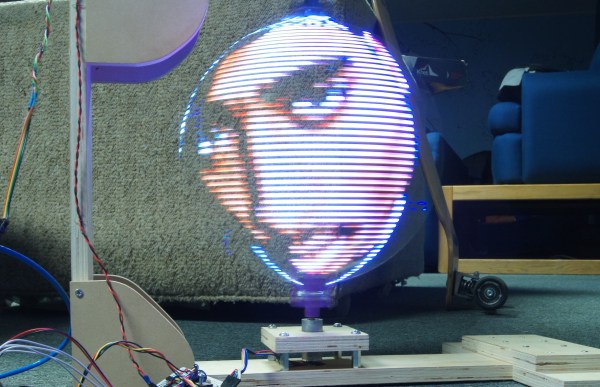
Gavin Morris has been working on his awesome sound responsive LED sculptures for a while. Technically the sculpture is an interesting application of WS2812 RGB LEDs, Raspberry Pis and a load of styrofoam cups and flower pots. However the artistic development, and inspiration for this project is equally interesting. Gavin shares his thoughts and a brief technical description of the project below.

Continue reading “The LED Roundsystem”

Listening To The Sounds Of The Earth

A geophone is a specially built microphone for listening to the Earth. [JTAdams] found them at a reasonable price so bought some to play with. A geophone is used to detect vibrations from earthquakes, explosions, rumbling trucks, and vibroseis vehicles. To be useful it needs an amplifier and a recording device to capture the signals.

24

[JTAdams] used a standard amplifier design for an LT1677 op-amp, fed the signal to an MCP3008 A/D converter, and read the output using a Raspberry Pi. A Python script records the data to a CSV file for processing. The Pi worked well because the entire setup needs to be portable to take into the field. Another Python script plots the data which is made available from a web page. A neat simple way of presenting the raw data. [JTAdams] promises more information in the future on post-processing the data. You don’t need a geophone to detect seismic waves if you build your own, but a real ‘phone will be more rugged.

Oh, what’s a vibroseis? It’s a truck with a big flat plate underneath it. The plate is hydraulically lowered to the ground until the weight of the truck is on it. The truck then causes the plate to vibrate, usually sweeping from around 10 hz to 100 hz. This infrasound pass through the ground until it is reflected back by underlying rock layers. A long string of geophones, think 1,000s of feet, detects the waves, which are recorded. In practice, many trucks are used to generate a synchronized signal of sufficient strength. Or, you can set off an explosion which is the technique used in water. Typically the information is used for oil and gas exploration.  A video of one of the trucks in action after the break.

Continue reading “Listening To The Sounds Of The Earth”