Robot Nerf Alarm Blasts You Awake With Foam

The sentry gun targets [Vinnie] with blasts of foam as he runs through the bedroom to the sounds of Your New Morning Alarm by [Marc Rebillet].
Waking up is hard; sometimes you need more than a little chiming alarm to get you out of bed. When [Vinnie Satriale] started unconsciously switching his alarms off, he went all out, deciding to build a Nerf sentry blaster to wake him up instead. 

A Nerf Rival Nemesis MXVII-10K flywheel blaster is the core of the build, with a 100-round capacity of soft foam balls. Stepper motors are used to control a pan and tilt system to aim the blaster. It’s moved under instruction from a Raspberry Pi that uses machine vision algorithms running on a Coral USB accelerator to track targets in the bedroom. A relay board is then used to activate the blaster’s firing action, blasting any targets until they wake up.

[Vinnie] had plenty of fun during build, also showing the sentry gun off to his coworkers in the office. It’s a hard sentry to dodge, with the machine vision algorithm using a full-body tracking model, so merely covering one’s face won’t be enough to get away.

We’ve seen all kinds of sentry guns over the years, from those firing rubber bands to others spraying jets of water. Video after the break.

Continue reading “Robot Nerf Alarm Blasts You Awake With Foam”

Coin Sorter Is Elegant And Beautiful

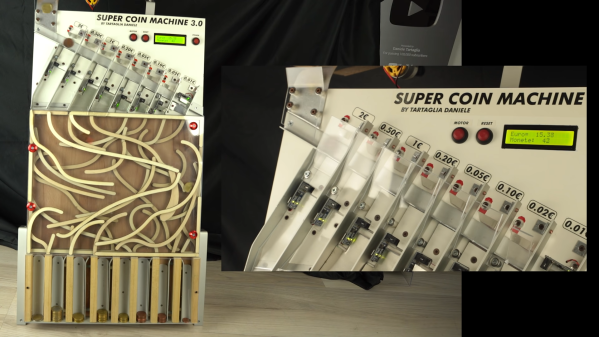
Counting change is a great way to teach children about mathematics and money, but it grows tiresome for those of us that have passed the first grade. Thus, a machine should the job, as [Daniele Tartaglia] demonstrates.

A vibrating motor is used to shake a hopper full of coins, letting them fall through a feeder slot into the machine at a steady rate. They then go through a size-based sorter, which flicks the coins into a different channel depending on their physical dimensions. The coins are counted via infrared sensors wired up to an Arduino, and then pass through a rather lovely maze on their way down to sorting bins at the bottom of the machine.

It’s a tidy build, and a great thing to have if you regularly find yourself needing to count change. We haven’t seen too many coin counters before, but we have seen a laundromat given an overhaul with some hacker skills. Video after the break.

Continue reading “Coin Sorter Is Elegant And Beautiful”

Ride-on Tracked Vehicle Is A Stout Metal Build

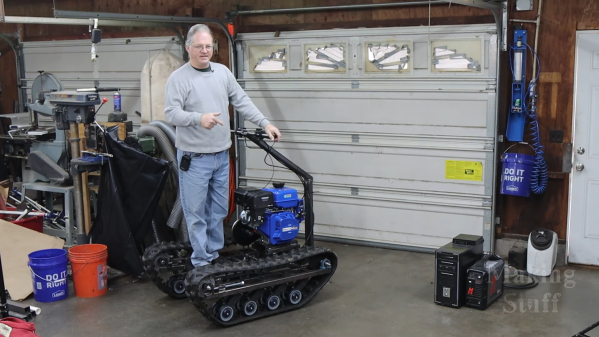
When we think of tracked vehicles, we normally think of tanks, or perhaps heavy construction machinery. Meanwhile the average member of the public is left out of the fun. [Bob] of [Making Stuff] won’t be one of them, however, having put together a ride-on tracked vehicle for his own enjoyment.

The machine is welded together from plenty of steel, making it more than tough enough to soak up the punishment of off-road duty. The design features four suspended buggy wheels on either side running inside rubber tracks, with a cogged drive wheel at the front. Propulsion is thanks to a 440 cc DuroMax engine good for a full 18 horsepower and 26 ft-lbs of torque, driving the tracks through a differential mounted up front.

The design has one major issue at the moment. The heavy engine is mounted ahead of the front wheel inside the tracks, which means the vehicle wants to nosedive at the slightest provocation. Such an event would be highly uncomfortable for the rider, so mods are needed, either by scooching the engine back a little or pushing the wheels forward.

We look forward to seeing [Bob] fix the issues and get the machine driving soon. We’ve seen other tracked builds before, too – often on the smaller scale. Video after the break.

Continue reading “Ride-on Tracked Vehicle Is A Stout Metal Build”

N-scale model railroad hidden in wall art

Hidden Model Railroading Taken To The Nth Scale

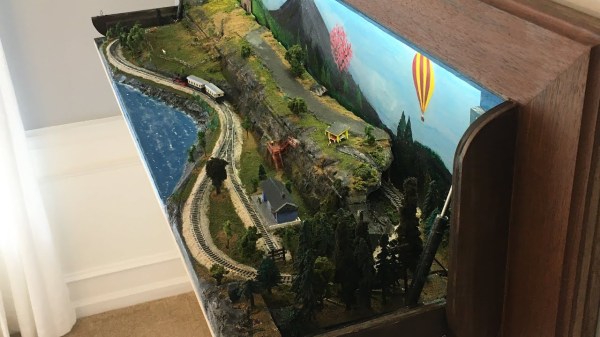
Most of us would be pretty happy with ourselves if we made one of those neat “epoxy river” types of art for our home. Not so with prolific maker [Peter Waldraff]. [Peter] is a skilled craftsman with a penchant for hiding model railroads in everyday furniture and fixtures. To this end, he’s created what he calls the Hidden Epoxy Railroad, which you can see in the video below the break.

The project starts with basic woodworking to build the frame, hinges, and the hinged epoxy river with its colored epoxy pour. Instead of stopping there, [Pete] continued by building a full N scale model railroad into the piece. The frame doubles as a backdrop complete with a beautifully painted scene with what we’re guessing is an N scale hot air balloon, too.

Of course, the skeptics among us might doubt whether the model railroad is fully hidden when closed. But one detail that Pete shared with us is that his wife never knew about the train portion of the build until their daughter pointed it out. She thought it was merely a piece of art for the dining room. Truly a great hack!

The entire build is documented on [Pete]’s YouTube channel, with its own 15 part build series. It’s definitely worth checking out. We’ve covered one of [Pete]’s hidden railroad builds before, so make sure you check that out, too!

Continue reading “Hidden Model Railroading Taken To The Nth Scale”

WiFi bird box with phone showing video of a rubber ducky

Building A WiFi-Enabled Bird Box On The Cheap

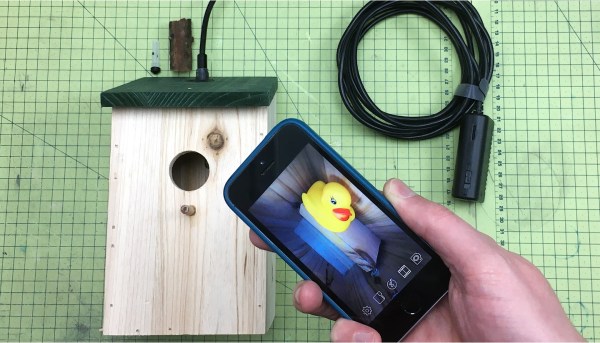
[Jude] was looking for a fun DIY project for him and his son and thought that a bird box might be a good option. He wanted to equip the box with a WiFi camera so he could watch his little guests from his phone but didn’t find any suitable, inexpensive, commercially-available options. So with that, he built one himself.

He did, however, start with a generic bird box, which he bought online, and then modified with his particular features of interest. He wanted the project to be scalable so after-school programs and other kids clubs could easily implement his design within a classroom setting. He figured minimizing the woodwork would make the project easier for children.

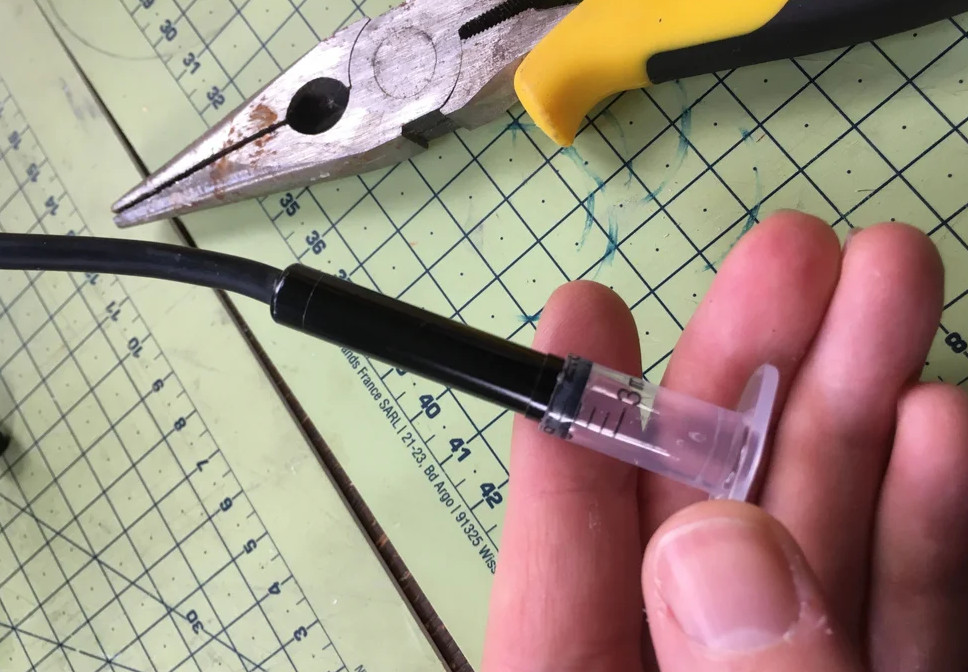
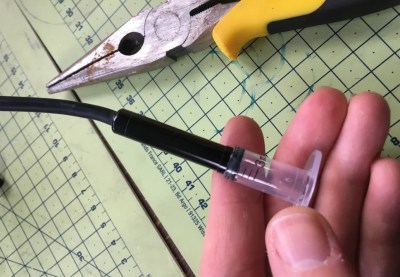
He added a dowel to the generic bird box he bought online, but cautions that readers need to investigate if a dowel would attract invasive species in their area. He found a relatively inexpensive WiFi-enabled endoscope that he noted was far more affordable than the camera-equipped, commercially-available bird boxes he found earlier. He craftily used a plastic syringe as a waterproof spy hole that housed the endoscope, allowing him to easily slip the camera in and out of the bird box without disturbing its occupants. He noted that the 3 mL syringe had the perfect inner diameter to fit the endoscope rather snugly.
[Jude] doesn’t intend to have the endoscope active 24/7, so he needed a way to seal the access hole when the camera was not in use. His many years at Dyson taught him that implementing a removable, water-tight, rubber seal is not as easy as people may think. Fortunately, the rubber stopper at the tip of the syringe’s plunger was naturally a perfect removable seal and he could use it to plug the access hole when the endoscope was not in use.

The endoscope was mostly waterproof, except for the WiFi transmitter, so [Jude] needed to place that end of the device in a waterproof enclosure. He said these are often called “IP rated” enclosures and he figured these could come in handy for any number of outdoor electronics projects so we imagine this might come in handy for a lot of our readers as well.

Mother nature has certainly inspired many projects here at Hackaday and [Jude]’s bird box is no exception. Cool project!


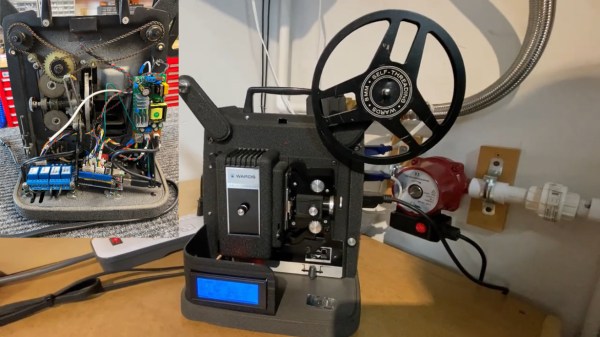
This film projecter is hiding an Arduino Uno that controls a water-based cooling system.

Cool The Shop With A Thermal Battery-Based System

Having any kind of shop is pretty great, no matter how large it may be or where it’s located. If the shop is in an outbuilding, you get to make more noise. On the other hand, it will probably get pretty darn hot in the summer without some kind of cooling system, especially if you don’t have a window for a breeze (or a window A/C unit).

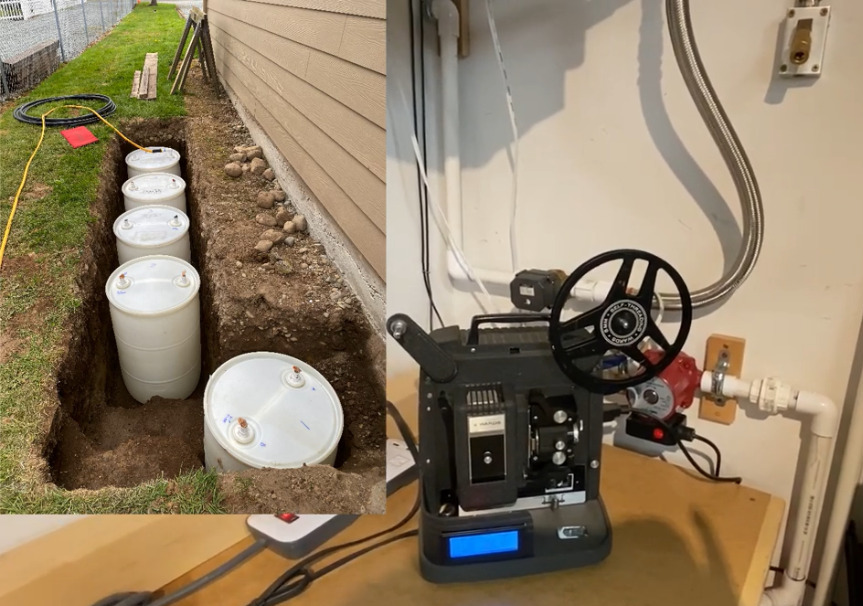
Five 55-gallon tanks of tap water are buried just outside the shop.[Curtis in Seattle] built an awesome thermal battery-based cooling system for his shop. The battery part consists of five 55-gallon drums full of tap water that are connected in series and buried a foot underground, about two feet out from the wall. There are two radiators filled with water and strapped to 20″ box fans  — one inside the shop, which sends heat from the shop into the water, and another outside that transfers heat out of the water and into the cool night air. Most summer days, the 800-square-foot shop stays at a cool 71°F (21.7°C).

We love that the controls are housed in an old film projector. Inside there’s an Arduino Uno running the show and taking input from four DS18B20 one-wire temperature sensors for measuring indoor, outdoor, battery, and ground temperatures. There are four modes accessible through the LCD menu — idle, cool the shop, recharge mode, and a freeze mode in case the outside temperature plummets. Why didn’t [Curtis in Seattle] use anti-freeze? It’s too expensive, plus it doesn’t usually get that cold. (Although we hear that Seattle got several inches of snow for Christmas.) Check it out after the break.

If you can’t just go burying a bunch of 55-gallon drums in the ground where you live, consider building a swamp cooler out of LEGO.

Continue reading “Cool The Shop With A Thermal Battery-Based System”

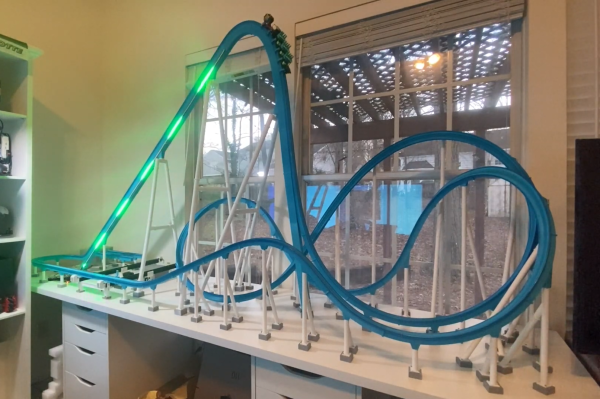
A model roller coaster

3D Printed Model Roller Coaster Accurately Simulates The Real Thing

While they don’t give the physical thrill of a real one, model roller coasters are always fun to watch. However, they actually make a poor analog of a full-sized ride, as gravitational force and aerodynamic drag don’t scale down in the same way, model roller coasters usually move way faster than the same design would in the real world. [Jon Mendenhall] fixed this deficiency by designing a model roller coaster that accurately simulates a full-sized ride.

The track and cart are all made of 3D printed pieces, which altogether took about 400 hours to print. The main trick to the system’s unique motion is that the cart is motorized: a brushless DC motor moves it along the track using a rack-and-pinion system. This means that technically this model isn’t a roller coaster, since the cart never makes a gravity-powered drop; it’s actually a small rack railway, powered by a lithium-ion battery carried on board the cart. An ESP32 drives the motor, receiving its commands through WiFi, while the complete setup is controlled by a Raspberry Pi that runs the cart through a predetermined sequence.

The design of the track was inspired by the Fury 325 roller coaster and simulated in NoLimits 2. [Jon] wrote his own software to generate all the pieces to be printed based on outputs from the simulator. This included all the track pieces as well as the large A-frames holding it up; some of these were too long to fit in [Jon]’s 3D printers and had to be built from smaller pieces. The physics simulation also provided the inputs to the controller in the form of a script that contains the proper speed and acceleration at each point along the track.

The end result looks rather slow compared to other model roller coasters, but actually feels realistic if you imagine yourself inside the cart. While it’s not the first 3D printed roller coaster we’ve seen, it’s probably the only one that accurately simulates the real thing. If you’re more interested in a roller coaster’s safety systems, we’ve featured them too.

Continue reading “3D Printed Model Roller Coaster Accurately Simulates The Real Thing”