An Instrument That Plays Along With You

muse

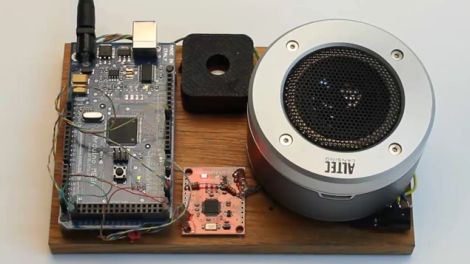
The crew over at Teague Labs was talking about musical instruments and how digital music creation seems to get bogged down under user interfaces littered with increasing numbers of buttons, knobs, and sliders. They decided to build a musical device that has its own musical inclinations and personality, while also allowing for two-way interaction with the user.

The resulting creation is Muze, a simple musical instrument with only a single user input. Muze has been programmed with a palette of notes that it can combine and remix into a nearly infinite number of musical combinations. Muze is perfectly happy composing on its own, and will create music that evolves over time, if left alone long enough.

As with all musicians, not every tune is a hit, so Muze can be gently nudged away from cacophonous melodies with a simple twist of a knob. Each of the device’s knobs represent a blend of functions, which are used to influence Muze when placed on the board. The interaction does not send Muze flying into a completely different direction, rather it tells Muze to shake things up a little bit, much like you would ask your guitarist to pick up the tempo during a jam session.

It’s a neat little instrument, and we can imagine it would be a big hit with kids and adults alike. Keep reading to see a video demonstration of Muze in action.

Continue reading “An Instrument That Plays Along With You” →

The Jazari Robotic Jazz Enesmble

As anyone who’s been to Chuck E Cheese’s knows, robotic bands have been under development for years. Patrick Flanagan’s cyborg percussion ensemble, Jazari seems to take things to a new level.

As Patrick describes it, Jazari “fuses African rhythms,
algorithmic composition, computer music, and electro-mechanics into
beat-driven steamfunk.”  The controls are quite unique as well.  Originally, the controller was simply a Wiimote. This was limited, since one needs three fingers to hold on to it, so a new “springbok” device was born allowing all five fingers to be used to play music.  The vocal part of the music is created using an Android program called “voloco”.

The video after the break should explain everything a little better, and the music itself is pretty cool.  Patrick will be doing more programming and hardware work over the summer rather than touring much, but “they” should give an awesome concert once all the bugs are worked out. Continue reading “The Jazari Robotic Jazz Enesmble” →

ChipKIT Sketch: Mini Polyphonic Sampling Synth

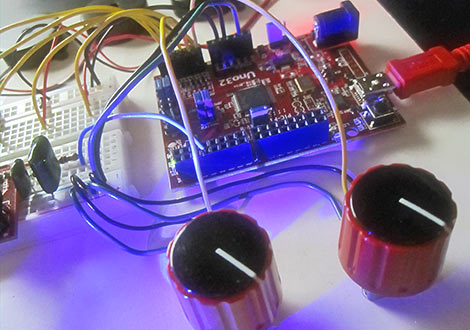
In our hands-on review of the Digilent chipKIT Uno32, we posed the question of what the lasting appeal might be for a 32-bit Arduino work-alike. We felt it needed some novel applications exploiting its special features…not just the same old Arduino sketches with MOAR BITS. After the fractal demo, we’ve hit upon something unique and fun…

Continue reading “ChipKIT Sketch: Mini Polyphonic Sampling Synth” →

Million Volt Guitar Rocks The House…for Science!

science_brothers_tesla_hero

[Bill Porter] and his friend [Dan Flisek] work together to put on a science-related educational stage show called “Science Brothers”, in which the pair try to convince school children that their field of expertise is the cooler science. While the two are competitive on stage, the main goal of the program is to get kids interested in science, no matter what the specialty.

The pair currently finance the project out of pocket, so they are always looking for ways to make things interesting while also keeping costs in check. With that in mind [Bill] came up with an awesome way to show off the Tesla coil he built a while back. His most recent educational creation is a little something he calls “Tesla Hero”.

Since he already had a solid state Tesla coil hanging around, he dug up a PS2 Guitar Hero controller and got busy getting the two acquainted. The guitar connects to the coil via a fiber optic isolator board, playing one of five notes as he strums along. A series of Arduino-driven LED strips adorn the guitar, flashing various colors while he plays, as you can see in the video below.

It’s quite a cool project, and we’re sure that his audience will be impressed!

Stick around to see a video of  Tesla Hero in action, and if you’re interested in learning more about the Science Brothers, be sure to check them out here.

Continue reading “Million Volt Guitar Rocks The House…for Science!” →

Archaeopteryx: A Large, Colorful MIDI Controller

This is [Robert Jarvis’] new MIDI controller which he has christened the Archaeopteryx. It makes its home (quite nicely might we add) in a discarded wooden cutlery case. This provides a strong and stable base for the controls while keeping the electrical connections close at hand for any rewiring or repair work.

The interface is made up of several different input devices. The guts from two Korg Nanokontrols donated the sliders and pots. These are both USB devices and they join with a USB keyboard which has been rewired to work with the colorful push buttons. All three devices connect to a hub inside which makes the device work using just one cable connection to the computer.

There’s a lot of wiring shoved into that shallow case. But if he keeps the keyboard mapping straight we think it won’t be too hard to configure the device. We like it that [Robert] included a snapshot of the back-of-the-envelope prototyping plans he made. This kind of ‘how I got there’ information is what we’re looking for when choosing projects to feature.

Sinister Tone Generator Brings The Bass

sinster_tone_generator

[RichDecibels] wrote in to share a new device he built called the “Sinster Tone Generator”. It’s basically a bass drone synthesizer that uses two pairs of heterodyning oscillators to generate the output. If you swing by his site, he has a long audio demo of the device in action with a bit of reverb and filtering applied to enhance the sound. After listening, we agree that it sounds pretty sinister!

The device is relatively small and handsomely packaged in a plastic project box he had custom cut by Ponoko. [Rich] says that this particular unit is a one-off that he has produced for a charity auction, and that bidding is open through Sunday if you really want to get your hands on it. If you happen to have the time to build one yourself, he has uploaded schematics and layout files to his site (as usual), so feel free to stop by and grab a copy.

Modular Synthesizer Is Rack-mounted And Reconfigurable

[Dirk] let us know about this fantastic music synthesis experimentation setup (translated). Turn your computer speakers off (to avoid the auto-playing music when every page loads) and dig into the wealth of information in this repository. Literally dozens of modules have been built and superbly mounted on a rack system. Each can be connected with other modules into an incredible number of different setups using patch wires that terminate with banana plugs.

The module enclosures themselves are made to fit in a standard 19″ rack. The front bezels were designed in CAD, with the rest of the housing made mostly of aluminum. Since each module tends to be quite small several are ganged into one rack skeleton to save space. You can see in the images above that there are as many as eight modules per rack slice.

You’ll enjoy reading about the many different sound chips that are in use here. But it doesn’t have to end there. If this has whet your appetite for your own rack-mounted system you’re in luck. The download area has schematics, board artwork, and build information for most of the modules.