PVC Pipes Play “Popcorn” Perfectly

There are all sorts of fun ways to make music with empty jugs and other things that resonate with a popping sound when poked with a finger. Should you ever get stuck on that proverbial desert island, you can entertain yourself by making cheerful, staccato music with nothing but a fingertip and the inside of your cheek. At the very least, it will keep your spirits up until you can fashion an ocarina from a coconut.

[Nicolas Bras] loves to make homemade instruments. When he saw all the scrap pieces of perfectly finger-sized PVC tubing piling up around the workshop, he decided to make an instrument specifically to play the effervescent synth tune “Popcorn”. (Video, embedded below.) He plays it by plugging and quickly unplugging wood-capped pipes with his fingers, and using another PVC tube to blow across the tops of them to fill out the orchestration.

[Nicolas] started by making a two-octave chromatic scale with 25 pipes ranging from C4 to C6. He kept building on it from there in both directions, ultimately ending up with a poppin’ 68-note pipe organ that sounds fantastic. If you’re interested in getting the sound samples, [Nicolas] has those and the instrument plans available through Patreon.

Be sure to check out the build and demo video below — it’s a joy to see it come together, and the whole thing clocks in under six minutes. Take our word for it and don’t jump to the “Popcorn” cover, because the build-up is necessary for maximum enjoyment.

Hungry for more “Popcorn”? Here’s a robotic glockenspiel busting out a striking cover.
Continue reading “PVC Pipes Play “Popcorn” Perfectly”

Stochastic Markov Beats

[Attoparsec] has been building intriguing musical projects on his YouTube channel for a while and his latest is no exception. Dubbed simply as “Node Module”, it is a rack-mounted hardware-based Markov chain beat sequencer. Traditionally Markov chains are software state machines that transition between states with given probabilities, often learned from a training corpus. That same principle has been applied to hardware beat sequencing.

Each Node Module has a trigger input, four outputs each with a potentiometer, and a trigger out. [Attoparsec] has a wonderful explanation of all the different parts and theories that make up the module at the start of his video, but the basic operation is that a trigger input comes in and the potentiometers are read to determine the probabilities of each output. One is randomly selected and fired. As you can imagine, there are loops and even dead-end nodes and for some musical pieces there is a certain number of beats expected, so a clever reset signal can be sent to pull the chain back to the initial starting state at a regular interval. The results are interesting to listen to and even better to imagine all the possibilities.

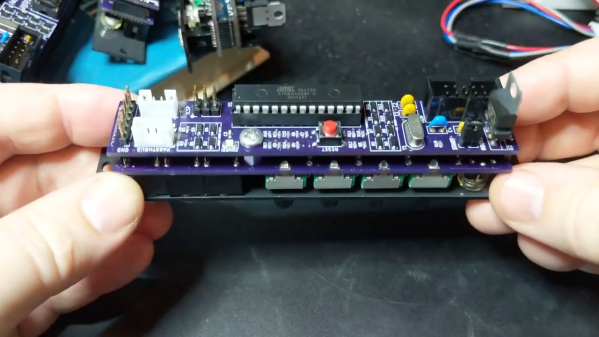
The module itself is an Arduino-based custom PCB that is laid out quite cleanly. The BOM, code, and KiCad files are available on GitHub if you want to make one yourself. This isn’t the first instrument we’ve seen [Attoparsec] make, and we’re confident it won’t be the last.

Continue reading “Stochastic Markov Beats”

12-Note Polyphony On An Arduino Synth

When synthesizers first hit the scene back in the mid-20th century, many were monophonic instruments, capable of producing just one pitch at a time. This was a major limitation, and over time polyphonic synthesizers began to flood into the scene, greatly expanding performance possibilities. [Kevin] decided to build his own polyphonic synthesizer, but far from taking the easy route, he built it around the Arduino Uno – not a platform particularly well known for its musical abilities! 

[Kevin]’s build manages 12-note polyphony, an impressive feat for the ATmega328 at the heart of the Arduino Uno. It’s done by running an interrupt on a timer at a steady rate, and implementing 12 counters, one per note. When a counter overflows, a digital IO pin is flipped. This outputs a square wave at a certain pitch on the IO pin, producing the given note. The outputs of 12 digital IO pins are mixed together with a simple resistor arrangement, producing a basic square wave synth. Tuning isn’t perfect, but [Kevin] notes a few ways it could be improved down the line.

[Kevin] has added features along the way, expanding the simple synth to work over several octaves via MIDI, while also building a small tactile button keyboard, too. It’s a project that serves as a great gateway into basic synthesis and music electronics, and we’re sure [Kevin] learned a lot along the way. We’ve seen other microcontroller synths before too, like this tiny device that fits inside a MIDI plug. Video after the break.

Continue reading “12-Note Polyphony On An Arduino Synth”

Continuous Excitation Piano Machine Looks Nervous, Sounds Grand

It’s not every day we see a grand piano with a Raspberry Pi inside, let alone one with 96 motors, but sometimes we get lucky. The contraption in question is one developed by [Konstantin Leonenko], as part of a collaboration with composer [Patricia Alessandrini] for a piece she created inspired by Ada Lovelace. Specifically, [Patricia] was inspired by Ada’s idea that an “analytical machine” would, someday, be able to create music on its own. [Konstantin] and [Patricia] worked together to make a machine that would learn from it’s human co-performers and create music with them.

Their creation, rather than just one tricked-out keyboard, is actually a portable attachment that can be easily fitted to any grand piano. Each of the device’s 96 motors drives a plastic “finger” that excites the piano’s strings. The result is a sound unlike any other — and you really need to experience it so click through that link at the top for the demo video.

Rather cleverly, the fingers are designed such that their dynamics help to mask the sound of the motor (a must for performances) while simultaneously enhancing the string’s timbre. Like any project, this one went through a number of iterations over the two-year design process, and even spun off into an entirely new, glove-based version.

We’ve seen some awesome music tech hacks, and this one fits right in with the rest. It’s always exciting to see an instrument as ubiquitous as the piano be used in new and refreshing ways. Be sure to check out the link at the top for a video of this incredible instrument in action!

Tiny Motors Enable Experimental Piano Performance

Just when you think you’ve seen every possible way to play the piano, [Alessandro Perini] came up with a new one. In this piece, written for the percussionist [Irene Bianco], hand-held motors become a tangible interface between composer, electronic music equipment, and the performer.

The performance involved ten small disc motors, held above the strings by a wooden frame. The motors are controlled by a Arduino Nano, which turns the motors on or off based on MIDI commands from a computer. However, the performance is not entirely automated. [Irene] wears a pair of contact microphones on her fingers, which she moves around inside the piano to capture the sounds of the strings vibrating in harmony with the motors themselves.

[Alessandro] has been kind enough to share a tutorial on how to recreate the hardware and software behind the performance for those keen to create similar work of their own. As with any musical endeavour, MIDI can always make it better. Video after the break.

Continue reading “Tiny Motors Enable Experimental Piano Performance”

Tonewheels Warble In This Organ-Inspired Musical Instrument

Younger readers may not recall the days when every mall had a music store — not the kind where tapes and LPs were sold, but the kind where you could buy instruments. These places inevitably had an employee belting out mall-music to all and sundry on an electric organ. And more often than not, the organist was playing a Hammond organ, with the distinct sound of these instruments generated by something similar to this tonewheel organ robot.

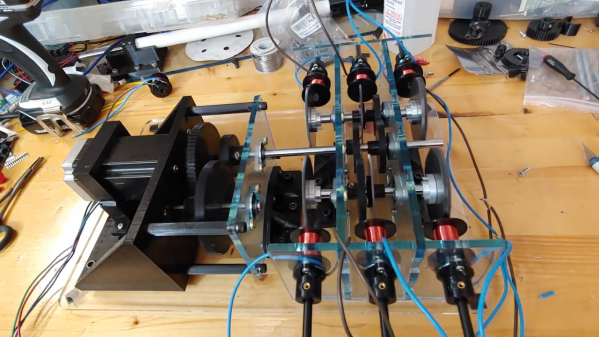
Tonewheels are toothed ferromagnetic wheels that are rotated near a pickup coil. This induces a current that can be amplified; alter the tooth profile or change the speed of rotation, and you’ve got control over the sounds produced. While a Hammond organ uses this technique to produce a wide range of sounds, [The Mixed Signal]’s effort is considerably more modest but nonetheless interesting. A stepper motor and a 1:8 ratio 3D-printed gearbox power a pair of shafts which each carry three different tonewheels. The tonewheels themselves are laser-cut from mild steel and range from what look like spur gears to wheels with but a few large lobes. This is a step up from the previous version of this instrument, which used tonewheels 3D-printed from magnetic filament.

Each tonewheel has its own pickup, wound using a coil winder that [TheMixed Signal] previously built. Each coil has a soft iron core, allowing for the addition of one or more neodymium bias magnets, which dramatically alters the tone. The video below shows the build and a demo; skip ahead to 16:10 or so if you just want to hear the instrument play. It’s — interesting. But it’s clearly a work in progress, and we’re eager to see where it goes. Continue reading “Tonewheels Warble In This Organ-Inspired Musical Instrument”

Simple Slide Whistle Gets A MIDI Makeover

On today’s episode of “Will it MIDI?” we have the common slide whistle. Spoiler alert: yes, it will, and the results are just on the edge of charming and — well, a little weird.

As maker [mitxela] points out, for all its simplicity, the slide whistle is a difficult instrument to play. Or, at least a difficult one to hit a note repeatably. It’s a bit like a tiny plastic trombone, in that both lack keys or stops that limit the vibrating column of air to a specific length. Actually, the beginning of the video below shows a clever fix for that problem on the slide whistle using magnets, but that’s mainly a side project.

[mitxela]’s MIDI-fication of the slide whistle required a bit more than a few magnets. To move the slide to defined positions, a pair of high-precision servos was connected by a laser-cut plywood scissors linkage. The lung-power of the musician is replaced by a small electric blower, mounted away from the whistle and supplying air through a long hose. The fan’s speed, and therefore the speed of the airflow, can be varied; this prevents low notes from shifting up in register from over-blowing, if that’s the right term. Another servo controls a damper that shuts off the flow of air from the mouth of the whistle to control notes without having to turn off the fan completely. The main article goes into detail about the control electronics and the calibration process.

The video has a few YouTube copyright strikes demo songs, and we have to say we’re impressed with the responsiveness of the mechanism. Some will object to the excess servo noise, but we found it nice — almost like guitar string-squeak. We like the tunes where [mitxela]’s servo-plucked music box joined in, too.