Arduino Drums Bring The Noise, No MIDI Required

When looking through existing Arduino drum kit projects, [joekutz] noticed that most of them just used the microcontroller as an input for an existing MIDI device. That’s fine if you’re just looking to build your own hardware interface, but he wondered if it would be possible to forgo the MIDI device completely and actually generate the audio internally.

To be sure, this is a lot to ask of an 8-bit microcontroller, which is probably why nobody does it this way. But [joekutz] wasn’t giving up without a fight. One of the trickiest aspects was storing the samples: the 8-bit, 11.025 KHz mono WAV files ultimately had to be converted into C data arrays with a custom Python script.

Unfortunately, since the samples are essentially part of the drum’s source code, he says distributing the firmware is something of a problem. Though it sounds as though there might be a solution to this soon for those who want to play along at home.

But don’t get the impression that this project is just software. Check out the custom impact sensors lovingly crafted from popsicle sticks and metal cut from soda cans, which have been mated with sections cut out of old DVD-Rs. Actually getting the beats out of the Arduino required the addition of a R2R DAC circuit and a TDA2822 amplifier. In the video after the break, you can hear the results for yourself.

[joekutz] is no stranger to homebrew electronic instruments. When we last heard from him, he was turning a very pink keyboard into his own personal circuit bending playground.

Continue reading “Arduino Drums Bring The Noise, No MIDI Required”

Cheap Speakers Sound Good With Easy Open Baffle Design

If you’ve spent any time around audio gear at all, you’ll know that enclosure design is as critical as the speaker drivers themselves. [Frank Olson] demonstrates this ably, with his open baffle design for some cheap off-the-shelf speakers.

[Frank]’s aim was to do a comparison between using no enclosure, and an open baffle design, with a pair of 2″ full-range speakers. These drivers are nothing special; just a low-cost part that you’d find in any cheap set of computer speakers. [Frank] screws the drivers into a thin, flat wooden board, and then adds a supporting strut to allow the speakers to stand on their own.

The comparison makes it clear that even this basic baffle design makes a big difference to perceived sound quality. Bass is fuller, and the sound is far improved thanks to the baffle blocking out of phase sounds from the rear of the speaker.

It’s a technique that could prove useful to anyone quickly trying to rig up an audio setup for the workshop or makerspace out of leftover parts. We’ve featured similar projects before that espouse the benefit of enclosure design when using even very affordable speakers. Video after the break.

Continue reading “Cheap Speakers Sound Good With Easy Open Baffle Design”

Rocking Out On A Limb With LE STRUM

It’s hard to imagine 80s Synth-pop without the keytar, and yet this majestic Centaur of a musical instrument rarely gets much love, and their players are often the target of ridicule. It almost seems as if being hung around the neck should be a privilege solely reserved for stringed instruments. Well, [midierror] has at least that part somewhat right then, with the Full On MIDI Leg that is guaranteed to make every keytarist look like a prestigious cellist in comparison.

What looks like the 1987 movie Mannequin taking a dark, Mengelesque turn, is as awesome as it is bizarre, thanks to building the concept of the LE STRUM into, well, a leg. LE STRUM itself is an open source MIDI instrument built by [Jason Hotchkiss], who describes it as “a cross between a Stylophone and an Omnichord”. It consists of a set of buttons to select different combinations of chords, that can than be strummed by scratching an attached stylus over an array of contact pads. However, [midierror], who also distributes a pre-assembled version of the LE STRUM, uses strings instead of contact pads, and a pick for the actual strumming, turning this into a close-enough string instrument.

The only thing missing now is a functioning knee joint, and maybe some inspiration from this MIDI-controlled concertina, and we’d be ready to revolutionize the accordion world with the, uhm, kneetar? And since it’s built around a PIC16, this thigh-slapper won’t even cost you an ARM, just the leg — but enough already with these toe-curling puns.

Continue reading “Rocking Out On A Limb With LE STRUM”

Adding MIDI To An Old Casio Keyboard

Not content to rule the world of digital watches, Casio also dominated the home musical keyboard market in decades past. If you wanted an instrument to make noises that sounded approximately nothing like what they were supposed to be, you couldn’t go past a Casio. [Marwan] had just such a keyboard, and wanted to use it with their PC, but the low-end instrumented lacked MIDI. Of course, such functionality is but a simple hack away.

The hack involved opening up the instrument and wiring the original keyboard matrix to the digital inputs of an Arduino Uno. The keys are read as a simple multiplexed array, and with a little work, [Marwan] had the scheme figured out. With the Arduino now capable of detecting keypresses, [Marwan] whipped up some code to turn this into relevant MIDI data. Then, it was simply a case of reprogramming the Arduino Uno’s ATMega 16U2 USB interface chip to act as a USB-MIDI device, and the hack was complete.

Now, featuring a USB-MIDI interface, it’s easy to use the keyboard to play virtual instruments on any modern PC DAW. As it’s a popular standard, it should work with most tablets and smartphones too, if you’re that way inclined. Of course, if you’re more into modular synthesizers, you might want to think about working with CV instead!

All About That Bass – Marble Machine X Keeps Growing

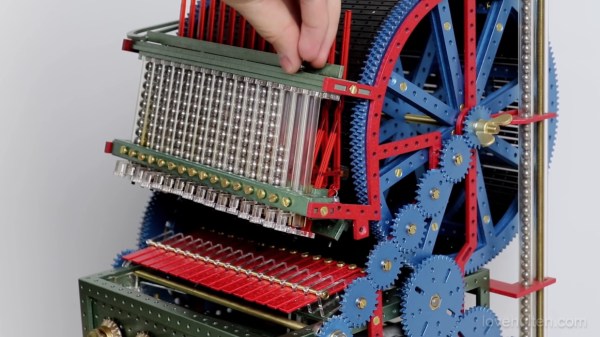
We’re okay if you call out Not A Hack™ on this one, because “hack” really doesn’t do justice to the creations of [Martin] from [Wintergatan]. You’re probably familiar with the Marble Machine that went viral a few years ago, and while it was impressive as-is back then, and most people would have declared the project finished at that point, it has turned into a seemingly never-ending work-in-progress project that has certainly come a long way ever since. Its latest addition: the Cyber Capos as upgrade for the bass, and you can find out all about it in its build video — also embedded below.

If you play a string instrument and ever used a capo — the clamping little helper device to smack the pitch up — you may have found yourself wishing that you could use it on any arbitrary fret on each string. Sure, there are partial capos and the spider capo to select individual strings, but you’re still limited to transpose along a single fret. Well, [Martin]’s Cyber Capos, a mechanical construct of four arms sliding along the neck, serve exactly that purpose, which allows him to free up his hands for other things while the marbles keep bouncing.

But you don’t have to be a bass player, or any musician really, to appreciate [Martin]’s build videos. We praised his general attitude and hacker-like spirit already the first time we mentioned the Marble Machine, and just watching him getting excited about his work and the appreciation for people supporting and assisting in the project, while embracing his mistakes, is a genuine delight.

Needless to say that [Martin] likes some uniqueness in music instruments, and the bass with its separate volume control and output for each string qualifies on its own for that. If you’re curious about more on that, there’s another video about it embedded after the break. And for the really impatient ones, you can see the capos in action in the first video around the 12:35 mark.

Continue reading “All About That Bass – Marble Machine X Keeps Growing”

Quality Upgrades Give Old Synth New Lease On Life

Technology marches on at a rapid pace, but in many fields much love remains for older hardware. While still highly capable, there’s often room for improvement thanks to components made available in the intervening years. After longing for his SY-77 synthesiser of the 90s, [Mark] sourced a tired SY-99, the next model up in the line – and set to work on some upgrades.

The SY-99 relied on floppy disks for storage, but the mechanical drives are now difficult to maintain, to say nothing of the unreliability of floppy media. [Mark] installed a SD Card HXC floppy emulator instead, using a Sparkfun SD breakout to neatly install the card slot in the synth’s case. The tired LCD was replaced with a newer model using the same controller, with an LED backlight proving a nice upgrade over the original EL unit.

Additionally, [Mark] realised that there was scope to create his own upgrade modules with off-the-shelf SRAM chips. This proves far cheaper than sourcing second-hand Yamaha stock off eBay, and is readily achievable by anyone with a basic understanding of digital logic. The ICs can be had for a few dollars, versus well over $50 for the original cards – if you can even find them. Some labor is involved, but it’s a lot less painful to the wallet.

[Mark]’s work is a great example of how hardware that was once prohibitively expensive can be given greater functionality at a lower cost thanks to new technology. We’ve seen other synths modded too, like this Korg Monotron. If you’ve been tinkering away in a keyboard yourself, be sure to let us know!

[Thanks to CRJEEA] for the tip]

Drumming A Beat On A Hundred-Year-Old Typewriter

We have seen a fair share of unusual items being turned into musical instruments. Luckily, with a little bit of hacking it is possible to turn almost anything into a MIDI controller. [William Sun Petrus] just converted a 1920s typewriter into a drum machine and delivers a hell of a live performance on it.

The build is rather simple, all [William Sun Petrus] needed was an Arduino Mega and lots of wires to convert a hundred-year-old Remington typewriter into a MIDI controller. Whenever a key is pressed the hammer hits a metal plate at the center of the typewriter and closes the contact between one of the Arduino’s IO pins and the 5 V rail like a regular push button. The Arduino code is based on the MIDI library sending commands to a PC which is running Hairless MIDI and Ableton. As sort of a gimmick, [William Sun Petrus] included an LCD screen which shows a line from Green Eggs and Ham by Dr. Seuss every time a key is pressed.

Interestingly, the latency due to the hammer’s travel time does not disturb [William Sun Petrus’] live play. To calm the skeptics in the comments he also released an unedited version of the video to prove that the performance is real and an instructional video on how to play his beat note by note.

Other unusual MIDI controllers include a bandoneon accordion or this English concertina.

Video after the break.

Continue reading “Drumming A Beat On A Hundred-Year-Old Typewriter”