Writing Dance Bangers Like It’s 1990 Again

Dance and house music exploded in a big way at the end of the 1980s. Typically the product of well-equipped studios with samplers and mixers worth thousands of dollars, it was difficult for the home gamer to get involved. That was, until the advent of the glorious Amiga, as [cTrix] ably demonstrates.

Sampling on your Amiga often meant sneaking off with the family hi-fi.

The video explains the history of both the music and the hardware, and highlights just why the Amiga was so special. Packing stereo audio and a four-channel sound chip, it had the grunt to pump out the tunes. All it was lacking was an audio input – which is where third-party hardware stepped in. Parallel-port analog-to-digital converters hit the market in a big way, letting users sample audio on their home computer without breaking the bank.

[cTrix] then proceeds to demonstrate how one would go about producing a dance track on an Amiga way back in 1990. A home stereo is used to play records, hooked up to a Stereo Master parallel port sampler. With a bunch of drum, piano, and synth samples recorded and saved on disk, a tracker is then used to assemble the track. It’s then compared with other music from the era as a great example of how things used to be done.

Overall, the Amiga will long have a legacy as the machine that brought real multimedia capabilities to the home computer. It’s one of our favourites, though keeping them going can be tough sometimes. Video after the break.

Continue reading “Writing Dance Bangers Like It’s 1990 Again”

Nifty Soundbender Built From EBay Modules

Custom audio greeting cards are a trifling gimmick, and a hefty investment compared to their paper-based colleagues. However, the technology inside can be twisted and hacked towards more interesting ends, as [lonesoulsurfer] demonstrates with his sound-bending build.

Rather then go to the trouble and expense of gutting a greeting card, [lonesoulsurfer] simply purchases the sound recording module off eBay which often turns out cheaper anyway. It’s hacked with a couple extra buttons and a speed control, and then wired up with a reverb module that itself gets tweaked to add an echo mode. It’s all bundled up with a speaker and microphone and installed in a case that formerly held an ignition tuning analyzer from the 1970s.

The final result is quite handsome, with a wooden panel holding the speaker and a smattering of knobs, buttons, and switches to play with. After recording an audio sample, it’s possible to speed it up, slow it down, and add echo and reverb until you’re left with something unrecognizable and weird. We’ve actually seen similar projects before, like this author’s first ever article for these hallowed pages. Video after the break.

Continue reading “Nifty Soundbender Built From EBay Modules”

Harmonicade Is A High-Scoring MIDI Controller

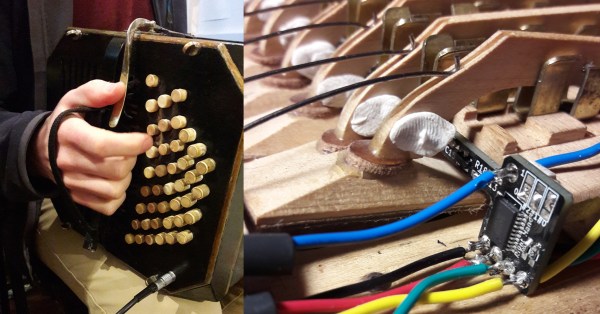
When [KOOP Instruments] started learning the piano, he wasn’t prepared for the tedium of learning chords and their relationships on the standard keyboard layout. But instead of killing his desire to tickle the ivories, it inspired him to explore alternative layouts that are easier to play. He converted to Isomorphism, started building MIDI controllers, and hasn’t looked back.

The latest incantation is Harmonicade, a dual-decked number arranged Wicki-Hayden style. Both decks have 5½ octaves, are (electrically) identical, and run off a single Teensy 3.6. We admire [KOOP]’s use of DB25 connectors to wrangle the wiring between the decks and the Teensy — quite a neat solution. Almost as neat as his beautifully-commented code.

Although the button decks and control boxes are all printed and open source, they are designed to be easily made from acrylic or plywood instead. [KOOP] is going to keep iterating until he’s totally happy with the control locations and layout, and the ease of breakdown and reassembly. We’ve got a double shot of videos for you after the break — one of [KOOP] playing Harmonicade, and a longer one exploring and playing its precursor, the Melodicade.

Tired of conventional-looking MIDI controllers? We hear your bellows and offer this MIDI controller in a concertina.

Continue reading “Harmonicade Is A High-Scoring MIDI Controller”

One Chip Does It All In This MacGuyver Synth

When you think of simple synths, what components come to mind? All you really need to make one is an oscillator, an amplifier, and some kind of input such that you can play different notes. Our favorite go-to for churning out square waves is probably the 40106 IC, which has six inverting Schmitt triggers, and then usually a 386 to amplify the output.

But it’s possible to go even simpler than that, and school is in session with [Jule] giving the lesson. [Jule]’s little analog synth uses a single IC for both the oscillator and the amplifier — a TL072 op-amp. The rest is made of purely discrete components.

[Jule] says those momentary switches are sub-par, and will add a vibrato effect if properly wiggled while pressed. To us, the buttons looks pretty nice, and much easier to jam out with than the ones with 1/8″ diameter actuators. Plus, whenever you press multiple buttons, the additive resistance unlocks the synth’s inner R2D2 voice. We really see no downsides here.

By default, this is an eight-button synth tuned to C major. But there’s a surprise — you can plug different capacitors into a piece of header and change the octave on the fly. Check it out after the break.

Making pitch-correct frequencies requires weird resistor values, which we can usually satisfy with two resistors in series. But wait, what’s up with resistor values, anyway? And why do they have a color code?

Continue reading “One Chip Does It All In This MacGuyver Synth”

Play That Funky 3D Printer…

Human brains are wired for music. Scientists think the oldest musical instruments were flutes that date back somewhere between 67,000 and 37,000 years ago. We assume though that people were banging on wood or their thighs, or knocking two rocks together long before that. Almost anything can be a musical instrument. A case in point: [elifer5000] walked into a room containing a lot of running 3D printers, and thought it seemed musical. Next thing you know, he harnessed 3D printers as a MIDI instrument.

At a hackathon, he found some software that converts a MIDI file to GCode. The only problem is a common printer has three axes and, therefore, can only produce (at most) three notes at once. The obvious answer to this problem is to use more printers, and that’s what he did, as you can see below.

Continue reading “Play That Funky 3D Printer…”

Make A Mean-Sounding Synth From Average Components

A while back, [lonesoulsurfer] stumbled upon a mind-blowing little DIY synth on YouTube and had to make one of his own. We don’t blame him one bit for that, ’cause we’ve been down that cavernous rabbit hole ourselves. You might want to build one too, after you hear the deliciously fat and guttural sounds waiting inside those chips and passives. Don’t say we didn’t warn you.

The main synth is built on five LM358 op-amps that route PWM through a pair of light-dependent resistors installed near the top. There are two more oscillators courtesy of a 40106 hex inverting Schmitt trigger, which leaves four more oscillators to play with should you take the plunge and build your own.

He didn’t just copy the guy’s schematic and call it good. He added [a 555-based arpeggiator that’s controlled with two homebrew optocouplers. These sound fancy and expensive, but can be bred easily at home by sealing an LED and an LDR inside a piece of black heat shrink tubing and applying a bit of PWM. With the flick of a toggle, he can bypass the momentary buttons and use the yellow knob at the top to sweep through the pitch range with a single input.

Although he doesn’t hold your hand through the build, [lonesoulsurfer] has plenty of nice, clear pictures of the process that nearly give a step-by-step guide. That plus the video demo and walk-through should get you well on your way to DIY synthville.

If this all seems very cool, but you’d really like to understand what’s happening as you descend into the rabbit hole, our own [Elliot Williams]’s Logic Noise series is an excellent start.

Continue reading “Make A Mean-Sounding Synth From Average Components”

Additive, Multi-Voice Synth Preserves Sounds, Too

For his final project in [Bruce Land]’s microcontroller design class, [Mark] set out to make a decently-sized synth that sounds good. We think you’ll agree that he succeeded in spades. Don’t let those tiny buttons fool you, because it doesn’t sound like a toy.

Why does it sound so good? One of the reasons is that the instrument samples are made using additive synthesis, which essentially stacks harmonic overtones on top the fundamental frequency of each note. This allows synthesizers to better mimic the timbre of natural, acoustic sounds. For each note [Mark] plays, you’re hearing a blend of four frequencies constructed from lookup tables. These frequencies are shaped by an envelope function that improves the sound even further.

Between the sound and the features, this is quite an impressive synth. It can play polyphonically in piano, organ, or plucked string mode through a range of octaves. A PIC32 runs the synthesizer itself, and a pair of helper PIC32s can be used to record songs to be played over. So [Mark] could record point and counterpoint separately and play them back together, or use the helper PICs to fine-tune his three-part harmony. We’ve got this thing plugged in and waiting for you after the break.

If PICs aren’t what you normally choose, here’s an FPGA synth.

Continue reading “Additive, Multi-Voice Synth Preserves Sounds, Too”