IEEE Spectrum had an interesting read about circuits using silicon carbide as a substrate. [Alan Mantooth] and colleagues say that circuits based on this or some other rugged technology will be necessary for missions to Venus, which they liken to hell. That might seem like hyperbole, but at about 460C with an atmosphere full of sulphuric acid, maybe it isn’t such a stretch. When the Soviets sent Venera 13 to Venus, it was able to send data for just over two hours before it was gone. You’d hope 40 years later we could do better.
Silicon carbide is a semiconductor made with an even mix of silicon and carbon. The resulting components can operate for at least a year at 500C. This high-temperature operation has earned them a place in solar energy and other demanding applications. [Alan], with the University of Arkansas along with colleagues from the KTH Royal Insitute of Technology in Stockholm are building test circuits aimed at developing high-temperature radios for use in environments like the one found on Venus.
Many years ago, I took a summer trip to the Maryland shore with some friends. One of my buddies and I got bored with playing football on the beach, so we decided to take a hike on one of the many trails back into the wooded area behind the dunes. At the trailhead we noticed a prominent sign, warning about the presence of “very aggressive mosquitos” and not to enter without first applying ample insect repellent. We scoffed at the warning as only young idiots could and soldiered on, bare-legged and confident that we’d be fine.
About three minutes into our hike, a small group came pelting down the trail in a panic. “It’s true! Turn back!” they shouted as they flew past us. Undeterred, or at least unwilling to appear that way to each other, we pressed on, only to discover a few minutes later that we were making a substantial blood sacrifice to the next generation of mosquitos on Assateague Island. We couldn’t bear more than a few seconds before turning tail and running back to the beach and jumping into the ocean to get rid of the last few dozen bloodsuckers.
I learned a valuable lesson from that experience, as well as developing a deep and abiding hatred of mosquitos. It turns out I’m in good company — pretty much everyone hates mosquitos, which are not just a nuisance but can be downright dangerous to be around. But if tests with genetically engineered mosquitos currently underway in Florida turn out well, we may be able to finally turn the tide against mosquito-borne diseases, simply by killing all the females before they ever reach adulthood.
It’s the same on Mars as it is here — just when you’re getting used to your job, the bosses go and change things up.
At least that’s our read on the situation at Jezero crater, where the Mars Ingenuity helicopter has just had its mission upgraded and extended. In a Friday morning press conference, the Ingenuity flight team, joined by members of the Perseverance team and some NASA brass, made the announcement that Ingenuity had earned an extra 30 sols of flight time, and would be transitioned from a mere “technology demonstrator” to an “operations demonstration” phase. They also announced Ingenuity’s fourth flight, which concluded successfully today, covering 266 meters and staying airborne for 117 seconds.
On April 28th, China successfully put the core module of their Tianhe space station into orbit with the latest version of the Long March 5B heavy-lift booster. This rocket, designed for launching large objects into low Earth orbit, is unique in that the 33.16 m (108.8 ft) first stage carries the payload all the way to orbit rather than separating at a lower altitude. Unfortunately, despite an international effort to limit unnecessary space debris, the first stage of the Long March 5B booster is now tumbling through space and is expected to make an uncontrolled reentry sometime in the next few days.
The massive booster has been given the COSPAR ID 2021-035-B, and ground tracking stations are currently watching it closely to try and determine when and where it will reenter the Earth’s atmosphere. As of this writing it’s in a relatively low orbit of 169 x 363 km, which should decay rapidly given the object’s large surface area. Due to the variables involved it’s impossible to pinpoint where the booster will reenter this far out, but the concern is that should it happen over a populated area, debris from the 21 metric ton (46,000 pound) booster could hit the ground.
The Tianhe core module.
This is the second launch for the Long March 5B, the first taking place on May 5th of 2020. That booster was also left in a low orbit, and made an uncontrolled reentry six days later. During a meeting of the NASA Advisory Council’s Regulatory and Policy Committee, Administrator Jim Bridenstine claimed that had the rocket reentered just 30 minutes prior, debris could have come down over the continental United States. Objects which were suspected of being remnants of the Long March 5B were discovered in Africa, though no injuries were reported.
China’s first space station, Tiangong-1, made an uncontrolled reentry of its own back in 2018. It’s believed that most of the 8,500 kg (18,700 lb) burned up as it streaked through the atmosphere, and anything that was left fell harmlessly into the South Pacific Ocean. While small satellites are increasingly designed to safely disintegrate upon reentry, large objects such as these pose a more complex problem as we expand our presence in low Earth orbit.
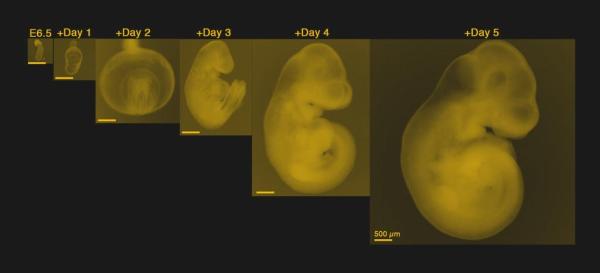
Well, it looks like those fetus fields from The Matrix (1999) just became a little bit more plausible. Although people-growing is probably a long way off, mice can now mostly develop inside an artificial uterus (try private window if you hit a paywall) thanks to a breakthrough in developmental biology. So far, the mice can only be kept alive halfway through gestation. There’s a point at which the nutrient formula provided to them isn’t enough, and they need a blood supply to continue growing. That’s the next goal. For now, let’s talk about that mechanical womb setup.
Carousel of Care
The mechanical womb was developed to better understand how various factors such as gene mutations, nutrients, and environmental conditions affect murine fetuses in development. Why do miscarriages occur, and why do fertilized eggs fail to implant in the first place? How exactly does an egg explode into 40 trillion cells when things do work out? This see-through uterus ought to reveal a few more of nature’s gestational secrets.
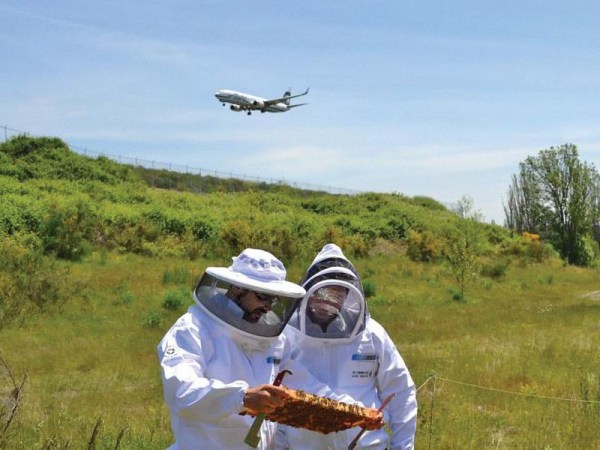
In the summer of 2012, honeybees swarmed the Pittsburgh airport, probably because the conditions are favorable there. Like many airports, the tarmac is surrounded by wild, wide-open fields that exist to contain the cacophony. And a couple of nearby creeks are dotted with plenty of forage-worthy wildflowers.
The relationship between honeybees and airports is a symbiotic one — the honey the bees produce is a litmus test for air pollution levels around the airport, which must fall within regulations. German airports have employed bees as ‘bio-detectives’ for over twenty years, and they give the honey away for free inside the terminal. It’s okay, though — analysis reveals that the hydrocarbon and heavy metal levels in the airport honey aren’t any higher than honey from non-industrial bees.
This week we’re starting off with a somber note, as Dan Kaminsky passed at only 42, of diabetic ketoacidosis. Dan made a name for himself by noticing a weakness in DNS response verification that could allow attackers to poison a target DNS resolver’s cache. A theoretical attack was known, where spoofed DNS responses could collide with requests, but Time-To-Live values meant that DNS requests only go out once per eight hours or so. The breakthrough was realizing that the TTL limitation could be bypassed by requesting bogus subdomains, and aiming the spoofed responses at those requests. This simple technique transformed a theoretical attack that would take 87 years to a very real 10 second attack. Check out the period video after the break, where Dan talked about his efforts in getting the problem fixed. Continue reading “This Week In Security: Dan Kaminsky, Banned From Kernel Development, Ransomware, And The Pentagon’s IPv4 Addresses”→