KiCad 4.0 Is Released

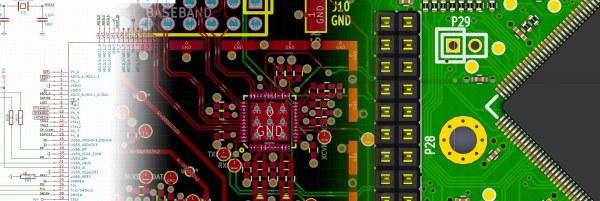
If you’re a KiCad user, as many of us here at Hackaday are, you’ll be elated to hear that KiCad 4.0 has just been released! If you’re not yet a KiCad user, or if you’ve given it a shot in the past, now’s probably a good time to give it a try. (Or maybe wait until the inevitable 4.0.1 bugfix version comes out.)

If you’ve been using the old “stable” version of KiCad (from May 2013!), you’ve got a lot of catching-up to do.

The official part footprint libraries changed their format sometime in 2014, and are all now hosted on GitHub in separate “.pretty” folders for modularity and ease of updating. Unfortunately, this means that you’ll need to be a little careful with your projects until you’ve switched all the parts over. The blow is softened by a “component rescue helper” but you’re still going to need to be careful if you’re still using old schematics with the new version.

The most interesting change, from a basic PCB-layout perspective, is the push-and-shove router. We’re looking for a new demo video online, but this one from earlier this year will have to do for now. We’ve been using various “unstable” builds of KiCad for the last two years just because of this feature, so it’s awesome to see it out in an actual release. The push-and-shove router still has some quirks, and doesn’t have all the functionality of the original routers, though, so we often find ourselves switching back and forth. But when you need the push-and-shove feature, it’s awesome.

If you’re doing a board where timing is critical, KiCad 4.0 has a bunch of differential trace and trace-length tuning options that are something far beyond the last release. The 3D board rendering has also greatly improved.

Indeed, there are so many improvements that have been made over the last two and a half years, that everybody we know has been using the nightly development builds of KiCad instead of the old stable version. If you’ve been doing the same, version 4.0 may not have all that much new for you. But if you’re new to KiCad, now’s a great time to jump in.

We’ve covered KiCad hacks before, and have another article on KiCad add-on utilities in the pipeline as we write this. For beginners, [Chris Gammell]’s tutorial video series is still relevant, and is a must-watch.

Thanks [LC] for the newsworthy tip!

Listen Up: IPhone Hack Diagnoses HVAC

We all know that guy (or, in some cases, we are that guy) that can listen to a car running and say something like, “Yep. Needs a lifter adjustment.” A startup company named Augury aims to replace that skill with an iPhone app.

Aimed at commercial installations, a technician places a magnetic sensor to the body of the machine in question. The sensor connects to a custom box called an Auguscope that collects vibration and ultrasonic data and forwards it via the iPhone to a back end server for analysis. Moving the sensor can even allow the back end to determine the location of the fault in some cases. The comparison data the back end uses includes reference data on similar machines as well as historical data about the machine in question.

Continue reading “Listen Up: IPhone Hack Diagnoses HVAC”

Power Over WiFi Might Not Be A Unicorn After All

There have been a few reports of power over WiFi (PoWiFi) on the intertubes lately. If this is a real thing it’s definitely going to blow all of the IoT fanboys skirts up (sorry to the rest of you *buzzword* fanboys, the IoT kids flash-mobbed the scene and they mean business).

All of the recent information we found points to an article by [Popular Science] titled “Best of What’s New 2015”. The brief write up includes a short summary lacking technical info, and fair play to [PopSci] as it’s a “Best Of” list for which they hadn’t advertised as an in-depth investigation.

However, we tend to live by the “If you’re gonna get wet, you might as well swim.” mentality, so we decided to get a little more information on the subject. After a bit of digging around we came across the actual article on [Cornell University]’s e-print archive where you can download the PDF that was published.

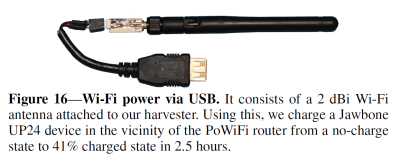
USB energy harvesting dongle.

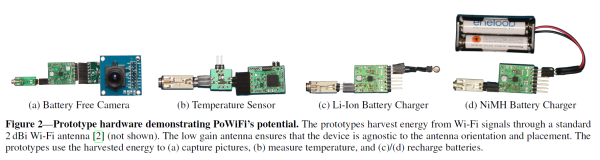
The paper goes into detailed explanation of the power harvesting theory including a schematic of the receiving end hardware. They had to create a constant transmission for the harvester to get over its minimum required voltage of operation. This was done with one of the wireless router’s unused channels to fill the voids of packet-less silence between normal WiFi communication.

As you can imagine PoWiFi is currently limited to powering/charging very low power devices that are used intermittently. The research team was able to charge a Jawbone headset at a rate of 2.3mA for 2.5 hours which resulted in the battery going from 0-41%. The punchline here is the distance, the device being charged was only 5-7cm from the PoWiFi router which is getting close to inductive charging range. The researchers stated in the paper that they were looking into integrating the harvesting circuitry and antenna into the headset while working towards a larger charging distance.

At the time of writing this article it seems that PoWiFi is best suited for devices such as: low powered sensors and motion activated cameras that have increased energy storage capacity, which the team mentioned as one of the continued research possibilities.

We’ve covered numerous wireless power projects before, some legit and some we still get a kick out of. Where do you think this one falls on that spectrum? Let us know in the comments below.

Thanks to [ScottVR] for the tip.

The $5 Raspberry Pi Zero

Rumors about a new Raspberry Pi have been circulating around the Internet for the past week or so. Speculation has ranged from an upgraded Model A or compute module to a monster board with Gigabit Ethernet, USB 3.0, SATA and a CPU that isn’t even in production yet. The time is now, and the real news is even more interesting: it’s a $5 Raspberry Pi Zero. It’s the smallest Pi yet, while still keeping the core experience.

Continue reading “The $5 Raspberry Pi Zero”

New Magnetic Semiconductor

When you think of South Dakota you generally think of Mount Rushmore and, maybe, nuclear missiles. However, [Simeon Gilbert] will make you think of semiconductors. [Simeon], a student at South Dakota State University, won first place at the annual Sigma Xi national conference because of his work on a novel magnetic semiconductor.

The material, developed in collaboration with researchers from the nano-magnetic group at the University of Nebraska-Lincoln, is a mix of cobalt, iron, chromium, and aluminum. However, some of the aluminum is replaced with silicon. Before the replacement, the material maintained its magnetic properties at temperatures up to 450F. With the silicon standing in for some of the aluminum atoms, the working temperature is nearly 1,000F.

Continue reading “New Magnetic Semiconductor”

DOE Announces A High Performance Computing Fortran Compiler Agreement

The U.S. Department of Energy’s National Nuclear Security Administration (NNSA) and its three national labs this week announced they have reached an agreement for an open-source Fortran front-end for Higher Performance Computing (HPC). The agreement is with IBM? Microsoft? Google? Nope, the agreement is with NVIDIA, a company known for making graphics cards for gamers.

The heart of a graphics card is the graphics processor unit (GPU) which is an extremely powerful computing engine. It’s actually got more raw horsepower than the computer CPU, although not as much as many claim. A number of years ago NVIDIA branched into providing compiler toolsets for their GPUs. The obvious goal is to drive sales. NVIDIA will use as a starting point their existing Fortran compiler and integrate it with the existing LLVM compiler infrastructure. That Fortran, it just keeps chugging along.

You can try out GPU programming on your Raspberry Pi. Yup! Even it has one, a Broadcom. Just follow the directions from Raspberry Pi Playground. You’re going to get your hands dirty with assembly language so this is not for the faint hearted. One of the big challenges with GPUs is exchanging data with them which gets into DMA processing. You could also take a look at [Pete Warden’s] work on using the Pi’s GPU.

Still wondering about the performance of CPU vs GPU? Here’s Adam Savage taking a look…

Continue reading “DOE Announces A High Performance Computing Fortran Compiler Agreement”

ON Semiconductor Acquires Fairchild

In the continuing process of semiconductor companies buying each other up, ON Semiconductor has acquired Fairchild Semiconductor for $2.4 Billion.

ON Semi and Fairchild’s deal is only the latest in a long line of mergers and acquisitions. We’ve recently seen Dialog’s buyout of Atmel, Avago’s purchase of Broadcom,  NXP and Freescale’s merger, and soon might see TI buy Maxim. We’re currently in the great time of acquisition, with nearly $100 Billion flowing from company to company in just a few months.

Companies have cash to spend and costs to cut. This latest deal is expected to save $150 Million in annual costs.

Fairchild has a long and storied history in the semiconductor industry, with the first integrated circuit produced in a Fairchild lab in Palo Alto. [Bob Widlar] made Fairchild his home until famously leaving for National Semiconductor in 1965. Somewhat ironically, Fairchild Semiconductor was bought by National Semiconductor in 1987.

ON Semiconductor’s history is not nearly as interesting, being spun off of Motorola’s semiconductor business in 1999. Although ON’s main line of business was discrete components, ON also has a catalog of quite a few power management ICs.

Unfortunately, because ON Semi bought Fairchild and not the other way around, we’re stuck with what is probably the worst logo in the entire semiconductor industry: drop-shadowed balls are so mid-90s!