Embedded Python: MicroPython Is Amazing

In case you haven’t heard, about a month ago MicroPython has celebrated its 11th birthday. I was lucky that I was able to start hacking with it soon after pyboards have shipped – the first tech talk I remember giving was about MicroPython, and that talk was how I got into the hackerspace I subsequently spent years in. Since then, MicroPython been a staple in my projects, workshops, and hacking forays.

If you’re friends with Python or you’re willing to learn, you might just enjoy it a lot too. What’s more, MicroPython is an invaluable addition to a hacker’s toolkit, and I’d like to show you why. Continue reading “Embedded Python: MicroPython Is Amazing”

Ticketmaster SafeTix Reverse-Engineered

Ticketmaster is having a rough time lately. Recently, a hacker named [Conduition] managed to reverse-engineer their new “safe” electronic ticket system. Of course, they also had the recent breach where more than half a billion accounts had personal and financial data leaked without any indication of whether or not the data was fully encrypted. But we’re going to focus on the former, as it’s more technically interesting.

Ticketmaster’s stated goals for the new SafeTix system — which requires the use of a smartphone app — was to reduce fraud and ticket scalping. Essentially, you purchase a ticket using their app, and some data is downloaded to your phone which generates a rotating barcode every 15 seconds. When [Conduition] arrived at the venue, cell and WiFi service was totally swamped by everyone trying to load their barcode tickets. After many worried minutes (and presumably a few choice words) [Conduition] managed to get a cell signal long enough to update the barcode, and was able to enter, albeit with a large contingent of similarly annoyed fans trying to enter with their legally purchased tickets.

Continue reading “Ticketmaster SafeTix Reverse-Engineered”

Exploded view of a mini PC built into a keyboard.

Keyboard Contains Entire Mini PC, Just BYOD

When we talk about keyboards that do it all, we usually mean either big ones with lots of keys and doodads like rotary encoders and displays, or small ones with lots of layers (and usually a few doodads, too). But this — this is something else entirely. Chinese PC maker Linglong have crammed an entire mini PC into a keyboard that’s small enough to fit in your back pocket. Oh, and it folds, too. All you need is a display.

Why do you need a display? Why not include one, if you’re going to wedge everything else in there? Well, the company envisions its users pairing it with a VR or AR glasses. But we can see use cases far beyond ownership of special spectacles, of course.

For instance, office work. Linglong says this key-puter (you read it here first) will last up to ten hours for light use, and nearly six hours for watching movies, but heavy use will have you down to four hours, which really isn’t that bad.

Spec-wise, it looks pretty good, with an AMD Ryzen 7 and either 16 or 32 GB of memory and a half- or full-terabyte hard drive. The whole thing is around 4 x 6″ (15 x 10cm), presumably in the folded orientation, and weighs less than two pounds (800 g). The projected cost is $400-500 depending on specs.

Unfortunately, this little key-puter isn’t available just yet. There are just 200 units available for Beta testing, and no, we don’t have one!

Main and thumbnail images via Linglong

New Battery Has No Anode

Conventional batteries have anodes and cathodes, but a new design from the University of Chicago and the University of California San Diego lacks an anode. While this has been done before, according to the University, this is the first time a solid-state sodium battery has successfully used this architecture.

Sodium is abundant compared to lithium, so batteries that use sodium are attractive. According to the University of Chicago’s news release:

Anode-free batteries remove the anode and store the ions on an electrochemical deposition of alkali metal directly on the current collector. This approach enables higher cell voltage, lower cell cost, and increased energy density…

Continue reading “New Battery Has No Anode”

New Solar Spheres Claim To Be Better Than Solar Panels

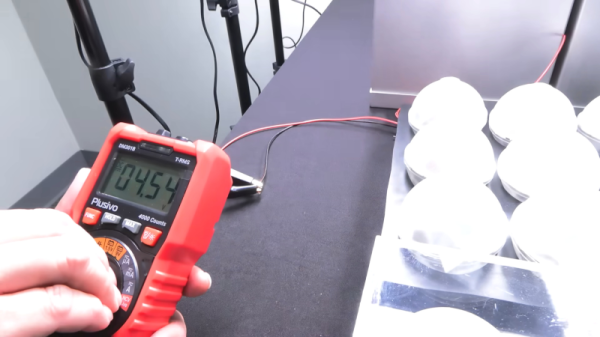
When you think of solar energy, you probably think of flat plates on rooftops. A company called WAVJA wants you to think of spheres. The little spheres, ranging from one to four inches across, can convert light into electricity, and the company claims they have 7.5 times the output of traditional solar panels and could later produce even more. Unfortunately, the video below doesn’t have a great deal of detail to back up the claims.

Some scenes in the video are clearly forward-looking. However, the so-called photon energy system appears to be powering a variety of real devices. It’s difficult to assess some of the claims. For example, the video claims 60 times the output of a similar-sized panel. But you’d hardly expect much from a tiny 4-inch solar panel.

Continue reading “New Solar Spheres Claim To Be Better Than Solar Panels”

This Week In Security: Hide Yo SSH, Polyfill, And Packing It Up

The big news this week was that OpenSSH has an unauthorized Remote Code Execution exploit. Or more precisely, it had one that was fixed in 2006, that was unintentionally re-introduced in version 8.5p1 from 2021. The flaw is a signal handler race condition, where async-unsafe code gets called from within the SIGALARM handler. What does that mean?
Continue reading “This Week In Security: Hide Yo SSH, Polyfill, And Packing It Up”

Cavity Filters, The Black Art You Have A Chance Of Pursuing

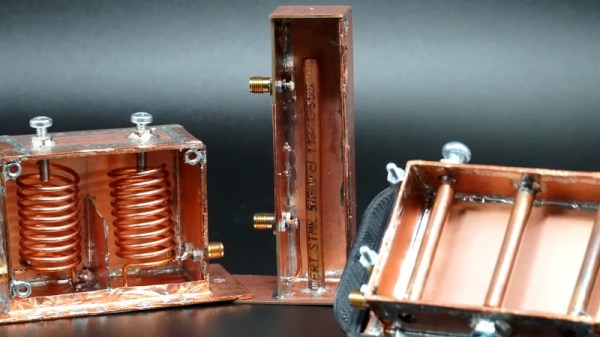
A tuned circuit formed by a capacitor and an inductor is a familiar enough circuit, and it’s understood that it will resonate at a particular frequency. As that frequency increases, so the size of the capacitor and inductor decrease, and there comes a point at which they can become the characteristic capacitance and inductance of a transmission line. These tuned circuits can be placed in an enclosure, at which they can be designed for an extremely high Q factor, a measure of quality, and thus a very narrow resonant point. They are frequently used as filters for that reason, and [Fesz] is here with a video explaining some of their operation and configurations.

Some of the mathematics behind RF design can be enough to faze any engineer, but he manages to steer a path away from that rabbit hole and explain cavity filters in a way that’s very accessible. We learn how to look at tuned circuits as transmission lines, and the properties of the various different coupling methods. Above all it reveals that making tuned cavities is within reach.

They’re a little rare these days, but there was a time when almost every TV set contained a set of these cavities which were ready-made for experimentation.

Continue reading “Cavity Filters, The Black Art You Have A Chance Of Pursuing”