Software Driving Hardware

We were talking about [Christopher Barnatt]’s very insightful analysis of what the future holds for the Raspberry Pi single board computers on the Podcast. On the one hand, they’re becoming such competent computers that they are beginning to compete with lightweight desktop machines, instead of just being a hacker curiosity.

On the other hand, especially given the shortage and the increase in price that has come with the Pi’s expanding memory endowments, a lot of people who would “just throw in a Raspberry Pi” are starting to think more carefully about their options. Five years ago, this would have meant looking into what you could whip together on an Arduino-based platform, either on actual Arduino hardware or on an ESP8266 or similar, but that’s a very different beast from a programmer’s perspective. Working with microcontrollers used to be very different from working with even the smallest Linux machines.

These days, there is no shortage of microcontrollers that have enough memory – both flash and RAM – to support a higher-level environment like MicroPython. And if you think about it, MicroPython brings to the microcontrollers a lot of what people were using a Raspberry Pi for in projects anyway: a friendly interactive programming environment that was free of the compile-here, flash-there debug cycle. If you’re happy coding Python on a single-board Linux computer, you’ll be more or less happy coding in MicroPython or Circuit Python on a microcontroller.

And what this leaves us with, as hackers, is a fantastic spectrum of choices. Where before there was a hard edge between programming C on an 8-bit PIC or an AVR and working with something that had a full Linux operating system like a Pi, it’s all blurry now. And as the Pis, the Jetson, and all the other Linux SBCs are blurring the boundary with more traditional computers as they all become more competent and gain more computer-like peripherals. Nowadays your choice is much freer, and the hardware landscape more fluid. You don’t have to let software development concerns drive your hardware choices, and we think that’s a great thing.
Farewell American Computer Magazines

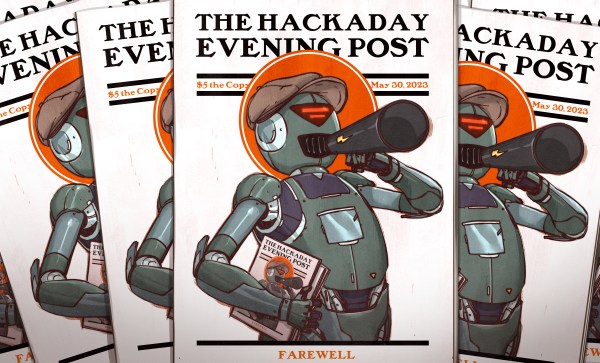
I grew up in a small town with a small library. The next town over had what I thought at the time was a big library, but it was actually more like my town had a tiny library, and the next one over had an actual small library. When I left to go to University, I found out what a real library looked like, and I was mesmerized. Books! Lots of books, many of them written in the current decade. My grades probably suffered from the amount of time I spent in the library reading things that didn’t directly relate to my classes. But there was one thing I found that would turn out to be life-changing: A real computer magazine. Last month, Harry McCracken pointed out that the last two widely-distributed American consumer computer magazines ceased paper publication. It is the end of an era, although honestly, it is more like a comatose patient expiring than a shocking and sudden demise.

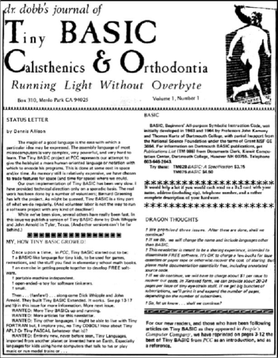
Dr. Dobb’s first issue was far from the slick commercial magazine it would become.

Actually, before I had gone to college, I did have a subscription to Kilobaud, and I still have some copies of those. No offense to Wayne Green, but Kilobaud wasn’t that inspiring. It was more an extension of his magazine “73”, and while I enjoyed it, it didn’t get me dreaming. Dr. Dobb’s Journal — the magazine I found in the stacks of my University’s library — was tangibly different. There was an undertone of changing the world. We weren’t sure why yet, but we knew that soon, everyone would have a computer. Maybe they’d balance their checkbook or store recipes. A few people already saw the potential of digital music reproduction, although, I must admit, it was so poor at the time, I couldn’t imagine who would ever care.

I say it was life-changing to discover the few issues of Dr. Dobb’s that were published back then because I would go on to contribute to Dr. Dobb’s throughout its storied history. I wrote the infamous DOS extender series, produced special issues, and, when it went mostly digital, was the embedded system blogger for them for more years than I care to admit. In fact, I have the dubious distinction of having the final blog posted; although the website has suffered enough bit rot, I’m not sure any of it has survived other than, maybe, on the Wayback machine. While I wasn’t with the magazine for its entire 38-year run, I read it for at least 35 and had some function there for about 24 of those.

Continue reading “Farewell American Computer Magazines”

Ask Hackaday: What’s Your “Tactical Tool” Threshold?

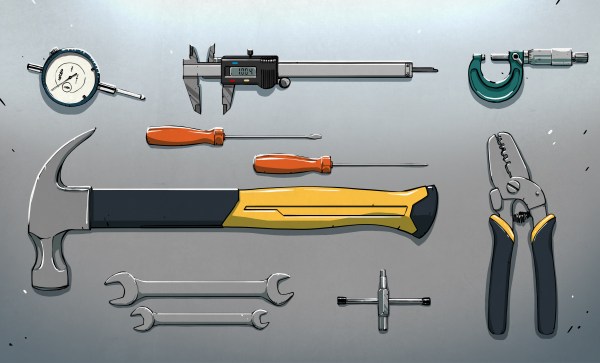
With few exceptions, every field has a pretty modest set of tools that would be considered the minimum for getting most jobs done. A carpenter can make do with tools that would fit in a smallish bag, while a mechanic can handle quite a few repairs with a simple set of socket wrenches and other tools. Even in electronics, a lot of repairs and projects can be tackled with little more than a couple of pairs of pliers, some cutters, and a cheap soldering iron.

But while the basic kit of tools for any job may be enough, there will always be those jobs that need more tools. Oh sure, sometimes you can — and should — make do with what you’ve got; I can’t count the number of times I’ve used an elastic band wrapped around the handles of a pair of needlenose pliers as an impromptu circuit board vise. But eventually, you’re going to come upon a situation where only the “real” tool will do, and substitutes need not apply.

As I look around my shop and my garage, I realize that I may have a problem with these “tactical tool” purchases. I’ve bought so many tools that I’ve used far fewer times than I thought I would, or perhaps even never used, that I’m beginning to wonder if I tackle projects just as an excuse to buy tools. Then again, some of my tactical purchases have ended up being far more useful than I ever intended, which has only reinforced my tendency toward tool collecting. So I thought I’d share a few of my experiences with tactical tools, and see how the community justifies tactical tool acquisitions.

Continue reading “Ask Hackaday: What’s Your “Tactical Tool” Threshold?”

All Your Robots Are Belong To Us: You Just Rent Them

Monthly bills. Everyone has them. Except if you go far enough back, not everyone had them. After all, you might live in a home your family has owned for generations. You might be able to produce all the basic necessities using your homestead: food from a garden, water from a well, textiles, soap, and candles. You might have to buy the occasional animal, but your recurring bills could be modest outside of the ever-present tax burden.

But as people moved to cities, they had to pay rent. Buy gas or coal and, eventually, electricity. Water and trash collection are pretty essential, too. But at some point, everyone realized that being in a position to bill you monthly is a good idea. Now we pay for the internet, movie subscriptions, meal plans, alarm monitoring, shopping clubs, cell phones, spa memberships. Soon we might be paying a monthly fee for our robots, too.

Rent To (Not) Own

In industry, this is a common occurrence. You often don’t buy a robot arm or similar device. That, after all, is a capital expense, and most tax codes require you to count it as an asset that slowly depreciates. Instead, you hire a robot from a service provider. Not only does that make it a pure expense, but the provider worries about software, repairs, and all that.

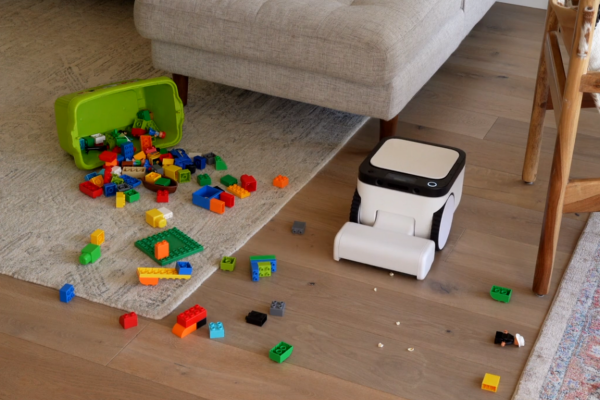
But at home, it is different. There’s no tax advantage in most places between owning a car and leasing it. Yet vendors want to adopt a rent-a-robot strategy. Case in point: a startup named Matician wants you to sign up for a robotic vacuum. For $125 a month, you get a super smart robot vacuum. You could, of course, buy a Roomba, but — according to Matician — the Matic robot uses computer vision to map your house and automatically finds messes. You can also voice command it to clean up areas. It also avoids wire and furniture. They didn’t mention if it can avoid presents left by your pets or not. It will avoid pets and kids, though.

Continue reading “All Your Robots Are Belong To Us: You Just Rent Them”

Hack Simple

Here at Hackaday, we definitely love to celebrate the hard hacks: the insane feats of reverse engineering, the physics-defying flights of fancy, or the abuse of cutting edge technology. But today I’d like to raise a rhetorical glass in tribute of the simple hacks. Because, to be perfectly honest, the vast majority of my hacks are simple hacks, and it’s probably the same for you too. And these often go unsung because, well, they’re simple. But that doesn’t mean that something simple can’t be helpful.

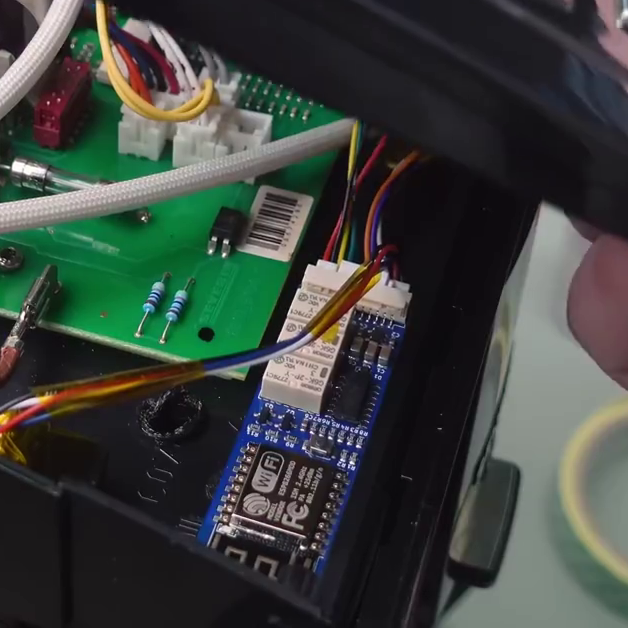
Case in point: an ESP8266 press-buttons device that we featured this week. It doesn’t do much. It’s main feature is that it connects to a home automation network over WiFi and enables you to flip three relays. Wires coming off the board are to be soldered to the not-yet-smart device in question, simply connected to each side of the button you’d like to press. In the example, a coffee machine was turned on and the “go” button pressed, automating one of the most essential kitchen rituals. While recording the podcast, I realized that I’ve built essentially this device and have it controlling our house’s heating furnace.

For the experienced hacker, there’s not much here. It’s a simple board design, the software heavily leverages ESPHome, so there’s not much work on that front either. But imagine that you lacked any of the wide-ranging skills that it takes to make such a device: PCB layout, ESP8266 software wrangling, or the nuances of designing with relays. You could just as easily build this device wrong as right. The startup costs are non-trivial.

Making a simple design like this available to the public isn’t a technical flex, and it’s not contributing to the cutting edge. But it just might be giving someone their first taste of DIY home automation, and a sweet taste of success. There’s not much easier than finding a switch and soldering on two wires, but if that’s the spark that pushes them on their path to greater hacks, that’s awesome. And even if it doesn’t, at least it’s another appliance under user control, connected to a private WiFi network rather than spying you out and phoning home to Big Toaster.

So here’s to the simple hacks!

Dear Ubuntu…

Dear Ubuntu,

I hope this letter finds you well. I want to start by saying that our time together has been one of creativity and entertainment, a time in which you gave me the tools to develop a new career, to run a small electronics business, make fun things, and to write several thousand articles for Hackaday and other publications, but for all that it’s sadly time for our ways to part. The magic that once brought us together has faded, and what remains is in danger of becoming a frustration.

In our early days as an item you gave me for the first time a Linux distro that was complete, fast, and easy to use without spending too much time at the CLI or editing config files to make things happen; you gave me a desktop that was smooth and uncluttered, and you freed me from all those little utilities that were required to make Windows usable. You replaced the other distros I’d been using, you dual-booted with my Windows machines, and pretty soon you supplanted the Microsoft operating system entirely.

Ubuntu and me and a trusty Dell laptop, Oxford Hackspace, 2017.
Me and Ubuntu in 2017, good times.

We’ve been together for close to two decades now, and in that time we’ve looked each other in the eye across a variety of desktop and laptop computers. My trusty Dell Inspiron 640 ran you for over a decade through several RAM, HDD, and SSD upgrades, and provided Hackaday readers with the first few years of my writing. Even the Unity desktop couldn’t break our relationship, those Linux Mint people weren’t going to tear us asunder! You captured my text, edited my videos and images, created my PCBs and CAD projects, and did countless more computing tasks. Together we made a lot of people happy, and for that I will always be grateful. Continue reading “Dear Ubuntu…”

How Far Can An EULA Go?

We read this news with mixed glee and horror: a company called Telly is giving TVs away, for the low price of having to live with an always-on advertisement bar and some pretty stringent terms and conditions. Break the terms, and they’ll repossess your TV. If you don’t give them the TV, they have your credit card on record and they think the set is worth $1,000.

The hacker in me sees free hardware, so I checked out the terms and conditions, and it doesn’t look good. They’ve explicitly ruled out opening up or physically modifying the device, and it has to continually have WiFi – for which you pay, naturally. It sounds like it could easily tell if you try to tamper with it. My next thought was, perhaps too cynically, to get one, put it in the closet, and wait for the company to go bankrupt. Because you know that business model isn’t going to last.

But it’s clear that they’ve seen through me. The most bizarre clause is that you have to “Use the Product as the primary television in Your household”. Now, we’re not lawyers, but it seems like an amazing stretch that they can tell you how intensively you are to use the product. Can you imagine a license with a keyboard that demanded that you only use it to write sci-fi novels, or that you have to use it more than any other keyboard?

Nope. Too many hoops to jump through for a silly free TV. You can keep your dystopian future.