Paper Punching Machine Looks Like Cute Piece Of Computer History Past

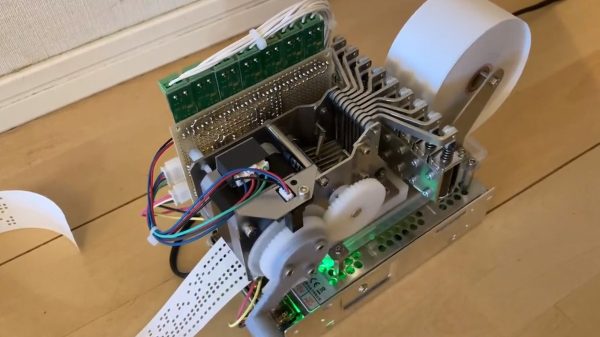
Computing used to run on punch cards. Great stacks of cards would run middling programs, with data output onto more punched cards in turn. [Nii] has built a machine in this vein, capable of punching binary into paper tape. 

The machine is run by a stepper motor, which is charged with feeding the paper tape through the machine in steady steps. A series of vertically-actuated solenoids punch holes in the paper tape as directed. The machine buzzes and clicks away like the best electromechanical computing devices of the mid-century era.

To what end, we couldn’t possibly say. One user noted the machine was punching seemingly random binary into the paper tape, and [Nii] has not provided any explanation as to the machine’s higher purpose. Regardless, whatever it is doing, it looks like it’s doing it well. Feel free to speculate in the comments.

Impressively, the petite device will be demonstrated at MF-TOKYO, the 7th Annual Metal Forming Fair in Tokyo this year. We’re sure the clickity-clack will be muchly appreciated in person.  Video after the break.

Continue reading “Paper Punching Machine Looks Like Cute Piece Of Computer History Past”
ZX Spectrum Gets A 3D FPS Engine

The Sony PlayStation and Nintendo 64 are well-known for bringing 3D gaming into the mainstream in a way that preceding consoles just couldn’t. The ZX Spectrum, on the other hand, is known for text adventures and barebones graphics. However, it now has a rudimentary version of a Quake-like engine, as demonstrated by [Modern ZX-Retro Gaming].

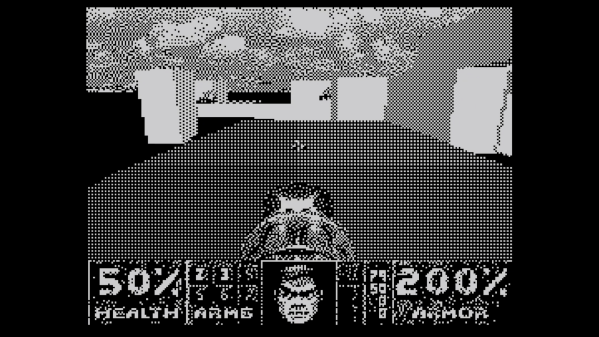
As you might expect, the basic ZX Spectrum that sat in front of your dodgy old TV in the 1980s isn’t really up to the task of running a full 3D game. The engine runs at a fairly jerky frame rate on a 3.5 MHz ZX Spectrum, with purely monochrome graphics. However, the game can run more smoothly on 7, 14, and 28MHz ZX Spectrum compatibles. As with many such projects, most of the video you’ll see is of the game running in emulators. Impressively, the game features sound effects, three weapons, and a standard WASD control layout as per modern FPS games.

If you’re wondering about the confusing visuals, there’s a simple explanation. Yes, the UI and weapons are straight out of Doom. However, the game is running on a true 3D engine, with 3D enemies, not sprites. It’s inspired by the full 3D engine pioneered by Quake, hence the designation.

Files are available for those wishing to try it out at home. We do see a fair bit of the ZX Spectrum around these parts. Video after the break.

Continue reading “ZX Spectrum Gets A 3D FPS Engine”

A Virus For The BBC Micro

If you work at all with British software or hardware engineers, you’ll find that there’s an entire generation perhaps now somewhere between their mid-40s and mid-50s, who stand slightly apart from their peers in their background and experience. These were the lucky teenagers who benefited from the British government’s 1980s push to educate youngsters in computing, and who unlike those before or who followed, arrived at university engineering courses fresh from school fully conversant with every facet of a computer from the hardware upwards.

[Alan Pope] is from that generation, and he relates a tale from his youth that wasn’t so out of place back in those days, of how he wrote what we’d now call a simple virus for the BBC Micro. Better still, he’s re-created it.

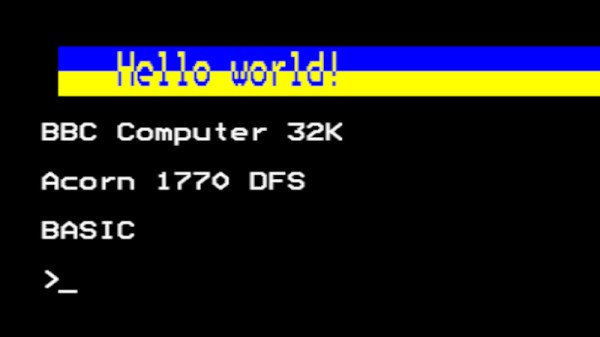
The post is as much a delightful trip back through that era of microcomputing, including an entertaining aside as he shared an airline journey with BBC Micro designer Chris Turner, and it serves as a reminder of how the BBC Micro’s disk operating system worked. There was a !boot file, which was what would be run from the disk at startup, and his bit of code would subvert that and hide itself in the machine’s so-called sideways RAM. The payload was pretty simple, every 32 soft reboots it would print a “Hello world” message, but it seems that was enough back in 1989 to get him into trouble. The 2023 equivalent works, but we’re guessing no teacher will come for him this time.

If you can’t find a real BBC Micro but still want one on hardware, we’ve brought you an FPGA version in the past.

Book8088 Slows Down To Join The Demoscene

As obsolete as the original IBM Model 5150 PC may appear, it’s pretty much the proverbial giant’s shoulders upon which we all stand today. That makes the machine worth celebrating, so much so that we now have machines like the Book8088, a diminutive clamshell-style machine made from period-correct PC chips; sort of a “netbook that never was.”

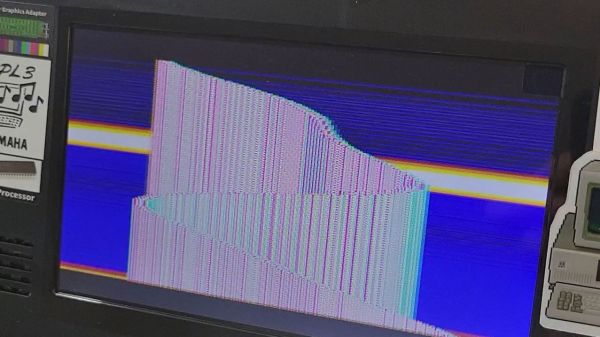
But the Book8088 only approximates the original specs of the IBM PC, making some clever hardware hacks necessary to run some of the more specialized software that has since been developed to really stretch the limits of the architecture. [GloriousCow]’s first steps were to replace the Book8088’s CPU, an NEC V20, with an actual 8088, and the display controller with a CGA-accurate Motorola MC6845. Neither of these quite did the trick, though, at least not on the demanding 8088MPH demo, which makes assumptions about CPU speed based on the quirky DRAM refresh scheme used in the original IBM PC.

Knowing this, [GloriousCow] embarked on a bodge-fest aimed at convincing the demo that the slightly overclocked Book8088 was really just a 4.77-MHz machine with a CGA adapter. This involved cutting a trace on the DMA controller and reconnecting it to the machine’s PIO timer chip, with the help of a 74LS74 flip-flop, a chip that made an appearance in the 5150 but was omitted from the Book8088. Thankfully, the netbook has plenty of room for these mods, and with the addition of a little bit of assembly code, the netbook was able to convince 8088MPH that it was running on the correct hardware.

We thoroughly enjoyed this trip down the DMA/DRAM rabbit hole. The work isn’t finished yet, though — the throttled netbook still won’t run the Area 5150 demo yet. Given [GloriousCow]’s recent Rust-based cycle-accurate PC emulation, we feel pretty good that this will come to pass soon enough.

Clock Hack Gives DEC Rainbow A New Lease On Life

In retrocomputing circles, it’s often the case that the weirder and rarer the machine, the more likely it is to attract attention. And machines don’t get much weirder than the DEC Rainbow 100-B, sporting as it does both Z80 and 8088 microprocessors and usable as either a VT100 terminal or as a PC with either CP/M or MS-DOS. But hey — at least it got the plain beige box look right.

Weird or not, all computers have at least a few things in common, a fact which helped [Dr. Joshua Reichard] home in on the problem with a Rainbow that was dead on arrival. After a full recapping — a prudent move given the four decades since the machine was manufactured — the machine failed to show any signs of life. The usual low-hanging diagnostic fruit didn’t provide much help, as both the Z80 and 8088 CPUs seemed to be fine. It was then that [Joshua] decided to look at the heartbeat of the machine — the 24-ish MHz clock shared between the two processors — and found that it was flatlined.

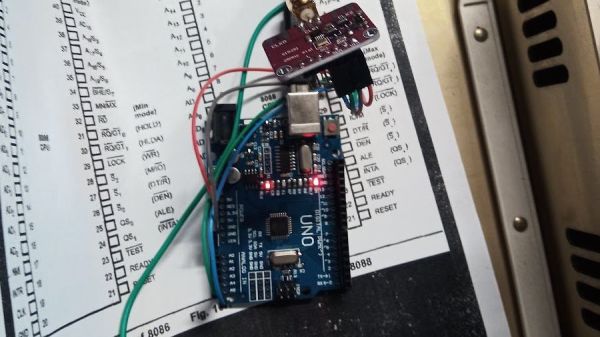
Unwilling to wait for a replacement, [Joshua] cobbled together a temporary clock from an Arduino Uno and an Si5351 clock generator. He connected the output of the card to the main board, whipped up a little code to generate the right frequency, and the nearly departed machine sprang back to life. [Dr. Reichard] characterizes this as a “defibrillation” of the Rainbow, and while one hates to argue with a doctor — OK, that’s a lie; we push back on doctors all the time — we’d say the closer medical analogy is that of fitting a temporary pacemaker while waiting for a suitable donor for a transplant.

This is the second recent appearance of the Rainbow on these pages — [David] over at Usagi Electric has been working on the graphics on his Rainbow lately.

Atari Introduces A New Old Console

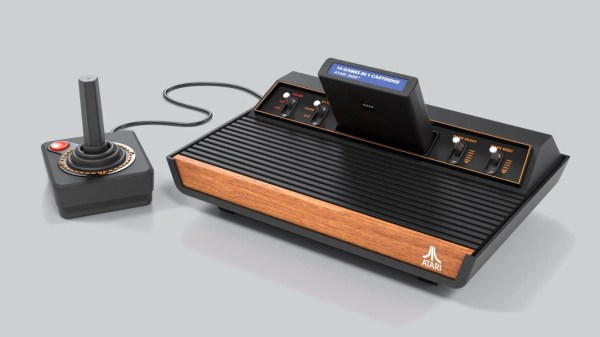
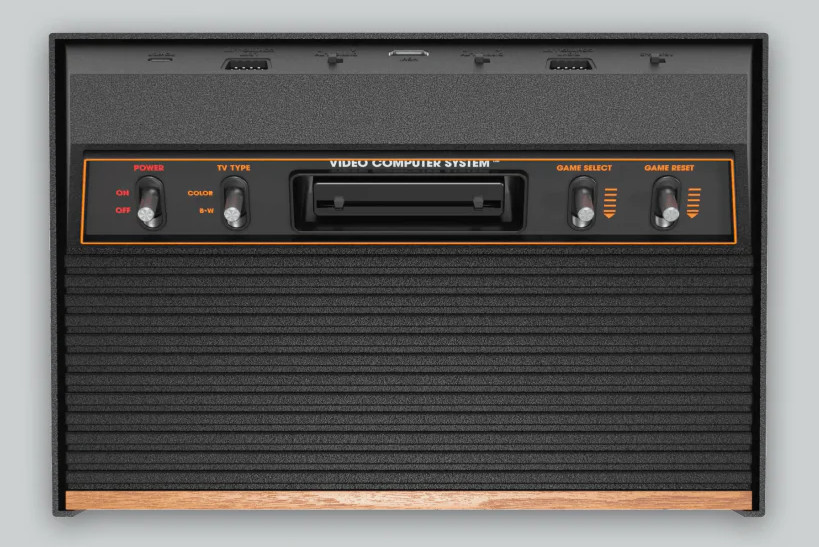
Readers of a certain age no doubt remember the Atari 2600 — released in 1977, the 8-bit system helped establish the ground rules for gaming consoles as we know them today, all while sporting a swanky faux wood front panel designed to make the system look at home in contemporary living rooms.

Now, nearly 50 years later, the Atari 2600 is back. The new system, imaginatively named the 2600+, looks exactly like the original system, albeit at around 80% scale. It will also work the same way, as the system will actually be able to play original Atari 2600 and 7800 cartridges. This is something of a surprise when compared to the previously released retro consoles from the likes of Sony and Nintendo, as they were all limited to whatever games the company decided to pack into them. Of course, this probably has something to do with the fact that Atari has been selling newly manufactured 2600 games for some time now.

Although it will play original cartridges, it’s still an emulated console at heart. There aren’t a lot of technical details on the product page, but it does say the 2600+ is powered by a Rockchip 3128 SoC with 256 MB of DDR3 RAM and 256 MB eMMC flash. Some quick searching shows this to be a pretty common board for set-top gadgets, and wildly overpowered considering the meager requirements for emulating a game console from 1977. We wouldn’t be surprised to find it’s running some kind of minimal Linux install and using one of the existing open source emulators.

While the 2600+ sports the same 9-pin D-sub controller connectors as the original console, it thankfully embraces modern display technology and outputs over HDMI. Each console will come with a “10-in-1” cartridge that contains some of the console’s most popular titles, as well as a modernized version of the original single-button joystick. (Unlike the original, the 2600+ comes with only a single joystick — the other is sold separately.)

Atari won’t start shipping the 2600+ until this fall, but they’re currently taking preorders for the $130 system. We’re eager to see somebody pull it apart, as the earlier “mini” consoles ended up being ripe for hacking.

Continue reading “Atari Introduces A New Old Console”

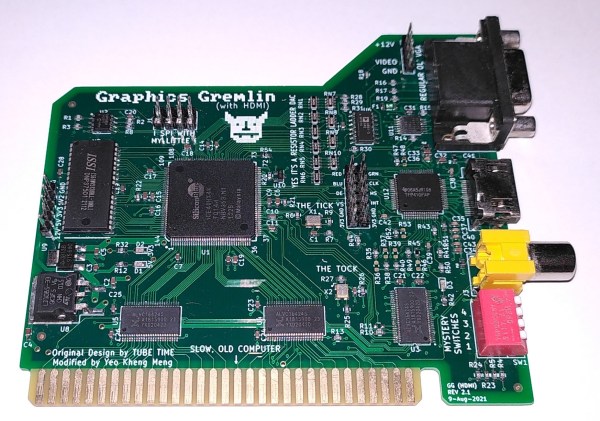
An 8-bit ISA card with VGA, HDMI and composite video connectors

Upgraded Graphics Gremlin Adds HDMI Video To Vintage PCs

Although new VGA-equipped monitors can still be bought, the old standard is definitely on its way out by now, being replaced by high-speed digital interfaces like HDMI and DisplayPort. It therefore makes sense to prepare for a VGA-less future, as [Yeo Kheng Meng] is doing. He designed an 8-bit ISA display card with an HDMI output that enables even the very first generation of PCs to talk to a modern monitor.

The design is based on the Graphics Gremlin by [Tube Time], which is an 8-bit ISA display card that aims to be software compatible with the obsolete MDA and CGA display formats while outputting a clean VGA signal. [Yeo Kheng Meng] modified the board by adding a TFP410 HDMI bus driver and replacing the rarely-used 9-pin RGBI connector with an HDMI version. He also updated the HDL code for the Lattice FPGA, which forms the heart of the graphics card, to account for the new digital output. While he was at it, he also added a few features he was missing in the original product, such as the option to select the color displayed in MDA mode and the ability to output both HDMI and composite video at the same time.

The video below shows the updated card in action in an IBM 5155 Portable PC. The HDMI port connects to a modern monitor, while the composite video output is routed to the 5155’s internal CRT as well as a small color monitor on top. The IBM thereby joins a small list of retro computers that have received an HDMI upgrade — the Amiga 500 and PlayStation 2 being other examples. HDMI might be a lot more complex to work with than VGA, but luckily there are open-source implementations that do much of the work for you.

Continue reading “Upgraded Graphics Gremlin Adds HDMI Video To Vintage PCs”