Building A Ceiling-Based Crane Robot To Keep A Room Clean

One of the joys you get to experience whether as a proud parent or pet owner is that a lot of things get left around haphazardly. You could of course pick every piece of discarded clothing, half-destroyed toy and detritus yourself, but as a parent of three children himself [Nathaniel Nifong] opted to use his engineering background to potentially over engineer a wires-suspended robotic claw to do this picking up for him.

What he calls Stringman robots requires an anchoring point at four corners of a room, after which the robotic crane can then scour across the ceiling, identify targets to pick up and move these to predesignated drop-off points. It’s an open source project with the LeRobot-based firmware available on GitHub in addition to build instructions for the physical hardware. There’s also a pilot run of ready to use hardware and kits for those who want to trial it, but aren’t interested in building it themselves via [Nathaniel]’s company website.

The basic idea is that this crane can run for an hour or so and deal with the mess in its room without having to do anything yourself. The process isn’t perfect yet, of course, with the underlying diffusion transformer to implement machine vision requiring more refinement. The gripper itself struggles with objects like books, which can be a concern for parents and bookworms, and of course while the crane is operating the wires will dip down as a potential risk to anyone in the room.

Compared to an overhead crane like a traditional bridge crane this wire-suspension crane is probably more stable, but either is an interesting engineering challenge when applied to a household. Next it would probably also be cool if items could be put away where they belong instead of dropped into a bin, as so far that task will still be left to deal with by the adult humans.

Continue reading “Building A Ceiling-Based Crane Robot To Keep A Room Clean”
Robot Chess But Each Piece Is A Small Robot

A topless chess piece. (Credit: 3DprintedLife, YouTube)

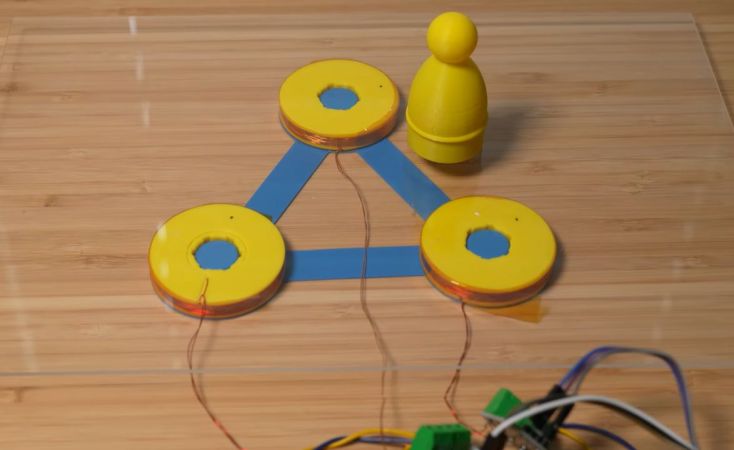
We have seen a number of self-playing chess boards over the years, but the general theme has been standard chess pieces moved by either an internal electromagnet or an external robotic arm. This is, of course, a reasonable choice, as it reduces complexity, and sometimes you can even use standard chess pieces on a regular board. But what if each piece could move by itself? That seems cooler, so that’s what [3DprintedLife] did with 3D-printed chess pieces that are also tiny robots.

Although technically not the first, as you can buy the commercial Chessnut Move offering, this being an open hardware and source project makes it a lot more interesting, also because the general design is generic enough to be usable for applications other than just playing chess.

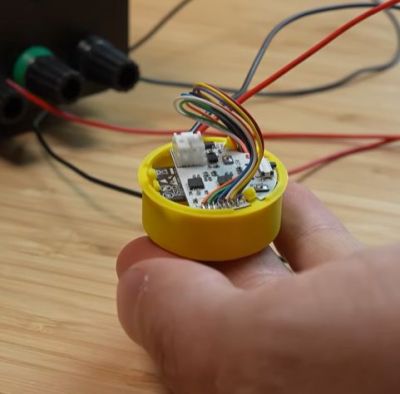
The MiniBots, as the individual pieces are called, are built around a custom PCB with an ESP32-C3 module, two PMO8-2 miniature stepper motors with requisite drivers, a magnetometer, and are powered by a 170 mAh LiPo battery. Communication with the central hub is done using ESP-NOW, with each MiniBot using its own dedicated channel.

This hub’s mainboard also runs on an ESP32-C3 for the wireless interface, while the processing is handled via a serial link with a Raspberry Pi SBC that runs the main Python-based software. Localizing the individual pieces on the board is done by scanning electromagnets embedded in the board and using the readings from the individual magnetometers to triangulate the positions.

Although at the end of the video a basic prototype sort of works, the ESP32-C3, being a single-core MCU, tripped up the firmware, necessitating some changes that should be in the next update, along with power saving and easier recharging being issues to address.

If you want to see a more conventional chess robot, we’ve seen plenty.

Continue reading “Robot Chess But Each Piece Is A Small Robot”

Print Your Own Robby The Robot

When it comes to robots, few are as iconic as Robby. [Ogrinz Labs] has wanted to build one and even examined a real one up for auction to get high-res photos of it. He also combined his designs with some other open-source designs, and it looks good. He’s released his design as a Creative Commons-licensed set of STL files that you, in theory, could print. There are more details and instructions in the video below.

If you are looking for something quick to print for the weekend, this isn’t it. As you might expect, this is a lot to print. The creator admits, too, that it isn’t totally accurate. It has bigger feet, for example, so his feet can fit inside. There are a few other modifications made for different reasons, but only a hard-core Robby enthusiast would notice any of them.

Continue reading “Print Your Own Robby The Robot”

Like A Wire Bender, But For Pop Tubes

Are you familiar with pop tubes? Resembling the corrugated section of a bendy straw, they are at the core of PopTuber, an intriguing research project from the Actuated Experience Lab at the University of Chicago.

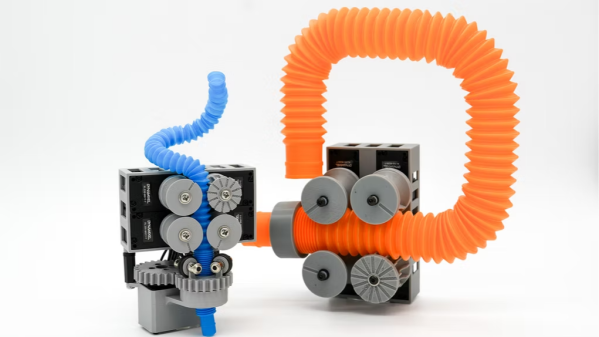
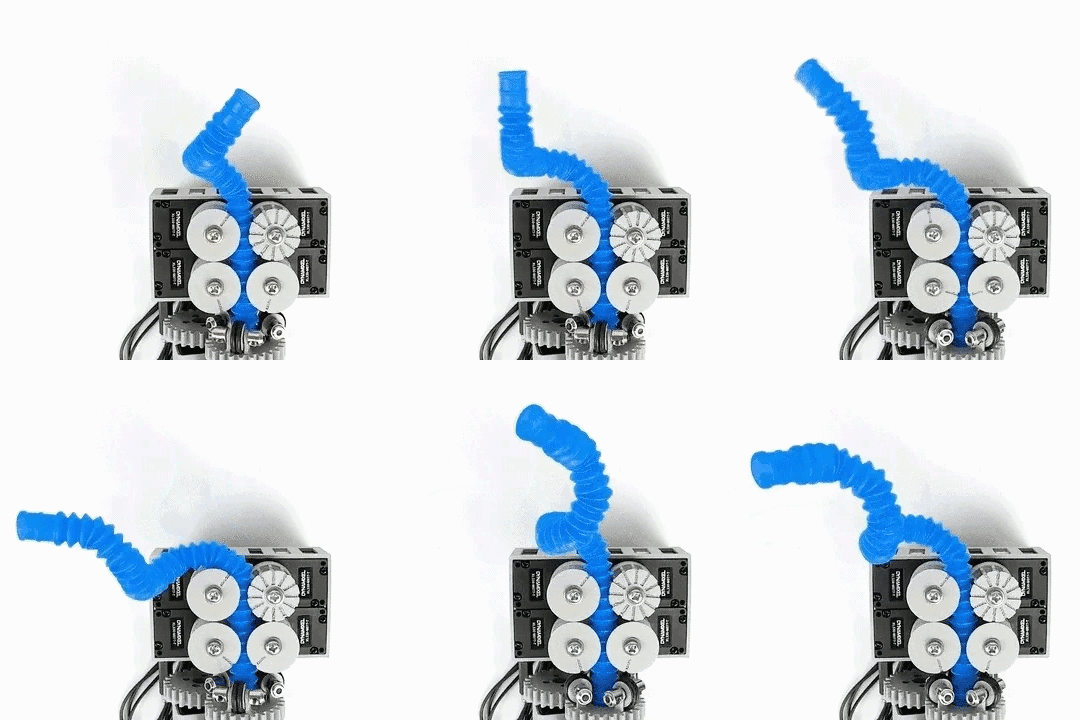
With five motors and specialized gears a pop tube can be formed into complex, arbitrary shapes, and just as easily reset.

PopTuber shows how five motors and some specialized gears are all it takes to bend pop tubes into complex and stable 3D shapes. One can design the shapes in software, feed a pop tube into the shaper, and watch the device do the work. Importantly, the device can just as easily reset and re-use the tube. Watch the video (embedded below the page break) to see it in action and get a feel for what it can do.

In concept, it’s a little like a wire-bending machine, although wire benders are bulkier in comparison, more complex to scale, and unbending a wire is a separate process with its own hardware.

This project explores possibilities for a machine that can crank out complex curves on demand, such as oddball user interfaces, physical prototyping, and even a strange sort of physical display. But the real forward-thinking and interesting question researchers asked is whether this idea could be a form of programmable matter. The project shows that five actuators in a relatively compact package are all that’s needed to shape (and reset) a pop tube of arbitrary length in a programmable way, and it can scale easily to different sizes.

Continue reading “Like A Wire Bender, But For Pop Tubes”

Classically-named Argus Robot Is Terminator Meets Tumbleweed

If you were making a multi-limbed symmetric nightmare of a robot, where else would you look for a name but Greek Mythology? The team at Duke University that came up with this particular multi-limbed creature had two obvious choices: name it for one of the Hundred-Handed giants, the Hecatoncheires, or lean on the fact that each limb has its own sensor and go for many-eyed Argus. Argus sounds better to a funding committee, so Argus it is.

Hecatoncheries would be a bit of a reach anyway, considering Argus only has 20 limbs in its current incarnation. It uses what the researchers are calling its ‘dynamic symmetry’ to get around– extending and retracting its many limbs to exert forces in any direction, it can bounce about like a beach ball on a windy day.

Continue reading “Classically-named Argus Robot Is Terminator Meets Tumbleweed”

Unitree GO-M8018-6 Motor Reverse Engineering

People seem to be rather into the Unitree Go2 quadruped robot, if only for the low price tag. But perhaps more interesting are the motors that propel it — they appear to be similar to the Go1’s GO-M8010-6 motors that Unitree also sells, with [Thomas Flayols] currently working on reverse-engineering its proprietary driver using the publicly available documentation for that motor and some reverse-engineering.

These motors are an assembly that includes a reducer, magnetic encoder, 3-phase inverter, current sensing, an RS-485 bus and a Cortex-M0-based CMS32M57xx MCU, all in a very capable package intended for robotics applications where a compact actuator is needed.

The first step of reverse-engineering involved the physical PCB, made all the more difficult as Unitree was so kind as to remove all markings on the ICs. Fortunately using an X-ray machine and some sleuthing it was possible to deduce the MCU and other components. Following this SWD/OpenOCD access to the MCU could be established and the firmware key extracted from the bootloader SRAM.

Although the firmware was encrypted, a locally recovered key was found to decrypt it. This allowed for an initial custom firmware to be developed, which [Thomas] hopes to develop into a fully featured open source firmware. Doing so would obviously open these motors to a larger audience outside of Unitree’s ecosystem, as they are pretty good value for what they offer mechanically.

It might give the associated Go2 robot a new life too considering the serious malware accusations and security issues pertaining to its firmware.

Autonomous Submarine Relies On Color Detection

We talk about all kinds of autonomous vehicles here at Hackaday, from aerial drones to rugged rovers. A little less common are the submarine builds, likely due to their technical complexity. That said, though they perhaps benefit most from autonomy given they’re so hard to talk to while underwater. In any case, [Ayman] has built an impressive sub that uses some rudimentary techniques to navigate around while under the surface. 

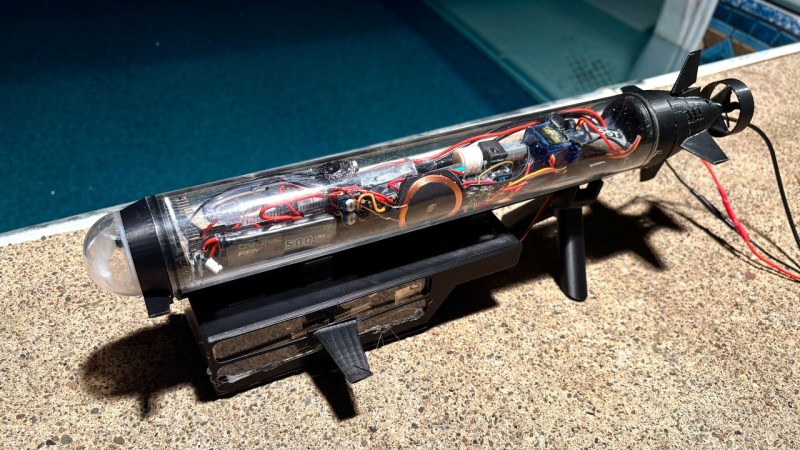
The build uses typical construction techniques for DIY subs of this size, with a clear acrylic tube serving as the body of the craft. It’s carefully sealed to ensure water ingress doesn’t send it to the bottom, using nifty tricks like a magnetic coupling for the prop. Inside, there’s a Raspberry Pi 4, kitted out with an Arducam IMX708 camera with a wide angle lens. It’s joined by a BNO085 inertial measurement unit, along with two BMP280 pressure sensors for keeping track of motion and the sub’s vital signs, while a DRV8833 motor controller runs the main drive motor.

There’s also an ESP32 which helps out with motor and servo control for steering, and ballast control. Sinking and floating the sub is handled with a pair of two ballast tanks constructed out of 5 mL syringes that are driven in and out with high-torque output gear motors. The build uses an antenna buoy so that communication can be maintained with the sub when it’s within a certain range of the surface.

A neat addition to the sub is its autonomous navigation code. [Ayman] whipped up some simple object avoidance routines, which rely on the Raspberry Pi’s camera. The code uses HSV values to track specific colored objects and avoid them, which proves more reliable than RGB as it allows tracking color in a largely brightness-independent manner.

Although we’ve featured other builds that use similar construction techniques, seeing a transparent submarine gliding through the water will always make us think of the incredible Open Source Underwater Glider that won the 2017 Hackaday Prize.

Continue reading “Autonomous Submarine Relies On Color Detection”