How Do You Think This Quadcopter Feels?

how-does-this-quadcopter-feel

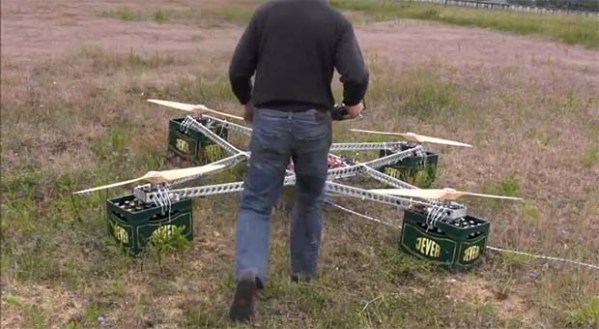
You don’t speak the language of dogs and yet you can tell when one is angry, excited, or down in the dumps. How does that work, and can it be replicated by a robot? That’s the question which [Megha Sharma] set out to study as part of her graduate research at the University of Manitoba in Winnipeg.

The experiment starts by training the robot in a series of patterns meant to mimic emotion. How, you might ask? Apparently you hire an actor trained in Laban Movement. This is a method of describing and dealing with how the human body moves. It’s no surprise that the technique is included in the arsenal of some actors. The training phase uses stationary cameras (kind of like those acrobatic quadcopter projects) to record the device as it is moved by the actor.

Phase two of the experiment involves playing back the recorded motion with the quadcopter under its own power. A human test subject watches each performance and is asked to describe how the quadcopter feels. The surprising thing is that when asked they end up anthropomorphising the inanimate device even further; making up small stories about what the thing actually wants.

It’s an interesting way to approach the problem of the uncanny valley in robotic projects.

Continue reading “How Do You Think This Quadcopter Feels?”

Salvaging Parts From Broken Roomba Robots

salvaging-parts-from-broken-roombas

The great thing about hacking on Roombas is that iRobot used quality parts to build them. [Jason] got his hands on a broken 5XX series Roomba and posted an article about how he reused the salvaged parts.

What you see above is one of the results of his work. This little bot takes commands from an IR television remote control. But he also used the setup to make a self-balancing bot. The two motors from the Roomba have magnetic rotary encoders with 8-bit resolution. Pair this with a well-tuned PID algorithm and you’re in business. The video below shows him testing a motor with his PID code.

You don’t get very much info on the guts of the donor robot. If that’s what you’re looking for you need to look at [Dino’s] Roomba 4000 teardown.

Continue reading “Salvaging Parts From Broken Roomba Robots”

Automata And Wooden Gears

mechanism

While most animated machines we deal with every day – everything from clocks to cars to computers – are made of metal, there is an art to creating automated objects out of wood. [Dug North] is a creator of such inventions, making automata out of wooden gears, cogs, and cams.

[Dug]’s inventions are simple compared to turbine engines, but they still retain an artistry all their own. With just simple woodworking tools, he’s able to creating moving vignettes of everyday scenes, everything from a dog barking at a bird, to Santa Claus gracefully soaring over a house on Christmas Eve.

Below, you’ll find a video of [Dug]’s creation, ‘An Unwelcome Dinner Guest’ – an automated dog barking at a wooden bird. There’s also a video of him being interviewed by the awesome people at Tested last year at the World Maker Faire.

Continue reading “Automata And Wooden Gears”

Build A Light Following Bristlebot As A Way To Teach Science

light-following-bristlebot

[Ben Finio] designed this project as a way to get kids interested in learning about science and engineering. Is it bad that we just want to build one of our own? It’s a light following bristlebot which in itself is quite simple to build and understand. We think the platform has a lot of potential for leading to other things, like learning about microcontrollers and wireless modules to give it wireless control.

Right now it’s basically two bristlebots combined into one package. The screen capture seen above makes it hard to pick out the two toothbrush heads on either side of a battery pack. The chassis of the build is a blue mini-breadboard. The circuit that makes it follow light is the definition of simple. [Ben] uses two MOSFETs to control two vibration motors mounted on the rear corners of the chassis. The gate of each MOSFET is driven by a voltage divider which includes a photoresistor. When light on one is brighter than the other it causes the bot to turn towards to the brighter sensor. When viewing the project log above make sure to click on the tabs to see all of the available info.

This directional control seems quite good. We’ve also seen other versions which shift the weight of the bot to change direction.

Continue reading “Build A Light Following Bristlebot As A Way To Teach Science”

Transformer Built From MIT Admissions Mailing Tube

mit-admissions-tube-robotIt’s not quite on the scale of [Michael Bay], but that’s probably a good thing. We do think that this robot built from a mailing tube by [Will Jack] would be right at home in a Transformers movie.

The bot starts out looking like a normal cardboard mailing tube. But the seam at the middle splits to reveal the electronics inside. An Arduino Uno drives the device, monitoring that infrared rangefinder which is facing forward. Each half of the tube acts as a wheel, pushing against the at-rest mass of the internals to create motion. It can even pull off a tank-like pivot to turn in place by spinning he halves in opposite directions.

We were intrigued to hear that the admissions department at the Massachusetts Institute of Technology sent a single page acceptance letter in these silver tubes to those students accepted into the class of 2017. The letter invites the incoming class to hack the tube and send in their results. We’re going to have to dig through the submissions and see if there are any other noteworthy projects.

Continue reading “Transformer Built From MIT Admissions Mailing Tube”

Best Robot Demos From ICRA 2013

best-robots-from-2013-ICRA

The 2013 IEEE International Conference of Robotics and Automation was held early in May. Here’s a video montage of several robots shown off at the event. Looks like it would have been a blast to attend, but at least you can draw some inspiration from such a wide range of examples.

We grabbed a half-dozen screenshots that caught our eye. Moving from the top left in clockwise fashion we have a segmented worm bot that uses rollers for locomotion. There’s an interesting game of catch going on in the lobby with this sphere-footed self balancer. Who would have thought about using wire beaters as wheels? Probably the team that developed the tripod in the upper right. Just below there’s one of the many flying entries, a robot with what looks like a pair of propellers at its center. The rover in the middle is showing off the 3D topography map it creates to find its way. And finally, someone set up a pool of water for this snake to swim around in.

Continue reading “Best Robot Demos From ICRA 2013”

Building A Strandbeest

flexing-jansen-mechanism

[Jeremy] may have given up on his big hexapod project, but that doesn’t mean he’s out of the world of legged robots just yet. He’s embarked on another project, much more elegant and beautiful than a simple hexapod. This time, he’s building a Strandbeest, the same machine designed by walking machine extraordinaire [Theo Jansen].

Coming up with the correct lengths and joints of a Strandbeest leg linkage isn’t something you can just pull out of your head, so after [Jeremy] found the inspiration for his new project he dug into the related literature on Strandbeest legs. He found the work of [Dominique Studer] and set to work making his own mechanical legs.

Right now, [Jeremy] has a prototype of the Strandbeest leg linkage made out of wood. It still needs a little bit of work, but soon enough there will be a PVC pipe Mountainbeest trolling the backwoods near [Jeremy]’s house.

Continue reading “Building A Strandbeest”