Machine Builds Rise From The Ashes

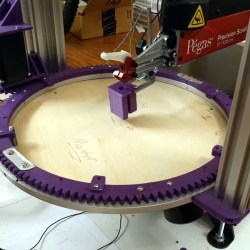
I was enchanted by a failed project this week. [Andrew Consroe]’s CNC scroll saw doesn’t work yet, but the emphasis is on the word “yet”. Heck, even when it does work, it might not make sense, but that’s not the point anyway.
cncsaw_thumb.jpg?w=250

A scroll saw table has a vertical reciprocating blade perpendicular to a table, a lot like a band saw but with a shorter blade. You push the wood sheet to be cut into the blade, and because it’s thin, you can twist and turn all sorts of interesting jigsaw-puzzle shapes. [Andrew] automated this with an X-Y gantry and an innovative geared rotating ring, needed to keep the wood fed into the cutting edge of the blade.

It’s a crazy contraption, and a difficult and unique movement planning problem, and watching it move in the video is a joy. But it’s not working either: errors in the motion add up over a cut, and he’s ended up snapping a blade on every piece. And this is version three of the device!

But here comes the inspiration. First, the only reason he’s filming this is to keep a log of how the project looked at this phase — he’s already planning out the next one. Second, this is the soul of learning by doing. You don’t learn anything unless you’re trying something new.

And finally, [Andrew]’s project reminds me of why I love machine builds in the age of rapid prototyping. Blazing through three entirely different machines cost him essentially nothing. Tearing apart version one left him with the same stepper motors, aluminum extrusions, and electronics as when he started out. Except that he now knew so much more about his particular problem space. Now he’s ready to go again.

So if you’re at all robotically inclined, but you’re looking at the cost of motors, belts, bearings, and steel, don’t think of it as an expense for this project, but for years’ worth of iterations, and maybe even fully different machines.

Just be sure to take [Andrew]’s lead and get it down and documented before you take it apart! Heck, send it in to Hackaday and it’ll live forever.

Rolling Out A New Robot Arm

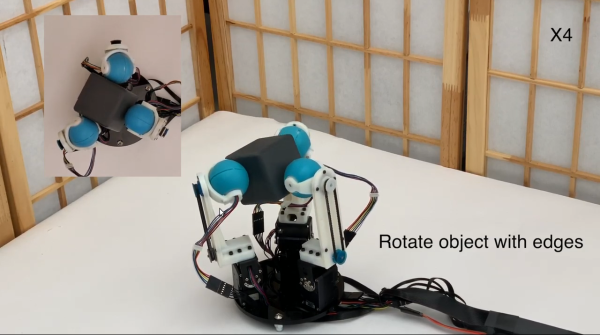
A lot of great scientific breakthroughs come through imitating nature, but technology often runs up against limits in certain areas. This is particularly evident in robotics, where it takes a lot of effort (and cost) to build a robot which can effectively manipulate heavy objects but not crush others which are more delicate. For that, a research group has looked outside of nature, developing a robotic grasper which uses omnidirectional wheels to grab various objects.

The robot hand is composed of three articulating fingers with fingertips which are able to actively manipulate the object that the hand is holding. With static fingertips, it is difficult to manipulate an object in the hand itself, but with the active surfaces at the fingertips it becomes easier to rotate the object without setting it down first or dropping it.

The project is much more than designing the robot hand itself, too. The robot uses calculated kinematics to manipulate the objects as well, but a second mode was also tried where the robot was able to “learn” how to handle the object it was given. The video linked below shows both modes in operation, with interesting results. If you prefer more biologically-inspired robot arms, though, there are always novel designs based on non-humans.

Continue reading “Rolling Out A New Robot Arm”

Dexter The Companion Bot Wants To Give You Five

The main character of Dexter’s Laboratory is a genius child inventor who inspired a lot of fans to become makers and inventors in their own right. [Jorvon Moss] a.k.a. [Odd_Jayy] counts himself as one of them. A serial companion bot builder, his projects are constantly evolving. But every once in a while he pauses long enough to share construction details. Like how we can build our own monkey companion bot Dexter named after the cartoon.

A slightly earlier iteration of Dexter attended Hackaday Superconference 2019. Perched on [Odd_Jayy]’s back, Dexter joined in a presentation on companion bots. We’ve been a fan of his work since Asi the robot spider and several more robots have been posted online since. Recently at Virtually Maker Faire 2020, he joined [Alex Glow] and [Angela Sheehan] to talk about their respective experiences Making Companion Bots.

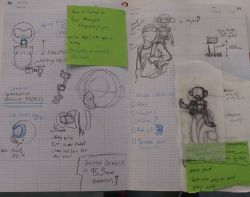
Sketchbook pages with Dexter concept drawings[Odd_Jayy] starts with sketches to explore how a project will look and act, striving to do something new and interesting every time. One of Dexter’s novelties is adding interactivity to companion bots. Historically people couldn’t do much more than just look at a companion bot, but Dexter can high five their fans! Sometimes the excited robot monkey ends up slapping [Odd_Jayy] instead, but they’re working through issues in their relationship. Everyone is invited to see rapid cycles of iterative improvements on Twitter and Instagram. As of this writing, a mini Dexter is underway with design elements similar to the “Doc Eyes” goggle project running in parallel. It’s always fun to watch these creations evolve. And by openly sharing his projects both online and off, [Odd_Jayy] is certainly doing his part to inspire the next wave of makers and inventors.

Unique Strandbeest Stands Tall With Line Of Legs

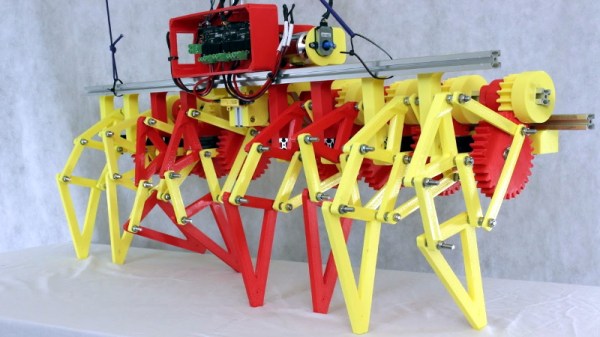
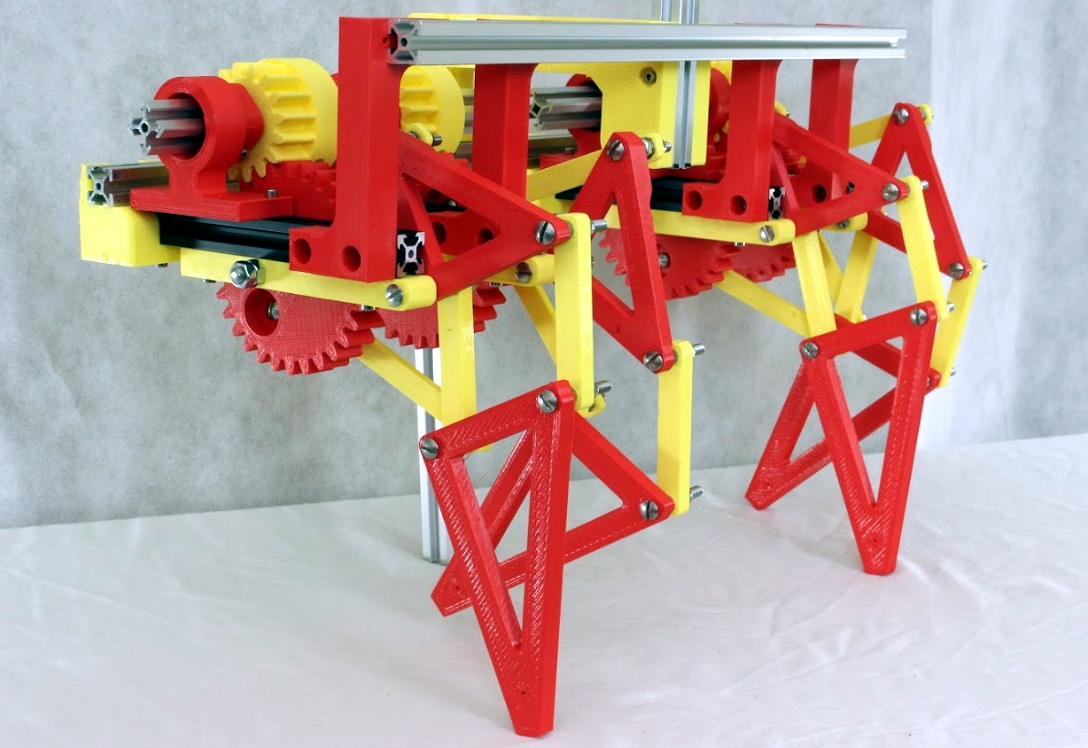
Multiple rows of intricately articulated legs are the defining characteristic of the Strandbeest, but [James Bruton] wondered if he could reduce that down to a single row using the same principles at work in a self-balancing two wheeled robot. While it’s perhaps a bit early to call his experiments a complete success, the first tentative steps taken by his (relatively) svelte Strandbeest certainly look promising.

Initially the robot only had two pairs of legs, but in testing [James] found this arrangement to be a bit unstable. By bringing the total count to four legs per side and improving the counterweight arrangement, the bot has been able to walk the length of the workshop. Unfortunately, an issue with the leg design seems to be preventing the Strandbeest from taking any backward steps.

Normally this wouldn’t be that big of a problem, but in this case it’s keeping the Strandbeest from being able to self-balance while standing still. In other words, the robot needs to keep moving forward or it will fall over. Still, [James] thinks the idea has promise and wants to continue experimenting with the bot in a larger area.

Specifically, he wants to see if the dual-motor robot can turn by varying the speed the two sets of legs are running at. If it can walk in a tight enough circle, it could keep right on marching until the power runs down. Sounds more than a little nightmarish to us, but we’d still like to see it.

Reader’s may recall [James] from this other another robotic projects, such as the phenomenal OpenDog. We don’t know where his obsession of legged robots comes from, but we certainly aren’t complaining.

Continue reading “Unique Strandbeest Stands Tall With Line Of Legs”

Dual-Wielding Robot Carves 3D Shapes From Foam With Warped Wire

“Every block of expanded polystyrene foam has a statue inside it and it is the task of the dual-arm hot wire-wielding robot to discover it.” — [Michelangelo], probably.

Be prepared to have your mind blown by this dual-wielding hot-wire 3D foam cutter (PDF). We’ve all seen simple hot-wire cutters before, whether they be manual-feed cutters or CNC-controlled like a 3D-printer. The idea is to pass current through a wire to heat it up just enough to melt a path as it’s guided through a block of polystyrene foam. Compared to cutting with a knife or a saw, hot-wire cuts are smooth as silk and produces mercifully little of that styrofoam detritus that gets all over your workspace.

But hot-wire cutters can’t do much other than to make straight cuts, since the wire must be kept taut. “RoboCut”, though, as [Simon Duenser] and his colleagues at ETH Zurich call their creation, suffers from no such limitations. Using an ABB YuMi, a dual-arm collaborative robot, they devised a method of making controlled curved cuts through foam by using a 1-mm thick deformable rod rather than a limp and floppy wire for the cutting tool. The robot has seven degrees of freedom on each arm, and there’s only so much the rod can deform before being permanently damaged, so the kinematics involved are far from trivial. Each pass through the foam is calculated to remove as much material as possible, and multiple passes are needed to creep up on the final design.

The video below shows the mesmerizing sweeps needed to release the Stanford bunny trapped within the foam, as well as other common 3D test models. We’re not sure it’s something easily recreated by the home-gamer, but it sure is fun to watch.

Continue reading “Dual-Wielding Robot Carves 3D Shapes From Foam With Warped Wire”

Useless Machine For An Existential Quandary

There’s no project that dives into existential quandaries more than a useless machine, as they can truly illustrate the futility of existence by turning themselves off once they have been powered on. Typically this is done with a simple switch, but for something that can truly put the lights out, and then re-illuminate them, [James]’s latest project is a useless machine that performs this exercise with a candle.

The project consists of two arms mounted on a set of gears. One arm has a lighter on it, and the other has a snuffer mounted to a servo motor. As the gears rotate, the lighter gets closer to the candle wick and lights it, then the entire assembly rotates back so the snuffer can extinguish the flame. Everything is built around an Arduino Nano, a motor driver powering a Pitman gear motor, and a set of Hall effect sensors which provide position data back to the microcontroller.

If you’re in the mood for a little existential angst in your own home, [James] has made the project files available on his GitHub page. We always appreciate a useless machine around here, especially a unique design like this one, and one which could easily make one recognize the futility of lighting a candle at all.

Continue reading “Useless Machine For An Existential Quandary”

Assemble Your (Virtual) Robotic Underground Exploration Team

It’s amazing how many things have managed to move online in recent weeks, many with a beneficial side effect of eliminating travel making them more accessible to everyone around the world. Though some events had a virtual track before it was cool, among them the DARPA Subterranean Challenge (SubT) robotics competition. Recent additions to their “Hello World” tutorials (with promise of more to come) have continued to lower the barrier of entry for aspiring roboticists.

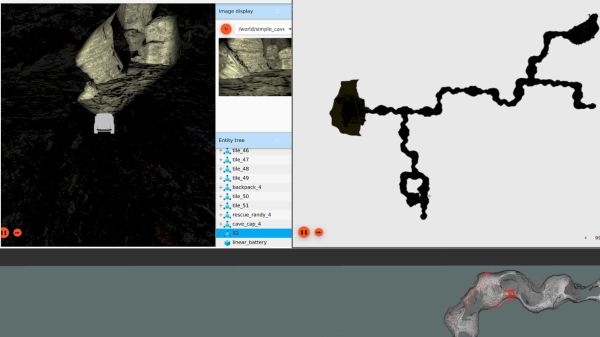
We all love watching physical robots explore the real world, which is why SubT’s “Systems Track” gets most of the attention. But such participation is necessarily restricted to people who have the resources to build and transport bulky hardware to the competition site, which is just a tiny subset of all the brilliant minds who can contribute. Hence the “Virtual Track” which is accessible to anyone with a computer that meets requirements. (64-bit Ubuntu 18 with NVIDIA GPU) The tutorials help get us up and running on SubT’s virtual testbed which continues to evolve. With every round, the organizers work to bring the virtual and physical worlds closer together. During the recent Urban Circuit, they made high resolution scans of both the competition course as well as participating robots.

There’s a lot of other traffic on various SubT code repositories. Motivated by Bitbucket sunsetting their Mercurial support, SubT is moving from Bitbucket to GitHub and picking up some housecleaning along the way. Together with the newly added tutorials, this is a great time to dive in and see if you want to assemble a team (both of human collaborators and virtual robots) to join in the next round of virtual SubT. But if you prefer to stay an observer of the physical world, enjoy this writeup with many fun details on systems track robots.