Piddler Illustrates Aliasing And The Z-Transform

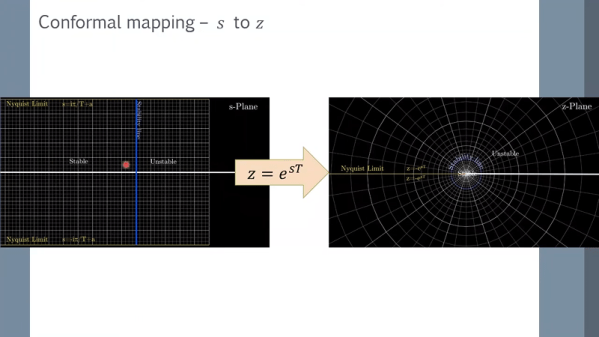
One of the problems about learning too much control system theory is that you start to realize almost everything is some sort of control system. That’s the case with [Fernando Zigunov]. After observing a Rayleigh-Plateau instability in his kitchen sink, he decided to build a little display piece that shows water apparently defying gravity that he calls The Piddler.

We’ve seen things like this before, of course. A coffee pump, a check valve, and a strobe lamp with a controller is all that it takes. What makes this project interesting is the over hour-long video lecture on the theory behind why this works and how it relates to aliasing and the z-transform. You can check out the video, below.

Continue reading “Piddler Illustrates Aliasing And The Z-Transform”

High Voltage Experiment Pipes Power With Water

The idea of transferring energy with water isn’t exactly new. In fact, it’s downright ancient. Running water has been tapped to power our contrivances since folks were getting excited about that new library they were opening up over in Alexandria. But what if there was a way to deliver power with water that wasn’t kinetic, and instead relied on the electrical properties of the planet’s favorite libation?

That’s exactly what [Jay Bowles] set out to explore with his latest experiment. Since water (we know, not pure water) conducts electricity, it stands to reason that it could be used as a stand-in for traditional copper wiring. Why would you want to do such a thing? Because unlike wires, water can easily morph into whatever shape may be required, and can be moved around and controlled with nothing more complex than ball valves.
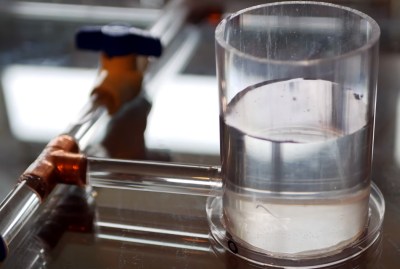
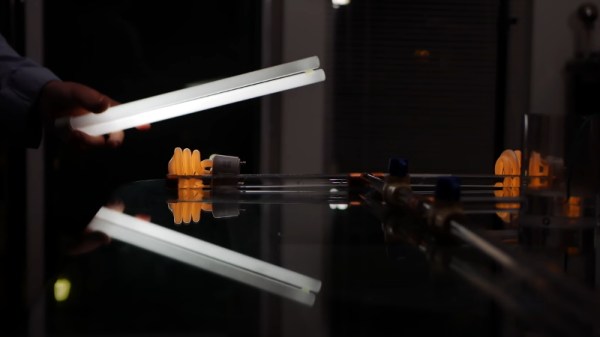
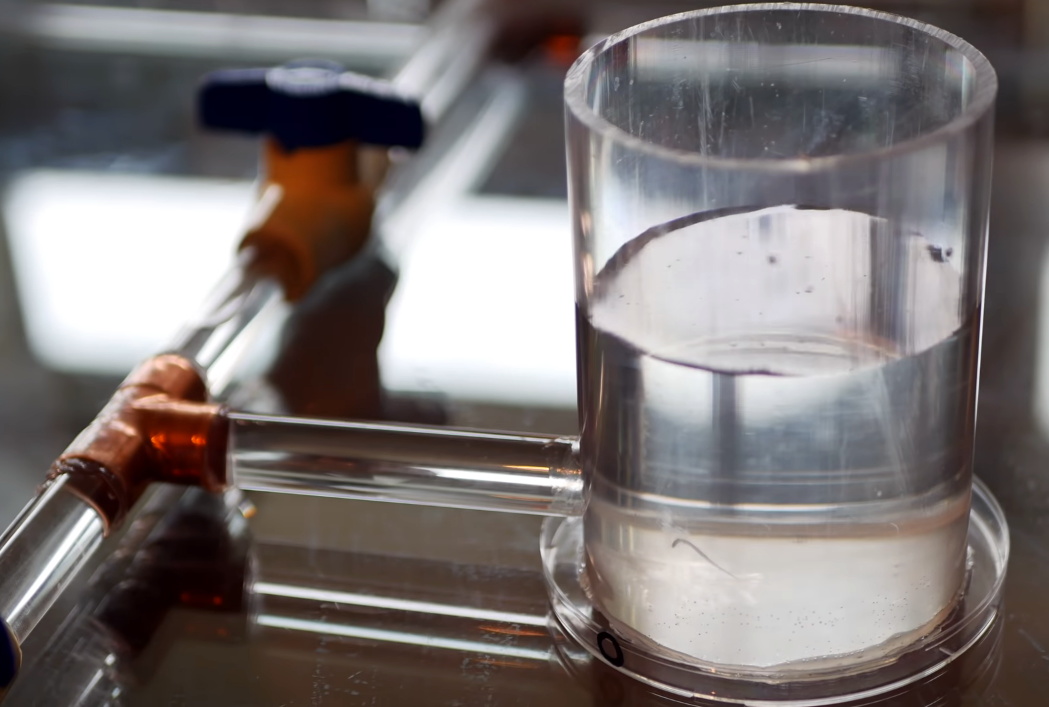
To test this concept, [Jay] put together a water distribution system out of simple acrylic tubing. A reservoir was attached to one of his high voltage generators, and copper caps were placed at the end of the tubes to serve as direct attachment points for devices.

But thanks to capacitive coupling, the fluorescent lights he uses don’t actually need to be physically connected to light up. As demonstrated in the video after the break, the lights surrounding the system can be independently controlled just by turning their respective valves on and off; all without any physical contact being made.

Of course, compared to traditional wiring there are plenty of downsides to this idea. Copper wires don’t tend to freeze in the winter and spring a leak, nor do they build up bubbles of explosive hydrogen gas. So it’s safe to say the wiring in your house probably won’t ever be replaced with a tube of charged water. But [Jay] does have some interesting ideas of how this technique could be used in non-traditional ways. For example, he describes how outdoor lighting could be powered by the energy radiating from a small stream.

Even if the practical applications of this technique are somewhat limited, there’s no question that it’s a fascinating idea. Believing that he’s the first person to ever demonstrate power transmission under these specific circumstances, he’s decided to call the concept “Bowles Transmission”. We’d love to see somebody use this principle in one of their projects, and we’re willing to bet so would [Jay].

As with his recent ozone sterilization experiments, we imagine this idea is going to be met with some debate. But that’s sort of the point. [Jay] doesn’t claim to have all the answers, and hopes these videos get people thinking and talking. As they say, nothing great was ever achieved without enthusiasm.

Continue reading “High Voltage Experiment Pipes Power With Water”

Crunching Giant Data From The Large Hadron Collider

Modern physics experiments are often complex, ambitious, and costly. The times where scientific progress could be made by conducting a small tabletop experiment in your lab are mostly over. Especially, in fields like astrophysics or particle physics, you need huge telescopes, expensive satellite missions, or giant colliders run by international collaborations with hundreds or thousands of participants. To drive this point home: the largest machine ever built by humankind is the Large Hadron Collider (LHC). You won’t be surprised to hear that even just managing the data it produces is a super-sized task.

Since its start in 2008, the LHC at CERN has received several upgrades to stay at the cutting edge of technology. Currently, the machine is in its second long shutdown and being prepared to restart in May 2021. One of the improvements of Run 3 will be to deliver particle collisions at a higher rate, quantified by the so-called luminosity. This enables experiments to gather more statistics and to better study rare processes. At the end of 2024, the LHC will be upgraded to the High-Luminosity LHC which will deliver an increased luminosity by up to a factor of 10 beyond the LHC’s original design value.

Currently, the major experiments ALICE, ATLAS, CMS, and LHCb are preparing themselves to cope with the expected data rates in the range of Terabytes per second. It is a perfect time to look into more detail at the data acquisition, storage, and analysis of modern high-energy physics experiments. Continue reading “Crunching Giant Data From The Large Hadron Collider”

A Smart Bandage For Monitoring Chronic Wounds

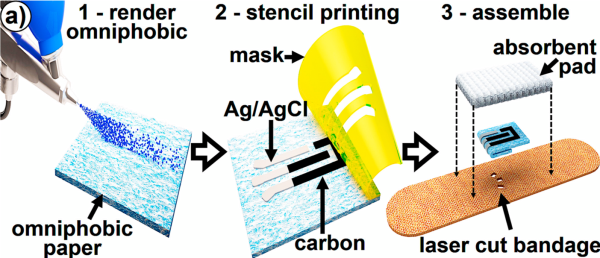
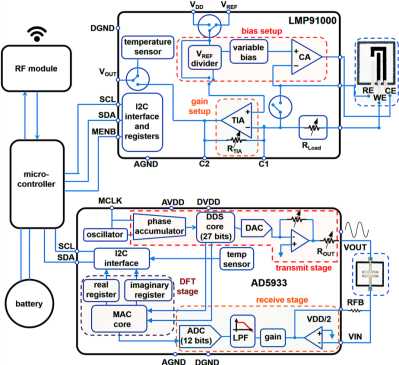
Here at Hackaday, we’re always enthralled by cool biohacks and sensor development that enable us to better study and analyze the human body. We often find ourselves perusing Google Scholar and PubMed to find the coolest projects even if it means going back in time a year or two. It was one of those scholarly excursions that brought us to this nifty smart bandage for monitoring wound healing by the engineers of FlexiLab at Purdue University. The device uses an omniphobic (hydrophobic and oleophobic) paper-based substrate coupled with an onboard impedance analyzer (AD5933), an electrochemical sensor (the same type of sensor in glucometers) for measuring uric acid and pH (LMP91000), and a 2.4 GHz antenna for wirelessly transmitting the data (nRF24L01). All this is programmed with an Arduino Nano. They even released their source code.

To detect uric acid, they used the enzyme uricase, which is very specific to uric acid and exhibits low cross-reactivity with other compounds. They drop cast uric acid onto a silver/silver chloride electrode printed on the omniphobic paper. Similarly, to detect pH, they drop cast a pH-responsive polymer called polyaniline emeraldine salt (PANI-ES) between two separate silver/silver chloride electrodes. All that was left was to attach the electrodes to the LMP91000, do a bit of programming, and there they were with their own electrochemical sensor. The impedance analyzer was a bit simpler to develop, simply attaching un-modified electrodes to the AD5933 and placing the electrodes on the wound.

The authors noted that the device uses a much simpler manufacturing process compared to smart bandages published by other academics, being compatible with large-scale manufacturing techniques such as roll-to-roll printing. Overcoming manufacturing hurdles is a critical step in getting your idea into the hands of consumers. Though they have a long way to go, FlexiLab appears to be on the right track. We’ll check back in every so often to see what they’re up to.

Until then, take a look at some other electric bandage projects on Hackaday or even make your own electrochemical sensor.

Open Source Raman Spectrometer Is Cheaper, But Not Cheap

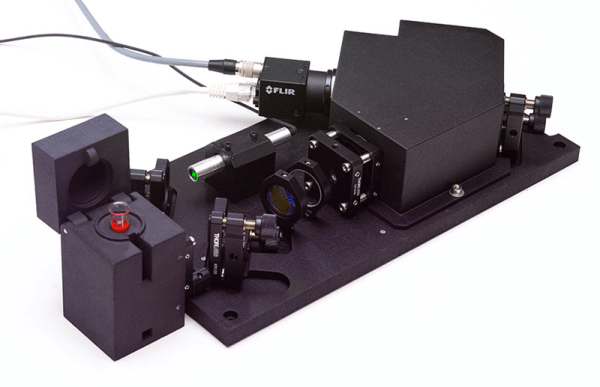
Raman spectrography uses the Raman scattering of photons from a laser or other coherent light beam to measure the vibrational state of molecules. In chemistry, this is useful for identifying molecules and studying chemical bonds. Don’t have a Raman spectroscope? Cheer up! Open Raman will give you the means to build one.

The “starter edition” replaces the initial breadboard version which used Lego construction, although the plans for that are still on the site, as well. [Luc] is planning a performance edition, soon, that will have better performance and, presumably, a greater cost.

Continue reading “Open Source Raman Spectrometer Is Cheaper, But Not Cheap”

Measuring The Speed Of Light In 1927

It is hard to remember that a lot of high tech research went on well before the arrival of electronic computers, lasers, and all the other things that used to be amazing but are now commonplace. That’s why we enjoyed [Michel van Biezen’s] two part post on how Michelson computed the speed of light in 1927. You can see the videos below.

Michelson wasn’t the first, of course. Galileo tried. He sent an assistant to the top of a hill with a lantern. When the assistant saw Galileo’s lantern, he was to uncover his lantern. They practiced near each other to account for reaction time. But when the assistant was 3 km away, it didn’t take any more time. The implication was that light traveled instantaneously, but, of course, it is actually just really fast.

By 1927, Michelson tried what was in effect the same technique but with better technology, and this time they put a reflector about 35 km away meaning the light had to go to the reflector and back for a total of about 70 km.

Continue reading “Measuring The Speed Of Light In 1927”

Lego Microscope Does Research

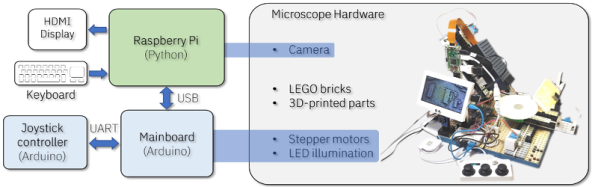
We’ve seen a lot of practical machines built using Lego. Why not? The bricks are cheap and plentiful, so if they can get the job done, who cares if they look like a child’s toy? Apparently, not [Yuksel Temiz]. He’s an engineer for IBM whose job involves taking pictures of microscopic fluidic circuits. When he wasn’t satisfied with the high-power $10,000 microscopes he had, he built his own. Using Lego. How are the pictures? Good enough to appear in many scientific journals.

Clearly, the microscope doesn’t just contain Lego, but it still came in at under $300. According to an interview from Futurism, the target devices are reflective which makes photographing them straight-on difficult. After experimenting with cameras on tripods, [Yuksel] decided he could build his own specialized device. You can see a video of the devices in question and some of the photographs below.

Continue reading “Lego Microscope Does Research”