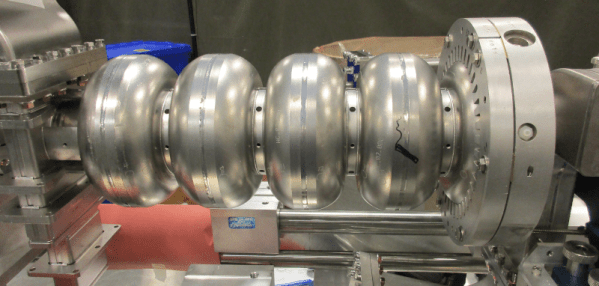
A circular metal vessel is shown, with a symmetrical rotor of four vanes standing inside. At the bottom of the vessel are four loudspeakers.

Building An Acoustic Radiometer

A Crookes radiometer, despite what many explanations claim, does not work because of radiation pressure. When light strikes the vanes inside the near-vacuum chamber, it heats the vanes, which then impart some extra energy to gas molecules bouncing off of them, causing the vanes to be pushed in the opposite direction. On the other hand, however, it is possible to build a radiometer that spins because of radiation pressure differences, but it’s easier to use acoustic radiation than light.

[Ben Krasnow] built two sets of vanes out of laser-cut aluminium with sound-absorbing foam attached to one side, and mounted the vanes around a jewel bearing taken from an analog voltmeter. He positioned the rotor above four speakers in an acoustically well-sealed chamber, then played 130-decibel white noise on the speakers. The aluminium side of the vanes, which reflected more sound, experienced more pressure than the foam side, causing them to spin. [Ben] tested both sets of vanes, which had the foam mounted on opposite sides, and they spun in opposite directions, which suggests that the pressure difference really was causing them to spin, and not some acoustic streaming effect.

The process of creating such loud sounds burned out a number of speakers, so to prevent this, [Ben] monitored the temperature of a speaker coil at varying amounts of power. He realized that the resistance of the coil increased as it heated up, so by measuring its resistance, he could calculate the coil’s temperature and keep it from getting too hot. [Ben] also tested the radiometer’s performance when the chamber contained other gasses, including hydrogen, helium, carbon dioxide, and sulfur hexafluoride, but none worked as well as air did. It’s a bit counterintuitive that none of these widely-varying gasses worked better than air did, but it makes sense when one considers that speakers are designed to efficiently transfer energy to air.

It’s far from an efficient way to convert electrical power into motion, but we’ve also seen several engines powered by acoustic resonance. If you’d like to hear more about the original Crookes radiometers, [Ben]’s also explained those before.

Hackers Can’t Spend A Penny

We aren’t here to praise the penny, but rather, to bury it. The penny, and its counterparts, have been vanishing all around the world as the cost of minting one far outweighs its value. But hackers had already lost a big asset: real copper pennies, and now even the cheaply made ones are doomed to extinction.

If you check your pockets and find a pre-1982 penny, it’s almost all copper. Well, 95% of its slightly-more-than-3-gram heft is pure copper. Since then, the copper penny’s been a fraud, weighing 2.5 g and containing only a 2.5% copper plate over a zinc core. During WWII, they did make some oddball steel pennies, but that was just a temporary measure.

Continue reading “Hackers Can’t Spend A Penny”

Meet The Shape That Cannot Pass Through Itself

Can a shape pass through itself? That is to say, if one had two identical solids, would it be possible to orient one such that a hole could be cut through it, allowing the other to pass through without breaking the first into separate pieces? It turns out that the answer is yes, at least for certain shapes. Recently, two friends, [Sergey Yurkevich] and [Jakob Steininger], found the first shape proven not to have this property.

A 3D-printed representation of a cube passing through itself [image: Wikipedia]
Back in the late 1600s, Prince Rupert of the Rhine proved it was possible to accomplish this feat with two identical cubes. One can tilt a cube just so, and the other cube can fit through a tunnel bored through it. A representation is shown here.

Later, researchers showed this was also true of more complex shapes. This ability to pass unbroken through a copy of oneself became known as Rupert’s Property. Sometimes it’s an amazingly tight fit, but it seems to always work.

Continue reading “Meet The Shape That Cannot Pass Through Itself”

A microscope objective is sitting on a spool of solder in a metal tin, in front of a circuit board which has wires running away from it.

Watching Radioactive Decay With A Homemade Spinthariscope

Among the many science toys that have fallen out of fashion since we started getting nervous around things like mercury, chlorinated hydrocarbons, and radiation is the spinthariscope, which let people watch the flashes of light on a phosphor screen as a radioactive material decayed behind it. In fact, they hardly expose their viewers to any radiation, which makes [stoppi]’s homemade spinthariscope much safer than it might first seem.

[Stoppi] built the spinthariscope out of the eyepiece of a telescope, a silver-doped zinc sulfide phosphor screen, and the americium-241 capsule from a smoke detector. A bit of epoxy holds the phosphor screen in the lens’s focal plane, and the americium capsule is mounted on a light filter and screwed onto the eyepiece. Since americium is mainly an alpha emitter, almost all of the radiation is contained within the device.

After sitting in a dark room for a few minutes to let one’s eyes adjust, it’s possible to see small flashes of light as alpha particles hit the phosphor screen. The flashes were too faint for a smartphone camera to pick up, so [stoppi] mounted it in a light-tight metal box with a photomultiplier and viewed the signal on an oscilloscope, which revealed many small pulses.

Continue reading “Watching Radioactive Decay With A Homemade Spinthariscope”

A photo of a brushed motor and brushless motor with a brushless controller board

An Introduction To DC Motor Technology

[Thinking Techie] takes us back to basics in a recent video explaining how magnets, coils, brushed DC motors, and brushless DC motors work. If this is on your “to learn” list, or you just want a refresher, you can watch the video below. It’ll be ten minutes well-spent.

The video covers the whole technology stack behind the humble DC motor in its various incarnations. Starting with basic magnetic effects, it then proceeds through 2-wire brushed DC motors and finally into 3-wire brushless DC motors (BLDC motors).

Continue reading “An Introduction To DC Motor Technology”

WWII Secret Agents For Science

We always enjoy [History Guy]’s musing on all things history, but we especially like it when his historical stories intersect with technology. A good example was his recent video about a small secret group during the Second World War that deployed to the European Theater of Operations, carrying out secret missions. How is that technology related? The group was largely made of scientists. In particular, the team of nineteen consisted of a geographer and an engineer. Many of the others were either fluent in some language or had been through “spy” training at the secret Military Intelligence Training Center at Camp Ritchie, Maryland. Their mission: survey Europe.

Continue reading “WWII Secret Agents For Science”

I/V plot at various voltage levels

2025 Component Abuse Challenge: Reverse Biasing An NPN BJT

For the Component Abuse Challenge our hacker [Tim Williams] observes that N-P-N reads the same way forwards and backwards, so… what happens if we reverse bias one? (Note: this remark about N-P-N reading the same forward and backward is a lighthearted joke; in fact the level of doping in the emitter and collector is different so those Ns are not fungible and will exhibit different properties and have different characteristics.)

What happens if we reverse bias an NPN transistor?In the margin you can see how the question was originally posed by Bob Pease back in March 18, 1996.

In his article [Tim] mentions that some transistors are specifically designed to operate when reverse biased, which [Tim] calls “inverted mode”, whereas most transistors are not designed to work in this fashion and that’s the sort of abuse that could damage the component and lead it to malfunction.

But what is Vout? [Tim] reports that he measured approximately -0.4 volts using his high-impedance meter. We tried this experiment in the lab ourselves but we were not able to duplicate [Tim]’s result; however there is a long list of potential reasons for such an outcome. If you do this experiment yourself we would love to hear about your results in the comments section!

If you’re still learning about transistors you might like to check out our five part series on transistors as amplifiers, starting here: Won’t Somebody, Please, Think Of The Transistors!

Thanks to [Tim] for his submission, we wish him the best of luck in the competition!