Neutrinos are some of the most elusive particles that are well-known to science. These tiny subatomic particles have no electric charge and an extremely small mass, making them incredibly difficult to detect. They are produced in abundance by the sun, as well as by nuclear reactions on Earth and in supernovae. Despite their elusive nature, scientists are keen to detect neutrinos as they can provide valuable information about the processes that produce them.
Neutrinos interact with matter so rarely that it takes a very special kind of detector to catch them in the act. These detectors come in a few different flavors, each employing its unique method to spot these elusive particles. In this article, we’ll take a closer look at how these detectors work and some of the most notable examples of neutrino detectors in the world today.
Data science is a relatively new term for a relatively old discipline. Essentially, it is data analysis, particularly for large data sets. It involves techniques as wide-ranging as statistics, computer science, and information theory. What to know more? Stanford has a “Data Science Handbook” that you can read online.
Topics range from how to design a study and create an analytic plan to how to do data visualization, summarization, and analysis. The document covers quite a bit but is very concise.
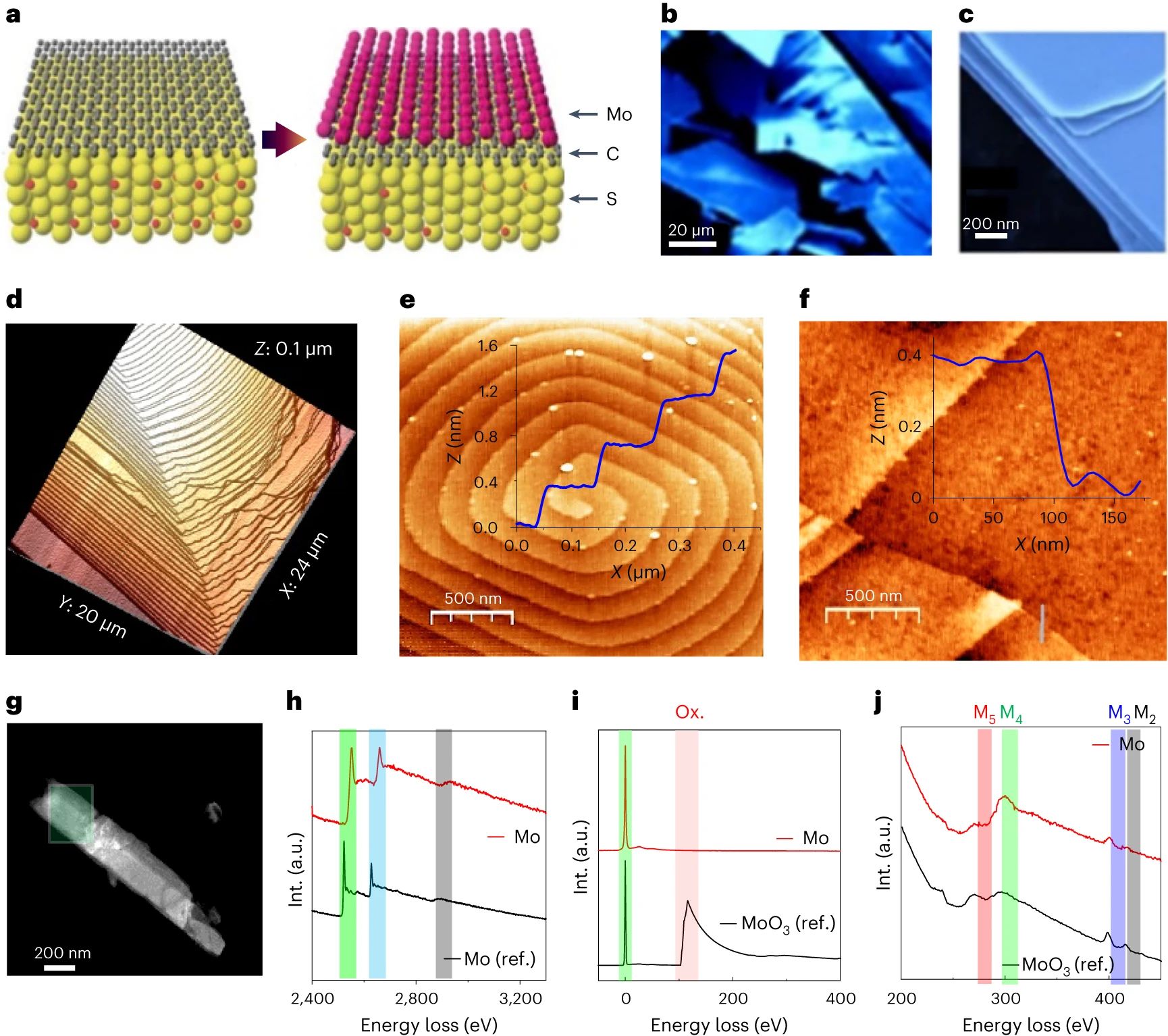
Amidst all the (well-deserved) hype around graphene, it’s important to remember that its properties are not unique to carbon. More atoms can be coaxed into stable 2-dimensional configuration, with molybdenene previously theoretically possible. This is now demonstrated by Tumesh Kumar Sahu and colleagues in a recent Nature Nanotechnology article, through the manufacturing of a 2D molybdenum-based material which they showed to be indeed molybdenene. Essentially, this is a 2D lattice of molybdenum atoms, a configuration in which it qualifies as Dirac matter, just like graphene. For those of us unfamiliar with Dirac materials, this gentle introduction by Jérôme Cayssol in Comptes Rendus Physique might be of use.
Manufacturing process of molybdenene. (Credit: Sahu et al., 2023)
In order to create molybdenene, the researchers started with molybdenum disulfide (MoS2), which using a microwave-assisted field underwent electrochemical transformation into whiskers that when examined turned out to consist out of monolayers of Mo. The sulfur atoms were separated using a graphene sheet. As is typical, molybdenene sheets were exfoliated using Scotch tape, in a process reminiscent of the early days of graphene research.
Much like graphene and other Dirac materials, molybdenene has many potential uses as a catalyst, as cantilever in scanning electron microscope (SEM) tips, and more. If the past decades of research into graphene has demonstrated anything, it is that what once seemed more of a novelty, suddenly turned out to have endless potential in fields nobody had considered previously. One of these being as coatings for hard disk platters, for example, which has become feasible due to increasingly more efficient ways to produce graphene in large quantities.
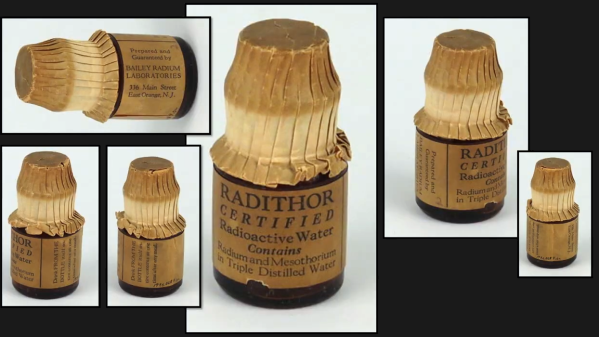
Take a little time to watch the history of Radithor, a presentation by [Adam Blumenberg] into a quack medicine that was exactly what it said on the label: distilled water containing around 2 micrograms of radium in each bottle (yes, that’s a lot.) It’s fascinatingly well-researched, and goes into the technology and societal environment surrounding such a product, which helped play a starring role in the eventual Food, Drug, and Cosmetic Act of 1938. You can watch the whole presentation in the video, embedded below the break. Continue reading “Radioactive Water Was Once A (Horrifying) Health Fad”→
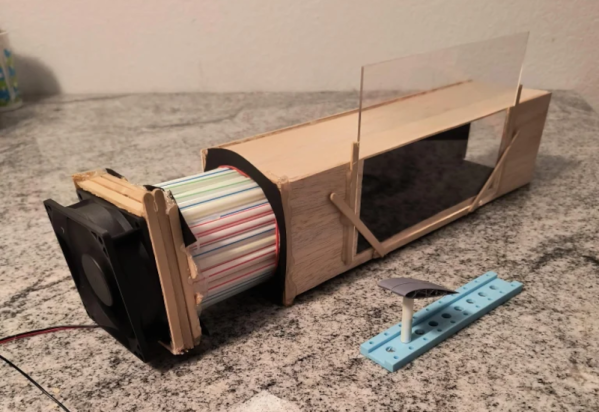
If you watch the movies, there isn’t much to a wind tunnel. Just a fan and a tunnel, right? The truth is there’s a lot more to it than that, and [ejs13] shows you how you can make a small tunnel with some basic supplies. One of the requirements for a useful tunnel is to have laminar flow — that is, flow in uniform layers with little, if any, mixing. This tunnel achieves laminar flow using an array of soda straws to direct the flow. In fact, there are 150 straws in total. You can see a short clip of the wind tunnel in action below.
The rest of the parts are easy, too. A computer fan provides wind, and there’s a little bit of wood and acrylic. You’ll notice in the video that you can easily see the airflow. That’s thanks to a light source, some water, and a bit of dry ice.
Scientists have found what they think may be the fastest known semiconductor. Sounds great, right? But it happens to made from one of the rarest elements: rhenium. That rare element combines with selenium and chlorine to form a “superatom.” Unlike conventional semiconductor material, the superatom causes phonons to bind together and resist scattering. This should allow materials that can process signals in femtoseconds,
Rhenium was the last stable element to be found in 1925. It is primarily used in combination with nickel in parts of jet engines, although it is also known as a catalyst for certain reactions. It is very rare and has a high melting point, exceeded only by tungsten and carbon. When it was discovered, scientists extracted a single gram of the material by processing 660 kg of molybdenite. Because of its rarity, it is expensive, costing anywhere from $2,800 to $10,600 per kilogram.
Although it probably feels like forever to many of us since Category 5 Ethernet cabling became prevalent, now that 2.5 and even 5 Gbit Ethernet has trickled into the mainstream, a pertinent question that many probably end up asking, is when you should replace Cat-5e wiring with Cat-6, or even Cat-7. Since most of us are likely to use copper network wiring for the foreseeable future in our domiciles and offices, it is a good question that deserves a good answer. Although swapping a Cat-5e patch cable with a Cat-7 one between a network port and computer is easy enough, replacing all the network cable already pulled through the conduits of a ‘future-proofed’ home is not.
The good news is probably that Category 8 Class II (Cat-8.2) is all you need to run your 40 Gbit Ethernet network with standard twisted pair wiring. The bad news is that you’re limited to runs of only thirty meters before signal degradation begins to kick in. If you take things down a notch to Cat-6A or Cat-7 (ISO/IEC 11801 Class EA and F, respectively), you can do 100 meter runs at 10 Gbit/s just like 100 meters runs at 1 Gbit/s were possible with Cat-5e before. Yet what differentiates these categories exactly?