Hackaday Links Column Banner

Hackaday Links: June 9, 2024

We’ve been harping a lot lately about the effort by carmakers to kill off AM radio, ostensibly because making EVs that don’t emit enough electromagnetic interference to swamp broadcast signals is a practical impossibility. In the US, push-back from lawmakers — no doubt spurred by radio industry lobbyists — has put the brakes on the move a bit, on the understandable grounds that an entire emergency communication system largely centered around AM radio has been in place for the last seven decades or so. Not so in Japan, though, as thirteen of the nation’s 47 broadcasters have voluntarily shut down their AM transmitters in what’s billed as an “impact study” by the Ministry of Internal Affairs and Communications. The request for the study actually came from the broadcasters, with one being quoted in a hearing on the matter as “hop[ing] that AM broadcasting will be promptly discontinued.” So the writing is apparently on the wall for AM radio in Japan.

Continue reading “Hackaday Links: June 9, 2024”

Happy Birthday, Tetris!

Porting DOOM to everything that’s even vaguely Turing complete is a sport for the advanced hacker. But if you are just getting started, or want to focus more on the physical build of your project, a simpler game is probably the way to go. Maybe this explains the eternal popularity of games like PONG, Tetris, Snake, or even Pac-Man. The amount of fun you can have playing the game, relative to the size of the code necessary to implement them, make these games evergreen.

Yesterday was Tetris’ 40th birthday, and in honor of the occasion, I thought I’d bring you a collection of sweet Tetris hacks.

On the big-builds side of things, it’s hard to beat these MIT students who used colored lights in the windows of the Green Building back in 2012. They apparently couldn’t get into some rooms, because they had some dead pixels, but at that scale, who’s complaining? Coming in just smaller, at the size of a whole wall, [Oat Foundry]’s giant split-flap display Tetris is certainly noisy enough.

Smaller still, although only a little bit less noisy, this flip-dot Tetris is at home on the coffee table, while this one by [Electronoobs] gives you an excuse to play around with RGB LEDs. And if you need a Tetris for your workbench, but you don’t have the space for an extra screen, this oscilloscope version is just the ticket. Or just play it (sideways) on your business card.

All of the above projects have focused on the builds, but if you want to tackle your own, you’ll need to spend some time with the code as well. We’ve got you covered. Way back, former Editor in Chief [Mike Szczys] ported Tetris to the AVR platform. If you need color, this deep dive into the way the NES version of Tetris worked also comes with demo code in Java and Lua. TetrOS is the most minimal version of the game we’ve seen, coming in at a mere 446 bytes, but it’s without any of the frills.

No Tetris birthday roundup would be complete without mentioning the phenomenal “From NAND to Tetris” course, which really does what it says on the package: builds a Tetris game, and your understanding of computing in general, from the ground up.

Can you think of other projects to celebrate Tetris’ 40th? We’d love to see your favorites!

Hackaday Podcast Episode 274: Capstan Robots, Avionics Of Uncertain Purpose, And What The Frack?

What do capstans, direct conversion receivers, and fracking have in common? They were all topics Hackaday editors Elliot Williams and Al Williams found fascinating this week. If you wonder what makes an electrical ground a ground, or what a theodolite is, you should check it out.

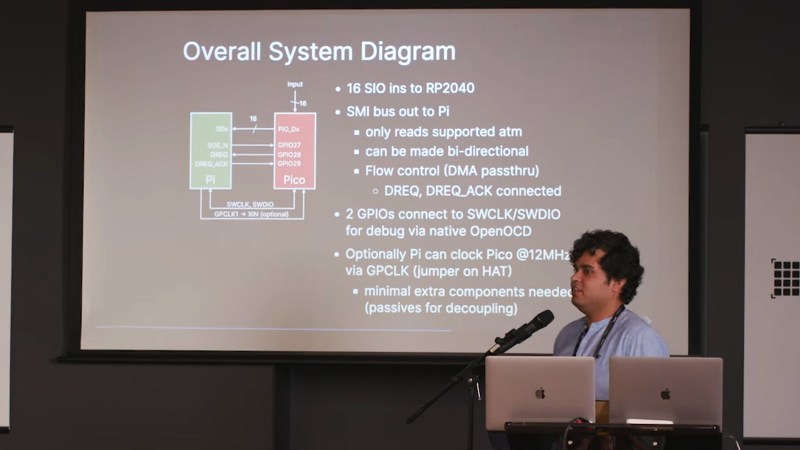
This week, the hacks came fast and furious. Capstans, instead of gears, work well for 3D-printed mechanisms, a PI Pico can directly receive radio signals, and the guys saw a number of teardowns and reverse engineering triumphs. You’ll also find solid-state heat pumps, flying wings, spectroscopy, and more.

The can’t miss articles this week? Learn about theodolites, a surveying feat from ancient Greece, and how fracking works.

Check out the links below if you want to follow along, and as always, tell us what we’ve mispronounced — or any other thoughts on the episode — in the comments!

Download an archival copy for your personal collection.

Continue reading “Hackaday Podcast Episode 274: Capstan Robots, Avionics Of Uncertain Purpose, And What The Frack?”

This Week In Security: Recall, Modem Mysteries, And Flipping Pages

Microsoft is racing to get into the AI game as part of Windows 11 on ARM, calling it Copilot+. It’s an odd decision, but clearly aimed at competing with the Apple M series of MacBooks. Our focus of interest today is Recall, a Copilot+ feature that not only has some security problems, but also triggers a sort of visceral response from regular people: My computer is spying on me? Eww.

Yes, it really sort of is. Recall is a scheme to take screen shots of the computer display every few seconds, run them through character recognition, and store the screenshots and results in a database on the local machine hard drive. There are ways this could be useful. Can’t remember what website had that recipe you saw? Want to revisit a now-deleted tweet? Is your Google-fu failing you to find a news story you read last week? Recall saw it, and Recall remembers. But what else did Recall see? Every video you watched, ever website you visited, and probably some passwords and usernames you typed in.

Continue reading “This Week In Security: Recall, Modem Mysteries, And Flipping Pages”

Hands On: Inkplate 6 MOTION

Over the last several years, DIY projects utilizing e-paper displays have become more common. While saying the technology is now cheap might be overstating the situation a bit, the prices on at least small e-paper panels have certainly become far more reasonable for the hobbyist. Pair one of them with a modern microcontroller such as the RP2040 or ESP32, sprinkle in a few open source libraries, and you’re well on the way to creating an energy-efficient smart display for your home or office.

But therein lies the problem. There’s still a decent amount of leg work involved in getting the hardware wired up and talking to each other. Putting the e-paper display and MCU together is often only half the battle — depending on your plans, you’ll probably want to add a few sensors to the mix, or perhaps some RGB status LEDs. An onboard battery charger and real-time clock would be nice as well. Pretty soon, your homebrew e-paper gadget is starting to look remarkably like the bottom of your junk bin.

For those after a more integrated solution, the folks at Soldered Electronics have offered up a line of premium open source hardware development boards that combine various styles of e-paper panels (touch, color, lighted, etc) with a microcontroller, an array of sensors, and pretty much every other feature they could think of. To top it off, they put in the effort to produce fantastic documentation, easy to use libraries, and free support software such as an online GUI builder and image converter.

We’ve reviewed a number of previous Inkplate boards, and always came away very impressed by the attention to detail from Soldered Electronics. When they asked if we’d be interested in taking a look at a prototype for their new 6 MOTION board, we were eager to see what this new variant brings to the table. Since both the software and hardware are still pre-production, we won’t call this a review, but it should give you a good idea of what to expect when the final units start shipping out in October.

Continue reading “Hands On: Inkplate 6 MOTION”

Mining And Refining: Fracking

Normally on “Mining and Refining,” we concentrate on the actual material that’s mined and refined. We’ve covered everything from copper to tungsten, with side trips to more unusual materials like sulfur and helium. The idea is to shine a spotlight on the geology and chemistry of the material while concentrating on the different technologies needed to exploit often very rare or low-concentration deposits and bring them to market.

This time, though, we’re going to take a look at not a specific resource, but a technique: fracking. Hydraulic fracturing is very much in the news lately for its potential environmental impact, both in terms of its immediate effects on groundwater quality and for its perpetuation of our dependence on fossil fuels. Understanding what fracking is and how it works is key to being able to assess the risks and benefits of its use. There’s also the fact that like many engineering processes carried out on a massive scale, there are a lot of interesting things going on with fracking that are worth exploring in their own right.
Continue reading “Mining And Refining: Fracking”

Pasteurisation: Probably Why You Survived Childhood

There’s an oft-quoted maxim that youngsters growing up on farms have a much stronger immune system than those growing up in cities. The idea is that they are exposed to far more dirt and eat food much closer to the field than their urban cousins. Without the help of a handy microbiologist or epidemiologist it’s difficult to judge its veracity, but personal experience suggests that the bit about dirt may be true at least.

It’s Dangerous To Idealise The Past.

It’s likely that the idea of rural kids seeing more bugs may come from the idea that those in the cities consume sterile processed food from the supermarket, it plays into a notion of an idealised past in which a somehow purer diet came more directly from its source. Somehow so the story goes, by only eating pasteurised and preserved foods, city dwellers are eating something inferior, stripped of its goodness. There’s a yearning for a purer alternative, something supermarkets are only too happy to address by offering premium products at elevated prices. So, was the diet of the past somehow more wholesome, and are those kids having their future health ruined by Big Food? Perhaps it’s time to turn back the clock a little to find out.

A mostly black cow in a field of green grass
Even clean cows have bugs. Carolyn Parsons, CC BY-SA 4.0.

It’s likely everyone knows that food  spoils if left unattended for long enough. Some foods, such as grain, can last a long time if kept dry, while others such as milk will go bad quite quickly. Milk in particular goes bad for two reasons; firstly because it’s an excellent bacterial growth medium, and secondly because it contains plenty of bacteria by its very nature. Even very clean cows have bugs.

If you lived in most large cities in the nineteenth century, the Industrial Revolution had likely placed you far enough from the nearest cow that your milk had a significant journey to make to reach you even with up-to-date rail transport. Without refrigeration, during that journey it had become a bacterial soup to the extent that even though it might not yet have gone sour, it had certainly become a bacterial brew. It was thus responsible for significant numbers of infections, and had become a major health hazard. So much for the purer diet consumed by city kids of the past. Continue reading “Pasteurisation: Probably Why You Survived Childhood”