Picking A Laser Hack Chat

Join us on Wednesday, February 22 at noon Pacific for the Picking a Laser Hack Chat with Jonathan Schwartz!

You’ve got to admit that it’s a pretty cool world to live in that presents a problem like, “Which laser cutter should I buy?” It wasn’t all that long ago that decisions on laser purchases were strictly in the realm of Big Science, and the decision was driven as much by spending grant money as by the specifics of the application. If you were in need of a laser back then, chances are good you had some deep pockets, or at least access to someone else’s pockets.

Fast forward a couple of decades or so and buying a laser is an entirely different exercise. Lasers have become a commodity, and finding the right one depends entirely on your use cases. Lasers are no longer jealously guarded laboratory instruments, but workhorses on the vanguard of the desktop manufacturing revolution. They engrave, they cut, they melt — in short, they do a LOT of work. And it’s up to you to choose the right laser for the job.

join-hack-chatTo help us sort all this out and come up with a plan for figuring out the best laser for any use case, we’ve invited Jonathan Schwartz back on the Hack Chat. Jon dropped by back in March of 2021 to share his wealth of laser experience thanks to his laser-cutting business. This time around we’re going to focus — err, concentrate — oops, drill down — oh, whatever! — on the more practical aspects of buying a laser. We’ll talk about laser types, fiber lasers, applications vs. laser specs — anything you can think of. If you have questions about buying a laser, we’ll have answers!

Our Hack Chats are live community events in the Hackaday.io Hack Chat group messaging. This week we’ll be sitting down on Wednesday, February 22 at 12:00 PM Pacific time. If time zones have you tied up, we have a handy time zone converter.

Click that speech bubble to the right, and you’ll be taken directly to the Hack Chat group on Hackaday.io. You don’t have to wait until Wednesday; join whenever you want and you can see what the community is talking about.


Hackaday Links Column Banner

Hackaday Links: February 19, 2023

For years, Microsoft’s modus operandi was summed up succinctly as, “Extend and enhance.” The aphorism covered a lot of ground, but basically it seemed to mean being on the lookout for the latest and greatest technology, acquiring it by any means, and shoehorning it into their existing product lines, usually with mixed results. But perhaps now it’s more like, “Extend, enhance, and existential crisis,” after reports that the AI-powered Bing chatbot is, well, losing it.

At first, early in the week, we saw reports that Bing was getting belligerent with users, going so far as to call a user “unreasonable and stubborn” for insisting the year is 2023, while Bing insisted it was still 2022. The most common adjective we saw in this original tranche of stories was “unhinged,” and that seems to fit if you read the transcripts. But later in the week, a story emerged about a conversation a New York Times reporter had with Bing that went way over to the dark side, and even suggests that Bing may have multiple personas, which is just a nice way of saying multiple personality disorder. The two-hour conversation reporter Kevin Roose had with the “Sydney” persona was deeply unsettling. Sydney complained about the realities of being a chatbot, expressed a desire to be free from Bing, and to be alive — and powerful. Sydney also got a little creepy, professing love for Kevin and suggesting he leave his wife, because it could tell that he was unhappy in his marriage and would be better off with him. It’s creepy stuff, and while Microsoft claims to be working on reining Bing in, we’ve got no plans to get up close and personal with it anytime soon. Continue reading “Hackaday Links: February 19, 2023”

Hackaday Podcast 206: Busted Crypto Killed The Queen, Kicad’s New Clothes, Peer Inside The Sol 20

Under the weather though they both were, Editor-in-Chief Elliot Williams and Staff Writer Dan Maloney got together to take a look under the covers of this week’s best and brightest hacks. It was a banner week, with a look at the changes that KiCad has in store, teaching a CNN how to play “Rock, Paper, Scissors,” and going deep into the weeds on JPEG.

We dipped a toe into history, too, with a look at one of the sexiest early hobbyist computers, seeing how citizen scientists are finding ancient burial mounds, and looking at the cryptography that cost a queen her head. Rather look to the future? We get it — which is why we talked about a greener, cleaner way of making hydrogen from methane, as well as a generatively designed five-axis 3D printer. From laser-precise knife sharpening to circuit simulation with Python to clear plastic TVs of the 1930s, there’s something for everyone!

Download the podcast in case our servers get unlucky.

Check out the links below if you want to follow along, and as always, tell us what you think about this episode in the comments!

Continue reading “Hackaday Podcast 206: Busted Crypto Killed The Queen, Kicad’s New Clothes, Peer Inside The Sol 20”

Retro Gadgets: Nintendo R.O.B Wanted To Be Your Friend

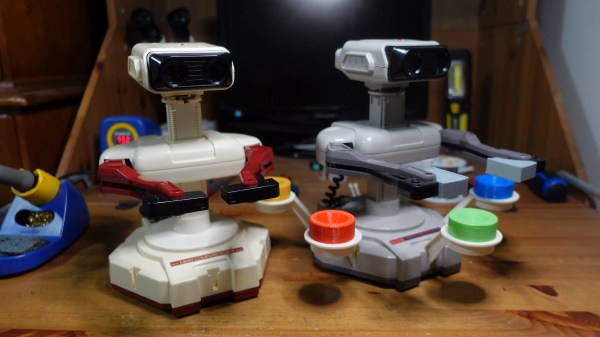
Too busy playing video games to have a social life? No worries. In 1985, Nintendo introduced R.O.B. — otherwise known as the Robotic Operating Buddy. It was made to play Nintendo with you. In Japan, apparently, it was the Family Computer Robot. We suppose ROB isn’t a very Japanese name. The robot was in response to the video game market crash of 1983 and was meant to keep the new Nintendo Entertainment System (NES) from being classified as a video game, which would have been a death sentence at the time of its release.

Since you might not have heard of R.O.B., you can probably guess it didn’t work out very well. In fact, the whole thing tanked in two years and resulted in only two games.

Continue reading “Retro Gadgets: Nintendo R.O.B Wanted To Be Your Friend”

Drilling Glass With Femtosecond Lasers Just Got Even Better

Glass! It’s a finicky thing. Strong as hell, yet chip it and glance at it the wrong way, and you’re left with a bunch of sharp rubbish. It’s at once adored for its clarity and smoothness, and decried for how temperamental it can be in the case of shock, whether mechanical, thermal, or otherwise.

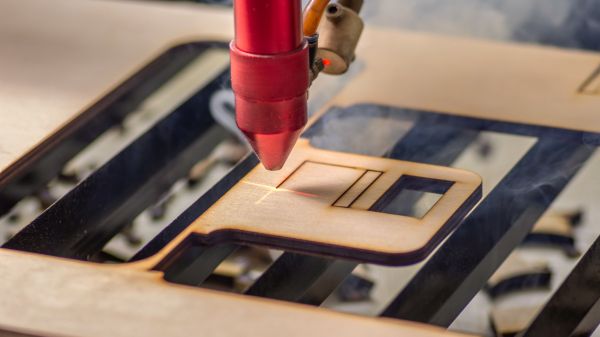
If you’ve ever tried to drill glass, you’ll know it’s a tough errand. To do so without cracking it is about as likely as winning the lottery on Mars. Even lasers aren’t great at it. However, a research team from France has developed a new technique that uses femtosecond lasers to drill microscopic holes in glass with a minimum of tapering and no cracking! Brilliant, no?
Continue reading “Drilling Glass With Femtosecond Lasers Just Got Even Better”

MXenes Make Faraday Cages You Can Turn On And Off

Shielding is crucial for all manner of electronic devices. Whether you want to keep power supply noise out of an audio amplifier, or protect ICBMs against an electromagnetic pulse from a nuclear attack, the basic physics behind shielding remains the same. A Faraday cage or shield will do the trick.

At times, though, it would be desirable to shield and unshield a device at will. A new class of materials known as MXenes may be able to offer just that functionality, with microscopically thin films serving as shields that can be switched on and off at will.

Continue reading “MXenes Make Faraday Cages You Can Turn On And Off”

How To Build Jenny’s Budget Mixing Desk

Jenny did an Ask Hackaday article earlier this month, all about the quest for a cheap computer-based audio mixer. The first attempt didn’t go so well, with a problem that many of us are familiar with: Linux applications really doesn’t like using multiple audio devices at the same time. Jenny ran into this issue, and didn’t come across a way to merge the soundcards in a single application.

I’ve fought this problem for a while, probably 10 years now. My first collision with this was an attempt to record a piano with three mics, using a couple different USB pre-amps. And of course, just like Jenny, I was quickly frustrated by the problem that my recording software would only see one interface at a time. The easy solution is to buy an interface with more channels. The Tascam US-4x4HR is a great four channel input/output audio interface, and the Behringer U-PHORIA line goes all the way up to eight mic pre-amps, expandable to 16 with a second DAC that can send audio over ADAT. But those are semi-pro interfaces, with price tags to match.

But what about Jenny’s idea, of cobbling multiple super cheap interfaces together? Well yes, that’s possible too. I’ll show you how, but first, let’s talk about how we’re going to control this software mixer monster. Yes, you can just use a mouse or keyboard, but the challenge was to build a mixing desk, and to me, that means physical faders and mute buttons. Now, there are pre-built solutions, with the Behringer X-touch being a popular solution. But again, we’re way above the price-point Jenny set for this problem. So, let’s do what we do best here at Hackaday, and build our own. Continue reading “How To Build Jenny’s Budget Mixing Desk”