Join Hackaday Editor-in-Chief Elliot Williams and Managing Editor Tom Nardi for a recap of all the best tips, hacks, and stories of the past week. We start things off with an update on Hackaday’s current slate of contests, followed by an exploration of the cutting edge in 3D printing and printables. Next up we’ll look at two achievements in detection, as commercial off-the-shelf hardware is pushed into service by unusually dedicated hackers to identify both dog poop and deep space pulsars (but not at the same time). We’ll also talk about fancy Samsung cables, homebrew soundcards, the surprising vulnerability of GPS, and the development of ratholes in your cat food.
There’s a danger in security research that we’ve discussed a few times before. If you discover a security vulnerability on a production system, and there’s no bug bounty, you’ve likely broken a handful of computer laws. Turn over the flaw you’ve found, and you’re most likely to get a “thank you”, but there’s a tiny chance that you’ll get charged for a computer crime instead. Security research in the US is just a little safer now, as the US Department of Justice has issued a new policy stating that “good-faith security research should not be charged.”
While this is a welcome infection of good sense, it would be even better for such a protection to be codified into law. The other caveat is that this policy only applies to federal cases in the US. Other nations, or even individual states, are free to bring charges. So while this is good news, continue to be careful. There are also some caveats about what counts as good-faith — If a researcher uses a flaw discovery to extort, it’s not good-faith. Continue reading “This Week In Security: Good Faith, Easy Forgery, And I18N”→
So you just built a super-mega robot project that you want to share with the world. Super! But now you’re faced with an entirely new and different problem: documenting the process for the world to see. It’s enough to drive you back down into the lab.
What software should I use to create my project site?
How deep down the rabbit hole should I go when it comes to documenting the project?
What toppings do I want on my something-to-eat-while-hacking pizza?
We’re not going to get into the age old “pineapple or no pineapple” debate, but it’s important to note that the topic of how to share a project with the world has as many choices as toppings, and just as many opinions. The answer will always be simple: Do what works best for you!
The purpose of this article is to give some options to somebody considering sharing their projects online. There isn’t enough room to talk about every single option available to a hacker, so be sure to fill in your favorite options in the comments below. Let’s dive in!
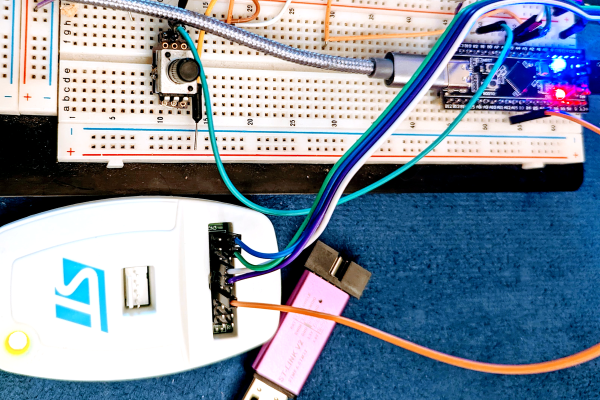
I’ll confess. Although printf-style debugging has a bad rep, I find myself turning to it on occasion. Sure, printf is expensive and brings in a lot of code, but if you have the space and time to use it while debugging you can always remove it before you are finished. However, what if you don’t have an output device or you are using it for something else? If you are using most modern ARM chips, you have another option — a dedicated output channel that is used for several things, including debugging output. I decided I wanted to try that on the Blackpill running mbed, and found out it isn’t as easy as you might think. But it is possible, and when you are done reading, you’ll be able to do it, too.
I’m writing this using the STM32-specific ST-LINK hardware. If you use other JTAG devices like the BlackMagic probe, you probably already have this set up for you.
What You Get
I’ll start backward with the end result, then talk about the software, so you’ll be good and motivated by the time you get to the hardware requirements. Spoiler alert: your existing hardware might need a quick hack to make it work, although you can buy something off the shelf if you prefer.
Here is a very simple test program:
SWO_Channel debugport;  // requires #include "SWO.h"
int main()
  {
  unsigned count=0;
  debugport.printf("\r\nHello World from SWO\r\n");
  debugport.printf("CPU SystemCoreClock is %d Hz\r\n", SystemCoreClock);

  while (1)
    {
    led = !led; // flip LED if output is true
    ThisThread::sleep_for(rate); // sleepy time
    if (count % 10) debugport.putc('*'); else debugport.printf("%d\r\n",count);
    count++;
    }
}
The rise of streaming services on the Internet was a revolutionary shift when it came to the world of media. No more would content be pumped in to homes in a one-way fashion, broadcast by major conglomerates and government-run organizations. Instead, individuals would be free to hunt for content suiting their own desires on an all-you-can-watch basis.
It’s led to a paradigm shift in the way we consume media. However, it’s also led to immense frustration thanks to the overwhelming amount of content on offer. Let’s take a look at why that is, and some creative ways you can get around the problem.
The Paradox of Choice
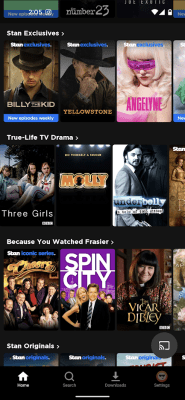
Many find the masses of content on streaming services to be overwhelming to choose from. Credit: author screenshot
Traditionally, when it came to media, there were two major arms of delivery: broadcast, and home media. One might listen to the radio, or flick on the TV, or alternatively, spin up a record, or select a movie to watch on tape. If none of those options sufficed, one might take a walk down to the local video store to rent something more appealing.
Fundamentally, it was an era in which choices were limited. There were a handful of TV stations to choose from, and if nothing good was on, you could go as far as finding something watchable on tape or going without. Many will remember afternoons and evenings spent watching reruns or a Friday night movie that had been on a million times before. Some shows went as far as becoming legends for their seemingly endless replay, from The Simpsons to M*A*S*H.
As the Internet grew, though, the game started to change. Torrent websites and streaming services came along, offering up the sum total of the world’s cultural output for free, or for a nominal cost for those averse to piracy. Suddenly when it came to choosing a movie to watch, one wasn’t limited to the five or so films on at the local cinema, nor what was left on the shelves at the local video rental. Instead, virtually any movie, from the invention of the format, could be yours to watch at a moment’s notice.
With so many options on the table, many of us find it harder to choose. It’s an idea popularly known as the Paradox of Choice, a term popularized by US psychologist Barry Schwartz in 2004. When our options are limited to a select few, choice is easy. They can quickly be compared and ranked and an ideal option chosen.
Add thousands of choices to the pile, and the job escalates in complexity to the point of becoming overwhelming. With so many different choices to contrast and compare, finding the mythical right choice becomes practically impossible. Continue reading “The Joy Of Broadcast Media Vs. The Paradox Of Choice”→
We don’t always acknowledge it, but most people have an innate need for music. Think of all the technology that brings us music. For decades, most of the consumer radio spectrum carried music. We went from records, to tape in various forms, to CDs, to pure digital. There are entire satellites that carry — mostly — music. Piracy aside, people are willing to pay for music, too. While it isn’t very common to see “jukeboxes” these days, there was a time when they were staples at any bar or restaurant or even laundrymat you happened to be in. For the cost of a dime, you can hear the music and share it with everyone around you.
Even before we could record music, there was something like a jukebox. Coin-operated machines, as you’ll recall, are actually very old. Prior to the 1890s, you might find coin-op player pianos or music boxes. These machines actually played the music they were set up to play using a paper roll with holes in it or metal disks or cylinders.
Early Days
That changed in 1890 when a pair of inventors connected a coin acceptor to an Edison phonograph. Patrons of San Francisco’s Palais Royale Saloon could put a hard-earned nickel in the slot and sound came out of four different tubes. Keep in mind there were no electronic amplifiers as we know them in 1890. Reportedly, the box earned $1,000 in six months.
Just as the Jedi youngling would have to build their light saber, so is it a rite of passage for a true geek to build their own computer interfaces. And nothing makes a personal computer more personal than a custom keyboard, a bespoke mouse, an omnipotent macropad, a snazzy jog wheel, or a fancy flight yoke.
In this contest, we encourage you to make your strangest, fanciest, flashiest, or most custom computer peripherals, and share that work with all the rest of us. Wired or wireless, weird or wonderful, we want to see it. And Digi-Key is sponsoring this contest to offer three winners an online shopping spree for $150 each at their warehouse! More parts, more projects.