As the Iraqi army retreated at the end of the first Gulf War, they took the term “scorched Earth policy” quite literally. Kuwaiti oil wells were set alight en masse, creating towering infernos that blackened the sky.
As it turns out, extinguishing a burning oil well is no easy feat. In the face of this environmental disaster, however, a firefighting team from Hungary made a name for themselves out on the desert sands, astride a jet-engined tank named Big Wind.
When starting a new electronics project today, one of the first things that we tend to do is pick the integrated circuits that make up the core of the design. This can be anything from a microcontroller and various controller ICs to a sprinkling of MOSFETs, opamps, and possibly some 7400- or 4000-series logic ICs to tie things together. Yet it hasn’t been that long since this level of high integration and miniaturization was firmly in the realm of science-fiction, with even NORBIT modules seeming futuristic.
Starting with the construction of the first point-contact transistor in 1947 and the bipolar junction transistor (BJT) in 1948 at Bell Labs, the electronics world would soon see the beginning of its biggest transformation to that point. Yet due to the interesting geopolitical circumstances of the 20th century, this led to a fascinating situation of parallel development, blatant copying of designs, and one of the most fascinating stories in technology history on both sides of the Iron Curtain. Continue reading “TTL And CMOS Logic ICs: The Building Blocks Of A Revolution”→
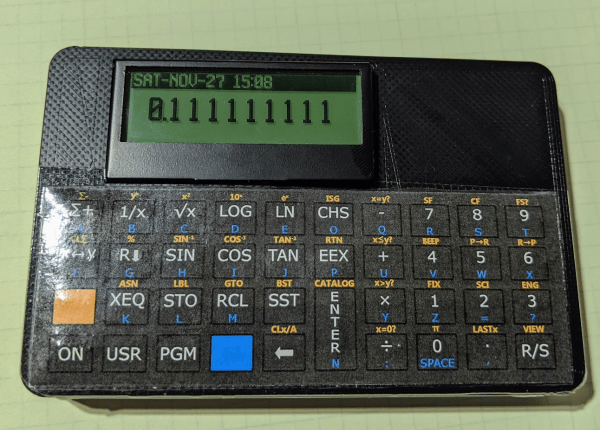
I have a confession to make. I write about a lot of projects for Hackaday, but there are very few I read about and then go actually build a copy of it. I don’t have a lot of time and I’m usually too busy building my own stuff. But once in a while, something strikes my fancy and I’ll either raid the junk box or buy the kit. The most recent case of that was the PX-41C, a replica of the classic HP-41C.
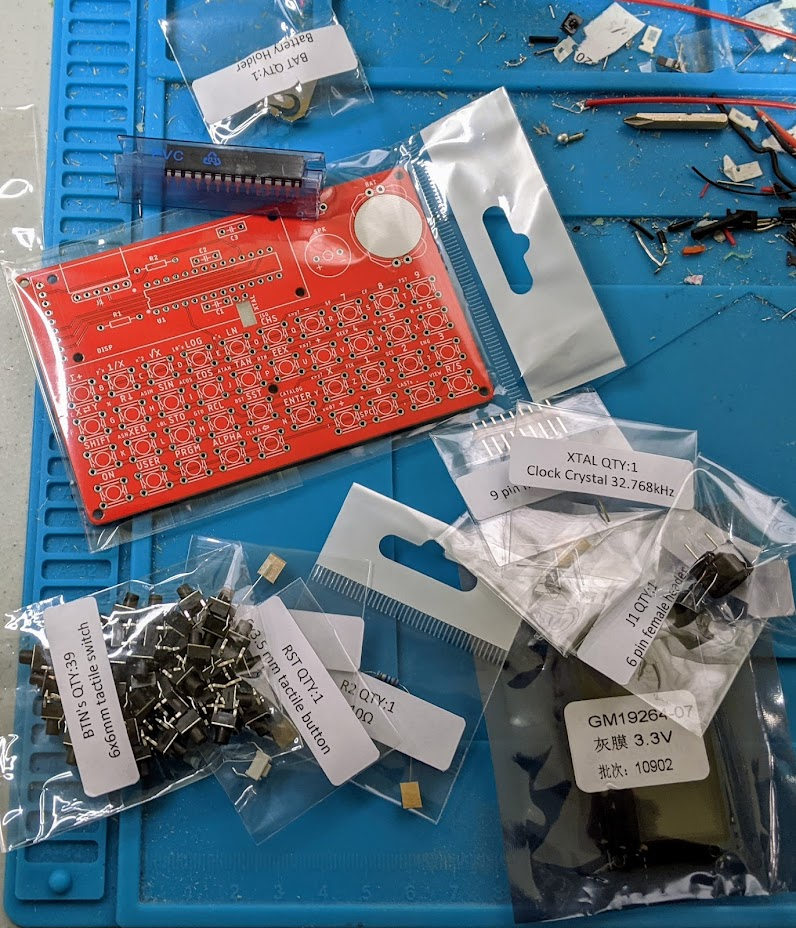
Nicely bagged parts.
The HP-41C is a somewhat legendary reverse-polish notation calculator. I still have my original HP-41C from 1979 (a very low serial number). It is still a workhorse but at 43 years old or so, I don’t like to leave it hanging around or near anything that might damage it. It has enough wear from the daily use it received 40 years ago. Sure, I have great emulation on my phone and I use that too, but the PX-41C kit looked fun, and with all through-hole parts it would be a quick build. The black Friday sale on Tindie sealed the deal for me.
Start-Up
The kit arrived on the Saturday after Thanksgiving, I decided to tackle it while waiting for some 3D prints. The components were all nicely bagged and marked. Tearing into the bags was a bit frustrating, but not hard and it did keep everything separate. There was a bill of materials, but — I thought — no instructions. Turns out the last part of the bill of materials is a link to some instructions. They aren’t much and I didn’t realize they were until after completing the board, but it isn’t hard to figure out. All the parts are marked on the silkscreen and you can probably figure it out — with a few caveats.
After the Thanksgiving break, we have two weeks of news to cover, so hang on for an extra-long entry. First up is GoDaddy, who suffered a breach starting on September 6th. According to an SEC filing, they noticed the problem on November 17th, and determined that there was unauthorized access to their provisioning system for their WordPress hosting service. For those keeping track at home, that’s two months and eleven days that a malicious actor had access. And what all was compromised? The email address and customer number of the approximate 1.2 million GoDaddy WordPress users; the initial WordPress password, in the clear; the SFTP and database passwords, also in the clear; and for some customers, their private SSL key.
The saving grace is that it seems that GoDaddy’s systems are segregated well enough that this breach doesn’t seem to have led to further widespread compromise. It’s unclear why passwords were stored in the clear beyond the initial setup procedure. To be safe, if you have a WordPress instance hosted by GoDaddy, you should examine it very carefully for signs of compromise, and rotate associated passwords. The SSL keys may be the most troubling, as this would allow an attacker to impersonate the domain. Given the length of time the attack had access, it would not surprise me to learn that more of GoDaddy’s infrastructure was actually compromised. Continue reading “This Week In Security: GoDaddy, Tardigrade, Monox, And BigSig”→
As the world grapples with the issue of climate change, there’s a huge pressure to move transport away from carbon-based fuels across the board. Whether it’s turning to electric cars for commuting or improving the efficiency of the trucking industry, there’s much work to be done.
It’s a drop in the ocean in comparison, but the world of motorsports has not escaped attention when it comes to cleaning up its act. As a result, many motorsports are beginning to explore the use of alternative fuels in order to reduce their impact on the environment.
Sales of electric vehicles continue to climb, topping three million cars worldwide last year. All these electric cars need batteries, of course, which means demand for rechargeable cells is through the roof.
All those cells have to come from somewhere, of course, and many are surprised to learn that automakers don’t manufacture EV batteries themselves. Instead, they’re typically sourced from outside suppliers. Today, you get to Ask Hackaday: why aren’t EV batteries manufactured by the automakers themselves? Continue reading “Ask Hackaday: Why Don’t Automakers Make Their Own EV Batteries?”→
It seems like there are two camps, the small group of people who care about UEFI and everyone else who doesn’t really notice or care as long as their computer works. So let’s talk about what UEFI is, how it came to be, what it’s suitable for, and why you should (or shouldn’t) care.