Hands On With Python 3.7: What’s New In The Latest Release

Used for general purpose programming, data science, website backends, GUIs, and pretty much everything else; the first programming language for many, and claimed to be the fastest growing in the world, is of course Python. The newest version 3.7.0 has just recently been released.
Naturally any release of Python, no matter how small, undergoes meticulous planning and design before any development is started at all. In fact, you can read the PEP (Python Enhancement Proposal) for Python 3.7, which was created back in 2016.

What’s new in 3.7? Why should you upgrade? Is there anything new that’s actually useful? I’ll answer these questions for you by walking through some examples of the new features. Whilst there’s not much in this release that will make a difference to the Python beginner, there’s plenty of small changes for seasoned coders and a few headline features you’ll want to know about.

Continue reading “Hands On With Python 3.7: What’s New In The Latest Release”

The Return Of RadioShack?

We’ve been following the ups and downs of Radio Shack for a while now, and it looks like another chapter is about to be penned in the storied retailer’s biography – and not Chapter 11 bankruptcy this time.

According to the ARRL website and major media reports, up to 50 of the 147 US locations of HobbyTown, the brick-and-mortar retailer of RC and other hobby supplies, will soon host a “RadioShack Express” outlet. Each outlet will be up to 500 square feet of retail space devoted to electronic components that would be of use to HobbyTown’s core customer base, as well as other merchandise and services.

HobbyTown locations in Mooresville, North Carolina, and Ontario, Ohio, will be among the first stores to get the RadioShack Express treatment. Current employees of the franchisees will staff the store-within-a-store, which will be stocked with RadioShack merchandise purchased by the store. Stores with Express outlets will have special RadioShack branding inside and out to attract customers. There’s talk of the deal being extended chain-wide if the pilot program goes well.

Back from the Ashes?

This is obviously great news for the beleaguered electronics retailer that was once a neighborhood fixture. True, its parts selection was often less than complete, more so in recent years than in the chain’s heyday in the mid-1970s and early 1980s. And it’s true that prices were often astronomical compared to buying online. But on a Sunday afternoon, The Shack was a lifesaver for that last minute part needed to finish a project, and the premium was well worth the convenience. Watching the decline of the chain and seeing stores disappear one by one was a slow, sad process, so that makes this seems like an unqualified positive development.

But is it? On the face of it, there’s a lot of synergy between the HobbyTown offerings and what could be stocked in a RadioShack Express. I’ve never actually visited a HobbyTown myself — I plan to fix that now that I know I’ve got an outlet nearby, even if it doesn’t appear to be on the list of 50 early Express locations — so I can only go by what I see listed online for merchandise. But a store that sells every conceivable part for RC cars and planes, drones, model rockets, and STEM-related toys and kits seems a likely place to find customers for RadioShack’s offerings.

It won’t be clear until someone sees one of these Express kiosks first hand and reports back, but it seems like we might see something like the old “cabinet o’ components” that was found in the back of the most recent incarnation of RadioShack retail stores, along with a few shelves full of things like solder, wire, and tools. There may also be some items in the Arduino-Pi space, which would be really exciting, although that might run afoul of existing HobbyTown offerings. Still, one-stop shopping of everything from servos to MOSFETs would be a huge win for electronics hobbyists.

Not the Cell Phones Again!

But there may be cause for concern. Reports are that RadioShack Express locations will also offer services such as cell phone repairs. Dipping a toe into the cell phone market seemed to be the beginning of the end for RadioShack the first time through, and by the time it was clear to everyone that the chain was on death’s door, it was hard to go into a RadioShack store without being bombarded by cell phone sales pitches. To be brutally frank, I don’t take the early inclusion of cell phone repairs as an encouraging sign of the long-term viability of the RadioShack Express concept. Do we really need another place that fixes cell phones? The areas that HobbyTown stores tend to locate are rife with places that fix phones already, so I just don’t see the point. And it just smacks of the bad old days of RadioShack.

Still, I’m cautiously optimistic that this is a positive development for RadioShack, and I think it’s a win for electronics hobbyists overall. I’ll be keeping my eye on my local HobbyTown for the return of that iconic RadioShack logo, and looking forward to the day that I can pay a buck for a resistor again. Until then, if any readers happen to be near one of the combined locations when they open next week, we’d love a boots-on-the-ground report. Post your observations in the comments below, and pix or it didn’t happen.

[via r/amateurradio]

Belgrade Badge Hacks

We’re still coming off the Hackaday Belgrade conference right now. If you were there, you know it was the greatest hardware conference ever. If you weren’t there, you missed out. Sorry. (Make sure you get in on the Hackaday Superconference in November.)

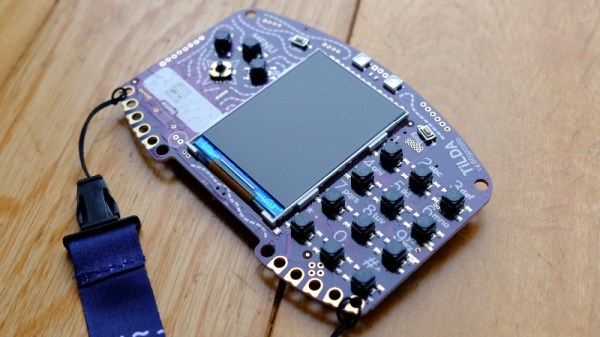
One of the many highlights of the Belgrade conference was, of course, the badge. The 2018 Hackaday Belgrade Badge is a masterpiece of hardware with a 55-key keyboard, RGB TFT LED, speaker, and a BASIC interpreter.

This badge is a masterpiece of electronic design by Voja Antonic. Just to take one small example from the design, check out the placement of the buttons. Think the slightly rotated buttons that make up the keyboard is only a stylistic choice? It’s not; by carefully rotating each button, the legs of each switch can fit in between each other. It’s brilliant.

Starting hardware this good, adding amazing software by Jaromir Sukuba to bring it to life, and distributing a badge to each hacker through the door is the perfect recipe for some amazing hacks. What were the best badge hacking tricks we saw at the 2018 Hackaday Belgrade conference? Check out the video of the badge hacking ceremonies and then join us below for a few of our favorites.

Continue reading “Belgrade Badge Hacks”

Using Pad Printers To Add Color To Artistic PCBs

I’ve done a few experiments in adding color to printed circuit boards. These experiments used a process known as pad printing, and so far all indications are that pad printing is a viable process for truly multicolor artistic PCBs. For this year’s DEF CON, I’m stepping things up and taking them to their logical conclusion. I’m making true multicolor PCBs with orange and blue ink. This is, I believe, the first time this has ever been done with printed circuit board art, and it is certainly the first time it has ever been documented.

You may be wondering why I need more color on my boards. It’s that time of year again where PCB artisans all around the world are gearing up for badgecon DEF CON. For the last few years, independent badge makers have come together to form a demoscene of hardware creation. This year, add-ons for badges are a thing, and everyone is getting in on the game. Tindie is filled with amazing electronic badges and add-ons that will be found at this year’s DEF CON. There are badges featuring the Cromulon from Rick and Morty, baby Benders from Futurama, pikachus, and glowing tacos.

This is all about badge art, but when it comes to rendering an image in fiberglass and soldermask, everyone is working with a limited palette. Yes, you can get pink and orange soldermask, but I can’t find a place that will do it inexpensively. For any PCB, your choice of colors are only green, red, yellow, blue, purple, black, or white. No, you can’t mix them.

But I want both orange and blue, on the same board, cheaply and easily — here’s how I did it.

Continue reading “Using Pad Printers To Add Color To Artistic PCBs”

Delta Clipper: A 1990s Reusable Single-Stage To Orbit Spaceship Prototype

With all the talk of SpaceX and Blue Origin sending rockets to orbit and vertically landing part or all of them back on Earth for reuse you’d think that they were the first to try it. Nothing can be further from the truth. Back in the 1990s, a small team backed by McDonnell Douglas and the US government vertically launched and landed versions of a rocket called the Delta Clipper. It didn’t go to orbit but it did perform some extraordinary feats.

Origin Of The Delta Clipper

DC-XAThe Delta Clipper was an unmanned demonstrator launch vehicle flown from 1993 to 1996 for testing vertical takeoff and landing (VTOL) single-stage to orbit (SSTO) technology. For anyone who watched SpaceX testing VTOL with its Grasshopper vehicle in 2012/13, the Delta Clipper’s maneuvers would look very familiar.

Initially, it was funded by the Strategic Defence Initiative Organization (SDIO). Many may remember SDI as “Star Wars”, the proposed defence system against ballistic missiles which had political traction during the 1980s up to the end of the Cold War.

Ultimately, the SDIO wanted a suborbital recoverable rocket capable of carrying a 3,000 lb payload to an altitude of 284 miles (457 km), which is around the altitude of the International Space Station. It also had to return with a soft landing to a precise location and be able to fly again in three to seven days. Part of the goal was to have a means of rapidly replacing military satellites should there be a national emergency.

The plan was to start with an “X” subscale vehicle which would demonstrate vertical takeoff and landing and do so again in three to seven days. A “Y” orbital prototype would follow that. In August 1991, McDonnell-Douglas won the contract for the “X” version and the possible future “Y” one. The following is the story of that vehicle and its amazing feats.

Continue reading “Delta Clipper: A 1990s Reusable Single-Stage To Orbit Spaceship Prototype”

What’s Inside A Scientology E-Meter?

This is something we’ve been waiting a very long time for. The Church of Scientology uses devices called E-Meters to measure Thetans in the body. We’re not going to discuss this further, because we don’t want to be murdered. In reality, the E-Meter is simply a device that costs five thousand dollars and only measures the resistance of the human body. It does this by having the subject hold two copper cylinders and a simple Wheatstone bridge. Why does the E-Meter cost five thousand dollars? As [Play With Junk] found out, it’s an exquisitely engineered piece of hardware.

[Play With Junk] acquired this E-Meter from eBay for something around $100, and from a system-level analysis, it’s really not anything special. There’s a fancy analog meter, yes, but most of this wouldn’t be out of place in any 90s-era piece of test equipment. There’s an 8051 microcontroller reading what are probably some fancy ADCs, and there’s an LCD driver on board. Slap it in a fancy injection-molded case, and you have an E-Meter.

What’s most impressive is the quality of the components that go into a machine that effectively only measures the resistance of the human body. The ‘trim’ pot is a Vishay wire-wound precision potentiometer that costs somewhere between $20 and $60. The power switch is an over-specced switch that probably costs $5. The control pots look and feel great, and the wiring is wrapped around chokes.

This is an exceptionally well-engineered device, and it shows. There’s an incredible amount of work that went into the electronics, and a massive amount of money that went into the fancy injection molded enclosure. If you’re looking for an example of a well-engineered tool, price be damned, you need only look at an E-Meter.

Check out the video below of the entire teardown.

Continue reading “What’s Inside A Scientology E-Meter?”