
Supercon 2024: Exploring The Ocean With Open Source Hardware

If you had to guess, what do you think it would take to build an ocean-going buoy that could not only survive on its own without human intervention for more than two years, but return useful data the whole time? You’d probably assume such a feat would require beefy hardware, riding inside an expensive and relatively large watertight vessel of some type — and for good reason, the ocean is an unforgiving environment, and has sent far more robust hardware to the briny depths.
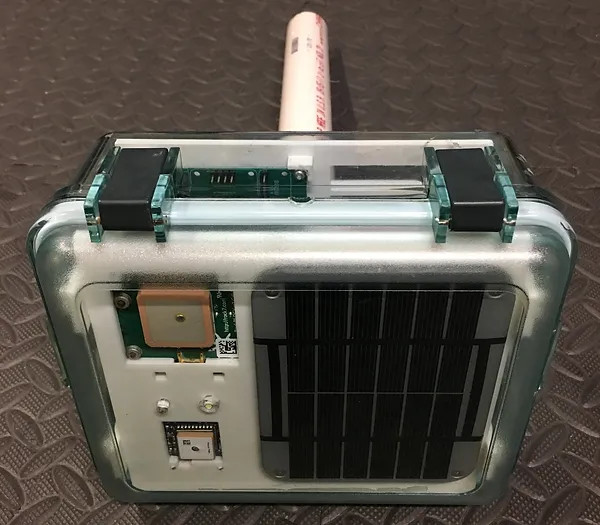
But as Wayne Pavalko found back in 2016, a little planning can go a long way. That’s when he launched the first of what he now calls Maker Buoys: a series of solar-powered drifting buoys that combine a collection of off-the-shelf sensor boards with an Arduino microcontroller and an Iridium Short-Burst Data (SBD) modem in a relatively simple watertight box.

He guessed that first buoy might last a few weeks to a month, but when he finally lost contact with it after 771 days, he realized there was real potential for reducing the cost and complexity of ocean research.

Wayne recalled the origin of his project and updated the audience on where it’s gone from there during his 2024 Supercon talk, Adventures in Ocean Tech: The Maker Buoy Journey. Even if you’re not interested in charting ocean currents with homebrew hardware, his story is an inspirational reminder that sometimes a fresh approach can help solve problems that might at first glance seem insurmountable.

Continue reading “Supercon 2024: Exploring The Ocean With Open Source Hardware”

Porting COBOL Code And The Trouble With Ditching Domain Specific Languages

Whenever the topic is raised in popular media about porting a codebase written in an ‘antiquated’ programming language like Fortran or COBOL, very few people tend to object to this notion. After all, what could be better than ditching decades of crusty old code in a language that only your grandparents can remember as being relevant? Surely a clean and fresh rewrite in a modern language like Java, Rust, Python, Zig, or NodeJS will fix all ailments and make future maintenance a snap?

For anyone who has ever had to actually port large codebases or dealt with ‘legacy’ systems, their reflexive response to such announcements most likely ranges from a shaking of one’s head to mad cackling as traumatic memories come flooding back. The old idiom of “if it ain’t broke, don’t fix it”, purportedly coined in 1977 by Bert Lance, is a feeling that has been shared by countless individuals over millennia. Even worse, how can you ‘fix’ something if you do not even fully understand the problem?

In the case of languages like COBOL this is doubly true, as it is a domain specific language (DSL). This is a very different category from general purpose system programming languages like the aforementioned ‘replacements’. The suggestion of porting the DSL codebase is thus to effectively reimplement all of COBOL’s functionality, which should seem like a very poorly thought out idea to any rational mind.

Continue reading “Porting COBOL Code And The Trouble With Ditching Domain Specific Languages”

Linux Fu: Stopping A Runaway

The best kind of Hackaday posts are the ones where there was some insurmountable problem with an elegant solution devised through deep analysis of the problem and creativity. This is not one of those posts. I’m sure you are familiar with bit rot. You know, something works for a long time and then, for no apparent reason, stops working. Well, that has been biting me, and lacking the time for the creative, elegant solution, I decided to attack it with a virtual chainsaw.

It all started with a 2022 Linux Fu about using autokey.

The Problem

I use autokey to give me emacs-style keystrokes in Web browsers and certain other programs. It intercepts keystrokes and translates them into other keystrokes. The problem is, the current Linux community hates autokey. Well, that’s not strictly true. They just love Wayland more. One reason I won’t switch from X11 is that I haven’t found a way to do something like I do with autokey. But since most of the powers-that-be have decided that X11 is bad and Wayland is good, X11 development is starting to show cracks.

In particular, autokey isn’t in the normal repositories for my distro anymore (KDE Neon). Of course, I’ve installed the latest version myself. I’m perfectly capable of doing that or even building from source. But lately, I’ve noticed my computer hangs, especially after sleeping for a long time. Also, after a long time, I notice that autokey just quits working. It is running but not working and I have to restart it. The memory consumption seems high when this happens. Continue reading “Linux Fu: Stopping A Runaway”

Jenny’s (Not Quite) Daily Drivers: Raspberry Pi 1

An occasional series of mine on these pages has been Daily Drivers, in which I try out operating systems from the point of view of using them for my everyday Hackaday work. It has mostly featured esoteric or lesser-used systems, some of which have been unexpected gems and others have been not quite ready for the big time.

Today I’m testing another system, but it’s not quite the same as the previous ones. Instead I’m looking at a piece of hardware, and I’m looking at it for use in my computing projects rather than as my desktop OS. You’ll all be familiar with it: the original Raspberry Pi appeared at the end of February 2012, though it would be May of that year before all but a lucky few received one. Since then it has become a global phenomenon and spawned a host of ever-faster successors, but what of that original board from 2012 here in 2025? If you have a working piece of hardware it makes sense to use it, so how does the original stack up? I have a project that needs a Linux machine, so I’m dusting off a Model B and going down memory lane.

Continue reading “Jenny’s (Not Quite) Daily Drivers: Raspberry Pi 1”

Hackaday Links Column Banner

Hackaday Links: April 13, 2025

It’s been a while since we’ve dunked on an autonomous taxi foul-up, mainly because it seemed for a while there that most of the companies field testing driverless ride-sharing services had either ceased operation or curtailed them significantly. But that appears not to be the case after a Waymo robotaxi got stuck in a Chick-fil-A drive-through. The incident occurred at the chicken giant’s Santa Monica, California location at about 9:30 at night, when the autonomous Jaguar got stuck after dropping off a passenger in the parking lot. The car apparently tried to use the drive-through lane to execute a multi-point turn but ended up across the entrance, blocking other vehicles seeking their late-evening chicken fix. The drive-through-only restaurant ended up closing for a short time while Waymo figured out how to get the vehicle moving again.

Continue reading “Hackaday Links: April 13, 2025”

This Week In Security: AI Spam, SAP, And Ivanti

AI continues to be used in new and exciting ways… like generating spam messages. Yes, it was inevitable, but we now have spammers using LLM to generate unique messages that don’t register as spam. AkiraBot is a Python-powered tool, designed to evade CAPTCHAs, and post sketchy SEO advertisements to web forms and chat boxes around the Internet.

AkiraBot uses a bunch of techniques to look like a legitimate browser, trying to avoid triggering CAPTCHAs. It also runs traffic through a SmartProxy service to spread the apparent source IP around. Some captured logs indicate that of over 400,000 attempted victim sites, 80,000 have successfully been spammed.

Continue reading “This Week In Security: AI Spam, SAP, And Ivanti”

Ask Hackaday: What’s A Sun-Like Star?

Is a bicycle like a motorcycle? Of course, the answer is it is and it isn’t. Saying something is “like” something else presupposes a lot of hidden assumptions. In the category “things with two wheels,” we have a winner. In the category “things that require gasoline,” not so much. We’ve noticed before that news stories about astronomy often talk about “sun-like stars” or “Earth-like planets.” But what does that really mean? [Paul Gilster] had the same questions, if you want to read his opinion about it.

[Paul] mentions that even textbooks can’t agree. He found one that said that Centauri A was “sun-like” while Centauri B was sometimes considered sun-like and other times not. So while Paul was looking at the examples of press releases and trying to make sense of it all, we thought we’d just ask you. What makes a star like our sun? What makes a planet like our planet?

Continue reading “Ask Hackaday: What’s A Sun-Like Star?”