1 KB Challenge: And The Winners Are…

The 1 kB Challenge deadline has come and gone. The judges have done their work, and we’re ready to announce the winners. Before you jump down to find out who won, I’d like to take a moment to say thanks to everyone who participated. We had some incredible entries. To say that judging was hard is quite an understatement. Even [Eben Upton], father of the Raspberry Pi got in on the action. He created a new helicopter game for the classic BBC Micro. Look for writeups on the winners and many of the other entries in the coming weeks.

Grand Prize
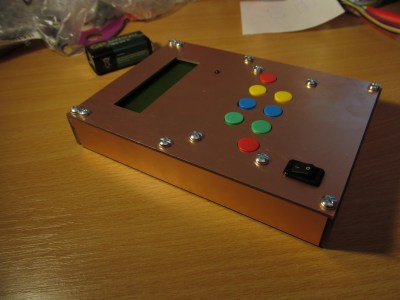
brainfckThe grand prize goes to [Jaromir Sukuba] for Brainf*cktor. [Jaromir] went above and beyond this time. He created a computer which can be programmed in everyone’s favorite esoteric programming language. Brainf*cktor uses 1019 bytes of program memory in [Jaromir’s] PIC18F26K22. You can write, execute and edit programs. [Jaromir] ran into a bit of a problem with his LCD. The character tables would have thrown him over the 1 kB limit. Not a problem – he designed his own compressed character set, which is included in the 1019 bytes mentioned above. All the clever software takes physical form with a homemade PCB, and a case built from blank PCB material. Best of all, [Jaromir] has explained his software tricks, as well as included a full build log for anyone who wants to replicate his project. All that hard work will be rewarded with a Digi-Comp II kit from EMSL.

First Prize

mosFirst prize goes to [Dumitru Stama] with M0S – CortexM0 RTOS in 1024 bytes. Operating systems are complex beasts. Many of our readers have toyed with the Linux Kernel. But writing a real-time OS from scratch? That’s quite an undertaking.  [Dumitru] didn’t shy away from the challenge. He designed a Real-Time Operating System (RTOS) for ARM processors, written completely in ARM thumb assembly instructions. This is no bare-bones executive. M0S has a rich list of features, including preemptive task scheduling, mutexes, and inter-process communication. [Dumitru] even gave us memory allocation with an implementation of malloc() and free(). The OS was demonstrated with a NUCLEO-F072RB board from ST-Micro.

[Dumitru] didn’t just drop a GitHub link and run. He documented M0S with seven project logs and a 37-minute long video. The video uses electronic whiteboard drawings to clearly explain all the internal workings of the operating system, as well as how to use it.

[Dumitru] is the proud new owner of a Maker Select 3D printer V2!

Second Prize

1klaserSecond prize goes to [Cyrille Gindreau] with 1K Challange Laser. Vector lasers generally take lots of memory. You have to manage galvanometers, laser drive, and perform all the magic it takes to convert a set of vectors to lines drawn in space. The project uses 912 bytes of program and initialized data memory to command an MSP430 to draw an image.

Proving that flattery will get you everywhere, [Cyrille] picked the Hackaday logo as the subject. The Jolly Wrencher is not exactly simple to convert to vector format, though. It took some careful optimizations to come up with an image that fit within 1 kB. [Cyrille] wins a Bulbdial Clock kit from EMSL.

Third Prize
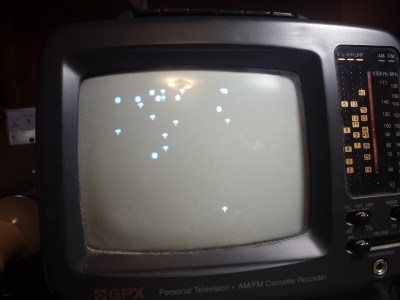
tinygamesThird prize goes to [Mark Sherman] with tinygames. Video games have been around for awhile, but they are never quite this small. [Mark] coaxed the minuscule Atmel ATtiny84 to play Centipede with only 1024 bytes of program memory. Even the BOM is kept small, with just a few support components. Control is handled by an Atari 2600 compatible joystick. Video is black and white NTSC, which is demonstrated on a period accurate CRT. [Mark] generates his video by racing the electron beam, exactly the same way the Atari 2600 did it.

[Mark] will take home a Blinkytile kit from Blinkinlabs.

Final thoughts

First of all, I’d like to thank the judges. Our own [Jenny List], [Gerrit Coetzee], [Pedro Umbelino], [Bil Herd], and [Brian Benchoff] worked hard with me in judging this contest. I’d also like to thank our community for creating some amazing projects. The contest may be over, but these projects are now out there for others to build, enjoy, and learn from.

I’ve wanted to organize this contest since [Jeri Ellsworth] and [Chris Gammell] took on the 555 contest way back in 2011. The problem is creating a set of rules that would be relatively fair to every architecture. I think 133 entries to this contest proves that we found a very fair set of constraints. It is safe to say this won’t be the last 1 kB Challenge here at Hackaday, so if you have ideas for future editions, share them in the comments!


At Last, An Open Source Electric Vehicle From A Major Manufacturer

There is a rule of thumb to follow when looking at product announcements at the fringes of the motor industry that probably has something in common with crowdfunding campaigns. If the photographs of the product are all renders rather than real prototypes, walk away. It is said that small volume vehicle production is a space that attracts either crooks or dreamers, and parting with your money to either can be a risky business. So when yet another electric vehicle platform makes its debut it’s always worth looking, but too often the rendered images outnumber anything from the real world and you know you’ll never see one on the road.

It is with interest then that we note an exciting announcement made last week at CES, that the French carmaker Renault are to release an open-source vehicle platform. It is called the POM, and it is based upon their existing Twizy electric buggy platform. If this last point causes you to snort with derision because the Twizy is a tiny and not very fast in-line two-seater with awful weather protection better suited to the French Riviera than an American Interstate, remember that the car itself is not the point of this exercise at this stage. Instead the access to the technology will spark fresh innovation in the open electric vehicle sector that will transfer into better systems for more practical open source vehicles in the future. (Incidentally, we’re told by people who’ve tried the Twizy that it can be something of an unexpected gem to drive. It seems the lowish top speed doesn’t matter in the twisties when you have a low centre of gravity and quite impressive acceleration in a tiny machine.)

Partnered with Renault are OSVehicle, ARM, Pilot Automotive, a manufacturer of automotive accessories, and Sensoria, who will be working on wearable accessories. It’s probable that you won’t see many POMs on the road if you don’t live in a territory that already has the Twizy, but it’s certain you’ll see its technological legacy in other vehicles.

We’ve covered plenty of electric cars in the past here at Hackaday, and this isn’t the first one with an open source angle. We’ve had a very nice Mazda-derived ground-up build, and an astounding home-made hub motor.

Get Ready For The Great Eclipse Of 2017

On August 21, 2017, the moon will cast its shadow across most of North America, with a narrow path of totality tracing from Oregon to South Carolina. Tens of millions of people will have a chance to see something that the continental US hasn’t seen in ages — a total eclipse of the sun. Will you be ready?

The last time a total solar eclipse visited a significantly populated section of the US was in March of 1970. I remember it well as a four-year-old standing on the sidewalk in front of my house, all worked up about space already in those heady days of the Apollo program, gazing through smoked glass as the moon blotted out the sun for a few minutes. Just watching it was exhilarating, and being able to see it again and capitalize on a lifetime of geekiness to heighten the experience, and to be able to share it with my wife and kids, is exciting beyond words. But I’ve only got eight months to lay my plans! Continue reading “Get Ready For The Great Eclipse Of 2017”

Fail Of The Week: NASA Edition

There’s a reason we often use the phrase “It ain’t Rocket Science”. Because real rocket science IS difficult. It is dangerous and complicated, and a lot of things can and do go wrong, often with disastrous consequences. It is imperative that the lessons learned from past failures must be documented and disseminated to prevent future mishaps. This is much easier said than done. There’s a large number of agencies and laboratories working on multiple projects over long periods of time. Which is why NASA has set up NASA Lessons Learned — a central, online database of issues documented by contributors from within NASA as well as other organizations.

The system is managed by a steering committee consisting of members from all NASA centers. Public access is limited to a summary of the original driving event, lessons learned and recommendations. But even this information can be quite useful for common folks. For example, this lesson on Guidance for NASA Selection & Application of DC-DC Converters contains several bits of useful wisdom. Or this one about IC’s being damaged due to capacitor residual discharge during assembly. If you ever need to add a conformal coating to your hardware, check how Glass Cased Components Fractured as a Result of Shrinkage in Coating/Bonding Materials Applied in Excessive Amounts. Finally, something we have all experienced when working with polarized components — Reverse Polarity Concerns With Tantalum Capacitors. Here is a more specific Technical Note on polarized capacitors (pdf): Preventing Incorrect Installation of Polarized Capacitors.

Unfortunately, all of this body of past knowledge is sometimes still not enough to prevent problems. Case in point is a recently discovered issue on the ISS — a completely avoidable power supply mistake. Science payloads attach to the ISS via holders called the ExPRESS logistics carriers. These provide mechanical anchoring, electrical power and data links. Inside the carriers, the power supply meant to supply 28V to the payloads was found to have a few capacitors mounted the other way around. This has forced the payloads to use the 120V supply instead, requiring them to have an additional 120V to 28V converter retrofit. This means modifying the existing hardware and factoring in additional weight, volume, heat, cost and other issues when adding the extra converter. If you’d like to dig into the details, check out this article about NASA’s power supply fail.

Thanks to [Jarek] for tipping us about this.

Pulsed Power And Its Applications

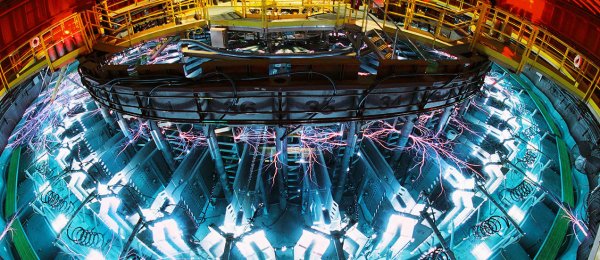
Pulsed power is a technology that consists in accumulating energy over some period of time, then releasing it very quickly. Since power equals energy (or work) divided by time, the idea is to emit a constant amount of energy in as short a time as possible. It will only last for a fraction of a second though, but that instantaneous power has very interesting applications. With this technology, power levels of more than 300 terawatts have been obtained. Is this technology for unlimited budgets, or is this in reach of the common hacker?

Consider for example discharging a capacitor. A large 450 V, 3300 uF electrolytic capacitor discharges in about 0.1 seconds (varies a lot depending on capacitor design). Since the energy stored in it is given by 1/2 CV², which gives 334 Joules of energy, the power delivered will be 3340 watts. In fact a popular hacker project is to build large capacitor banks. Once you have the bank, and a way to charge it, you can use it to power very interesting devices such as:

untitled1
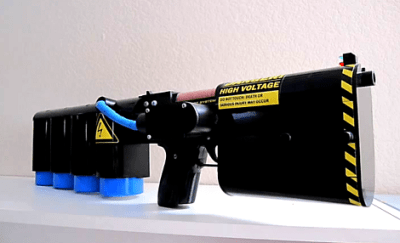
A portable, 1.25 kJ coilgun by [Jason Murray]

Railguns in particular are subject to serious research. You may have read about the navy railgun, capable of reaching a muzzle speed of more than 4,600 mph (around Mach 6), more than any other explosive-powered gun. Power is provided by a 9-megajoule capacitor bank. The capacitors discharge on two conducting rails, generating an electromagnetic field that fires the projectile along the rails. The rail wear due to the tremendous pressures and currents, in the millions of amperes range, is still a problem to be solved.

Continue reading “Pulsed Power And Its Applications”

Paper Airplane Machine Gun V2.0

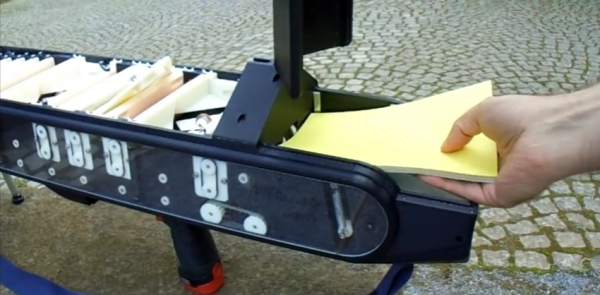
A little over two years ago we posted an amazing contraption that holds a stack of paper sheets, folds them into paper planes, and launches them. There’s now a newer version — the PFM A5 v2.0. It is over a meter long, weighs about 10 kilograms, and features a mind-boggling number of gears and moving parts. Video is embedded below.

In one end travels one sheet of paper after the next. At each stage in the process the paper is folded (symmetrically) and creased by a vertical wheel to make up the keel of the finished plane before launching out the other end. Amazing, and not a jam or “PC Load Letter” error message in sight!

This, of course, has a purpose… junk ads from the sky!

Continue reading “Paper Airplane Machine Gun V2.0”

The 3D Printers Of CES

CES is over, and now we can take a step back, distance ourselves from the trade show booths, and figure out where 3D printing will be going over the next year.

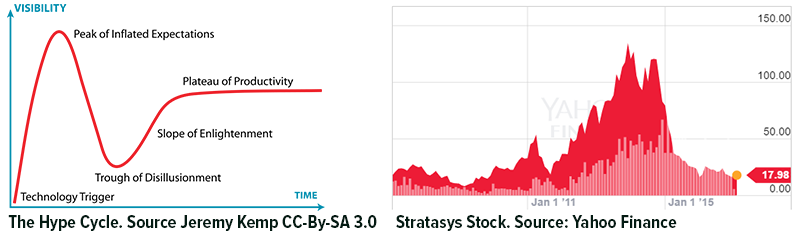
The Hype Cycle is a great way to explain trends in fads and technological advances. VR and autonomous cars are very early on the Hype Cycle right now. Smartphones are on the plateau of productivity. 3D printing is head-down in the trough of disillusionment.

For this year’s CES, 3D printing is not even a product category. In fact, the official documentation I found at Prusa’s booth listed their company in the ‘Assistive Technologies’ category. These are dark days for the public perception of 3D printing. The source of this perception can be brilliantly presented in a pair of graphs:

hype-cycle

The perception of 3D printing has been tied inexorably to Makerbot. Makerbot presented the only 3D printer on The Colbert Report. Only Makerbot had their 3D printing storefronts featured on CNN. It’s been like this for half a decade, and hopefully things will get better.

This doesn’t mean 3D printing isn’t improving. In fact, it’s the best it’s ever been. CES had the most innovative printers I’ve seen in years. I caught a glimpse of this year’s top-selling printer (and it launches in April). Resin machines are going to be very popular soon. What did CES have to offer? Check it out below.

Continue reading “The 3D Printers Of CES”