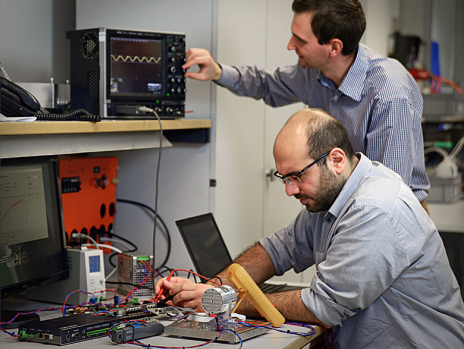
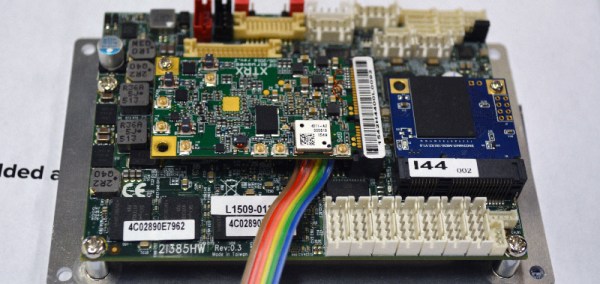
Satellites make many of our everyday activities possible, and the technology continues to improve by leaps and bounds. A prototype, recently completed by [Arda Tüysüz]’s team at ETH Zürich’s Power Electronics Systems Lab in collaboration with its Celeroton spinoff, aims to improve satellite attitude positioning with a high speed, magnetically levitated motor.
Beginning as a doctoral thesis work led by [Tüysüz], the motor builds on existing technologies, but has been arranged into a new application — with great effect. Currently, the maneuvering motors on board satellites are operated at a low rpm to reduce wear, must be sealed in a low-nitrogen environment to prevent rusting of the components, and the microvibrations induced by the ball-bearings in the motors reduces the positioning accuracy. With one felling swoop, this new prototype motor overcomes all of those problems.
There’s a problem with software defined radio. It’s not that everyone needs to re-learn what TEMPEST shielding is, and it’s not that Bluetooth is horribly broken. SDR’s biggest problem is one of bandwidth and processing. With a simple USB TV Tuner, you can listen in on aircraft, grab Landsat images from hundreds of miles up, or sniff the low-power radios used in Internet of Things things. What you can’t do is make your own WiFi adapter, and you can’t create your own LTE wireless network. This is simply a problem of getting bits from the air to a computer for processing.
At HOPE last weekend, the folks behind the very capable LimeSDR and a new company working with Lime’s hardware laid out the possibilities of what software defined radio can do if you make a link to a computer very fast, and add some processing on the SDR itself.
You may not remember this, but Nintendo hardware used to be a pretty big deal. The original Game Boy and NES both had remarkable industrial design that, like the Apple II and IBM Thinkpad, weren’t quite appreciated until many years after production ended. But, like many of you, [daftmike] had nostalgia-fueled memories of the NES experience still safely locked away.
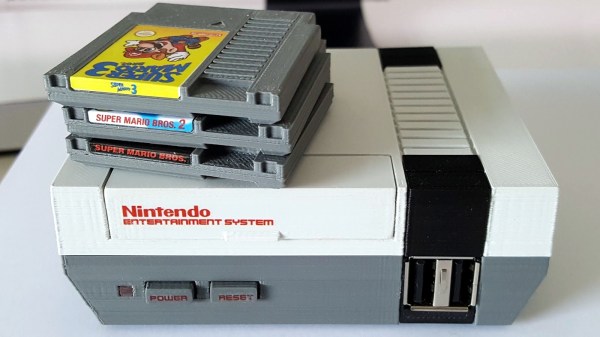
Memories like lifting the cartridge door, blowing on the cartridge, and the feel of the cartridge clicking into place. So, understandably, reliving those experiences was a key part of [daftmike’s] Raspberry Pi-based NES build, though at 40% of the original size. He didn’t just want to experience the games of his youth, he wanted to experience the whole NES just as he had as a child.
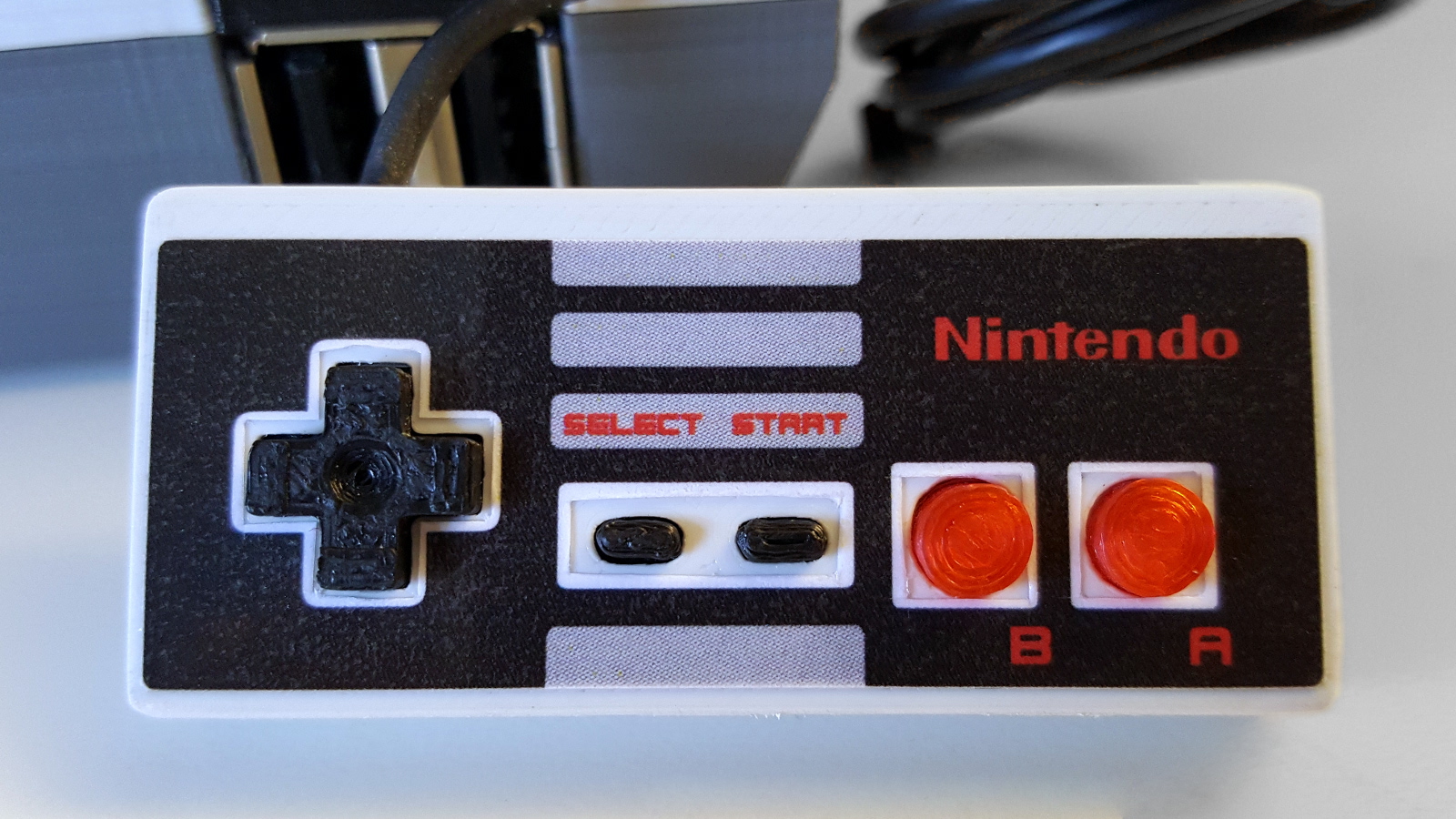
Now, like any respectable hacker, [daftmike] didn’t let gaps in his knowledge stop him. This project was a learning experience. He had to teach himself a lot about 3D design and modeling, using Linux, and programming. But, the end result was surely worth the work; the attention to detail shows in features like the USB placement, the power and reset buttons, and of course the game cartridges which work with the magic of NFC and still include the insert and toggle action of the original cartridge carriage.
If you have a 3D printer and Raspberry Pi available, you could build a similar NES emulator yourself. But if you don’t have a 3D printer, but do have an original NES lying around, you could pull of the Raspberry Pi in a NES case hack. Whichever you do, the NES’s beauty deserves to be displayed in your home.
Almost exactly two years ago, shocking news thundered across the electronics blogosphere. There was a new WiFi module on the block. It was called the ESP8266, a simple serial device capable of taking care of an 802.11 network and a WiFi stack, giving any project with a microcontroller access to the Internet. Earlier modules to connect microcontrollers were sufficient for the task, but nothing could beat the ESP8266 on price.
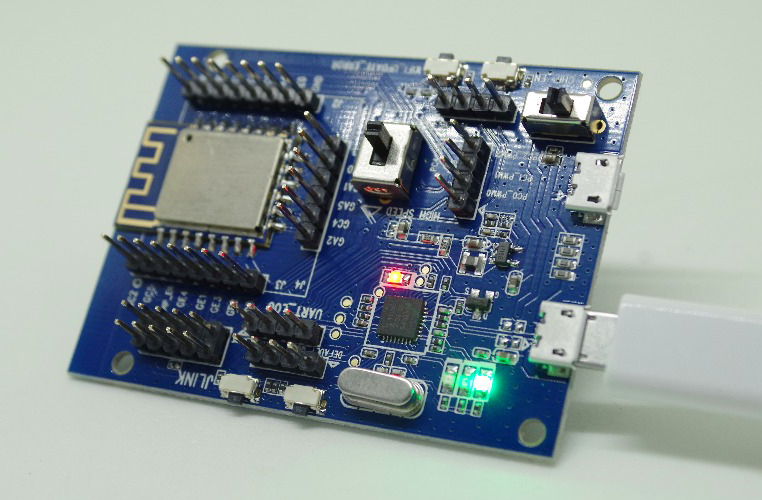
The RTL8710 dev kit
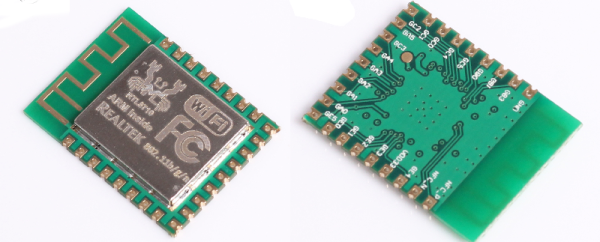
Now, there’s a new module that’s even cheaper and more powerful than the ESP8266, and just like all of our favorite parts from China, it inexplicably shows up on eBay and AliExpress before anywhere else. It’s the Realtek RTL8710, available on eBay, on AliExpress, and elsewhere around the web for about $1.50 per device. There’s also a dev kit for the device featuring breakouts, an additional microcontroller, and a few switches and buttons for about $15.
As you would expect, there is zero English-language data available about the RTL8710, everything is in Chinese. There is a forum of sorts going over this new chip, and the Google Translatrix is good enough to glean a little bit of info about the new chip.
The RTL8710 features an ARM processor clocked at 166MHz. Stock, this module is running FreeRTOS. There’s 1MB of Flash, 48k of RAM available to the user, up to 21 GPIOs, 3 I2C, 4 PWM pins, and 2 PCM. This module also comes with an FCC logo, but I can’t find anything on the FCC website about this module.
If anything, the Realtek RTL8710 isn’t meant to be a competitor to the ESP8266. While extremely popular and still very useful, the ‘next gen’ ESP32 is due to be released in a month or so, and with the exception of Bluetooth on the ESP32, this Realtek module should match its capabilities quite well. Whether anyone can get an English datasheet is another matter, but if history is any indication a few English language RTL8710 forums will pop up a few hours after this is posted.
We last covered the project when he had, unfortunately, wrecked the thing in a remote-controlled test flight. He later discovered that the motor’s crankshaft bearings had, well, exploded. The resulting shrapnel destroyed the motor and crashed the drone. He described this failure mode as “concerning”.
Also concerning is the act of stepping into the seat once all the propellers are started up. He tags this as “watch your step or die”. Regardless, he also describes flying in the thing as so incredibly fun that it’s hard to stay out of it; like a mechanical drug. It explains why his channel has been lately dominated by videos of him testing the multicopter. Those videos are found after the break.
The device drinks 0.65-0.7 liters per minute of gasoline, and he’s been going through reserves working out all the bugs. This means everything from just figuring out how to fly it to discovering that the dust from the ground effect tends to clog up the air filters; which causes them to run lean, subsequently burning up sparkplugs. Dangerous, but cool.
[Lukas] started his epic SDR-from-scratch build when he was 16. Projects like this aren’t completed overnight. (He’s now 18. We’re impressed.)
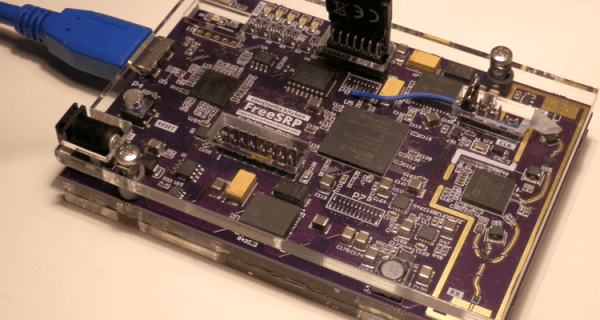
The project itself is a Software-Defined Radio built on top of the 12-bit Analog Devices AD9364 transceiver IC. A big fat FPGA takes the data and runs it off to a USB 3.0 interface, which is necessary for the amount of data this thing will be producing — he’s got it receiving 56 MHz of bandwidth. In short, this is an SDR peripheral that’s in the big leagues.
After two years of work and (only!) three revision, [Lukas] got the thing working. Read his writeup for the blow-by-blow account. In the end, a 6-layer board was necessary for the routing to get the full speed out of the clocking, and he discovered the reason that you use exactly the specified bias resistors — the expensive ADC chip gets very hot. But he didn’t give up, and in the end he pulled off a project of immense complexity. In his own words:
I have discovered that taking on large projects, even when not knowing how to tackle problems that might arise, is a very effective way of learning for me. It’s just important to be persistent, as I’ve seen that almost any problem can be solved on your own — which is incredibly rewarding — even if you get stuck and seem to not make progress for a while.
[Lukas] is now working on the software. He’s already got a hacked osmocom driver working, so it plays nice with GNURadio.
Of course, there are tons of ways to get into SDR without building your own from scratch, but we applaud [Lukas] for going the hard way. If you’re tempted to follow in his footsteps, have a look at [Michael Ossmann]’s great talk on making the RF design process as tractable as possible.
Wood. Humans have burned it for to heat their homes for thousands of years. It’s truly a renewable source of energy. While it may not be the most efficient or green method to warm a space, it definitely gets the job done. Many homes still have a fireplace or wood burning stove for supplemental heat. For those in colder climates, wood is more than just supplemental, it’s needed simply for survival.
Splitting maul by Chmee2 via Wikipedia
The problem with firewood is that it doesn’t come ready to burn. Perfect fireplace sized chunks don’t grow on trees after all. The trees have to be cut up into logs. The logs must be split. The split wood then needs to dry for 6 months or so.
Anyone who’s spent time manually splitting wood can tell you it’s back breaking work. Swinging an 8 pound maul for a few hours will leave your hands numb and your shoulders aching. It’s the kind of work that leaves the mind free to wander a bit. The hacker’s mind will always wander toward a better way to get the job done. Curiously we haven’t seen too many log splitting hacks here on the blog. [KH4] built an incredible cross bladed axe back in 2015, but that’s about it.