Weightless IoT Hardware Virtually Unavailable

It has been over 2 years since we last mentioned the Weightless SIG and their claims of an IoT open standard chip with a 10 year battery life and 10km wireless range, all at a jaw dropping price of $2 per chip. There was a planned production run of the 3rd gen chips which I would suspect went to beta testers or didn’t make it into production since we didn’t hear anything else, for years.

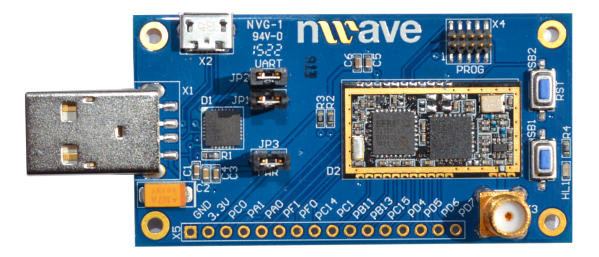
Recently, a company called nwave began producing dev-kits using the Weightless Technology which you can see in the banner image up top. Although the hardware exists it is a very small run and only available to members of the development team. If you happen to have been on the Weightless mailing list when the Weightless-N SDK was announced there was an offer to get a “free” development board to the first 100 development members. I use bunny ears on free because in order to become a member of the developer team you have to pay a yearly fee of £900. Don’t abrasively “pffffft” just yet, if you happened to be one first 100 there was an offer for developers that came up with a product and submitted it back for certification to get their £900 refunded to them. It’s not the best deal going, but the incentive to follow through with a product is an interesting take.

Continue reading “Weightless IoT Hardware Virtually Unavailable”

V8 Javascript Fixes (Horrible!) Random Number Generator

According to this post on the official V8 Javascript blog, the pseudo-random number generator (PRNG) that V8 Javascript uses in Math.random() is horribly flawed and getting replaced with something a lot better. V8 is Google’s fast Javascript engine that they developed for Chrome, and it’s used in Node.js and basically everywhere. The fact that nobody has noticed something like this for the last six years is a little bit worrisome, but it’s been caught and fixed and it’s all going to be better soon.

In this article, I’ll take you on a trip through the math of randomness, through to pseudo-randomness, and then loop back around and cover the history of the bad PRNG and its replacements. If you’ve been waiting for an excuse to get into PRNGs, you can use this bizarre fail and its fix as your excuse.

But first, some words of wisdom:

Any one who considers arithmetical methods of producing random digits is, of course, in a state of sin. For, as has been pointed out several times, there is no such thing as a random number — there are only methods to produce random numbers, and a strict arithmetic procedure of course is not such a method.
John von Neumann

John von Neumann was a very smart man — that goes without saying. But in two sentences, he conveys something tremendously deep and tremendously important about random variables and their mathematical definition. Indeed, when you really understand these two sentences, you’ll understand more about randomness than most everyone you’ll meet.

Continue reading “V8 Javascript Fixes (Horrible!) Random Number Generator”

An Actual Working Hoverboard

What with 2015 being the apparent “year of the hoverboard”, we have a final contender before the year ends. It’s called the ArcaBoard from ArcaSpace, A private space company. And it doesn’t use magnets, or superconductors, or any smoke and mirrors — just a whole lot of ducted fans.

Thirty-six of them to be precise. The ArcaBoard uses 36 electric motors with an apparent 7.55HP each, powered by a massive bank of lithium ion batteries. Together, they produce 430 pounds of thrust, which allows most riders to float around quite easily. Even with that huge power drain, it apparently lasts for a whole 20 minutes, which is pretty impressive considering its size.

Continue reading “An Actual Working Hoverboard”

Turning The Pi Zero Into A USB Gadget

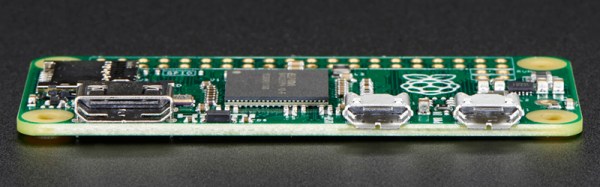
The Raspberry Pi Zero is limited, or so everyone says, and everyone is trying to cram a USB hub and WiFi adapter on this tiny, tiny board. One thing a lot of people haven’t realized is that the Raspberry Pi Zero comes with a USB OTG port, meaning it can function as a USB device rather than a USB host. This means the Raspi can become a serial device with just a USB cable, an Ethernet device, MIDI device, camera, or just about anything else you can plug into a USB port. Adafruit has your back with a tutorial for using the USB OTG port as a serial and Ethernet interface, and the possible applications are extremely interesting.

The only requirement for using the USB OTG port for device applications is an update to the kernel. This is easily installed by dumping a few files on an SD card and a employing bit of command line wizardry. The simplest example is setting up the Pi Zero as a USB serial device, allowing anyone to log into a serial console on the Pi with just a USB cable.

A slightly more interesting application is setting up the Pi as an Ethernet gadget. This effectively tunnels all the networking on the Pi Zero through a USB cable and a separate computer. The instructions are extremely OS-specific, but the end result is the same: you can apt-get on a Pi Zero to your heart’s desire with a new kernel loaded onto the SD card and a USB cable.

This experimentation is just scratching the surface of what is possible with the OTG port on the Pi Zero. MIDI devices are easy, and with a ton of GPIOs, the Pi Zero itself could become a very interesting musical instrument. Want the Pi Zero to be a storage device? That’s easy too. The USB Gadget will end up being one of the most exciting uses for the Pi Zero, and we can’t wait to see what everyone will come up with next.

A Better Expanding Table

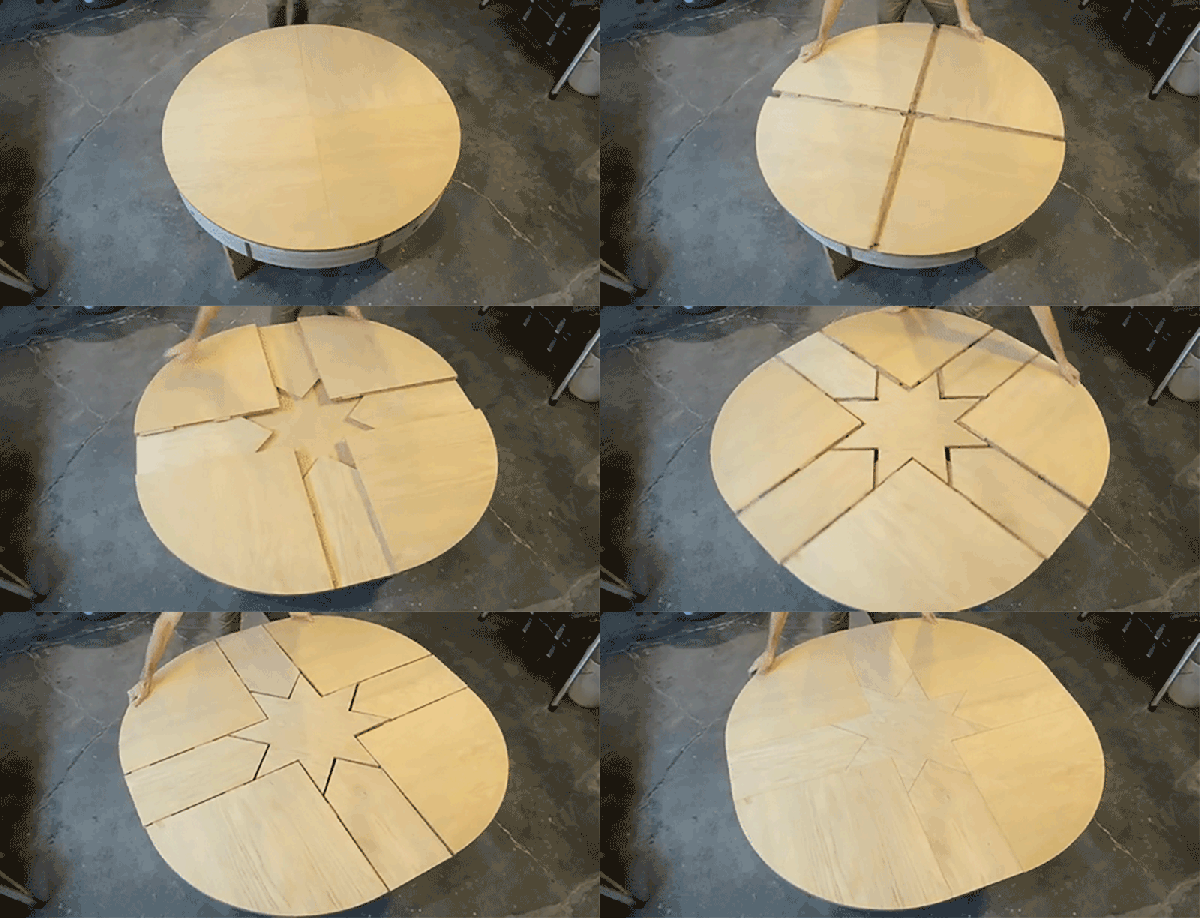
About a year ago, [Scott] completed what is probably one of the finest builds ever shown on a YouTube channel. It was an expanding wooden table, a build inspired by a fantastically expensive expanding table that was itself inspired by a creation by a mad woodworker in the early 1800s. Although [Scott]’s table is a very well-engineered build, there were a few things he wasn’t happy with. Over the past few months he’s been refining the design and has come up with the final iteration – and plans – for a wooden mechanical expanding table.

Late last year, [Scott] had about 450 hours of design and build time in his table, and by the time he got to the proof of concept stage, he simply ran out of steam. Another year brings renewed enthusiasm, and over the past month or so he’s been working on much-needed improvements to his expanding table that included a skirt for the side of the table, and improvements to the mechanics.

The expanding table is rather thick with three layers of tabletop stacked on top of each other, and those exposed mechanical linkages should be hidden. This means a skirt, and that requires a huge wooden ring. [Scott] built a ring 5 1/2″ deep, about an inch and a half thick, and has the same diameter of the table itself. This means cutting up a lot of plywood, and stacking, gluing, sanding, and routing the entire thing into a perfectly round shape.

The other upgrades were really about the fit and finish of the internal mechanics of the table. Screws were changed out, additional brackets were crafted, and the mounts for the internal ‘star’ was upgraded.

After all that work, is the table done? No, not quite; the skirt could use a veneer, proper legs need to be built, and the entire thing could use a finish. Still, this is the most complete homebuilt expanding table ever conceived, and [Scott] has the plans for his table available for anyone who would want to replicate his work.

Continue reading “A Better Expanding Table”

Nikon Resurrection: Repairing A Broken Lens

Modern DSLR cameras are amazing devices. Mechanics, electronics, and optics, all rolled up in a single package. All that technology is great, but it can make for a frustrating experience when attempting any sort of repair. Lenses can be especially difficult to work on. One misalignment of a lens group or element can lead to a fuzzy image.

[Kratz] knew all this, but it didn’t stop him from looking for a cheap lens deal over on eBay. He found a broken Nikon DSLR 55-200mm 1:4-5.6 AF-S VR camera lens for $30. This particular lens is relatively cheap – you can pick up a new one for around $150 online. Spending $30 to save $120 is a bit of a gamble, but [Kratz] went for it.

The lens he bought mostly worked – the auto-focus and vibration reduction system seemed to be fine. The aperture blades however, were stuck closed. Aperture blades form the iris of a lens. With the blades closed down, the lens was severely limited to brightly lit situations. All was not lost though, as the aperture is a relatively simple mechanical system, which hopefully would be easy to repair.

pinNikonKeeping screws and various parts in order is key when taking apart a lens. [Kratz] used a tip he learned right here on Hackaday: He drew a diagram of the screw positions on a thick piece of paper. He then stuck each screw right into the paper in its proper position.



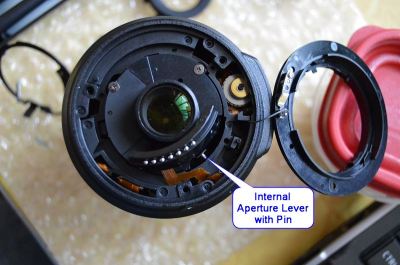
Carefully removing each part, [Kratz] found a pin had slipped out of the rod that connects the lens’ internal parts with the external aperture control arm. Fixing the pin was simple. Getting the lens back together was quite a bit harder. Several parts have to be aligned blindly. [Kratz] persevered and eventually everything slipped into alignment. The finished lens works fine, albeit for a slightly noisy auto-focus.

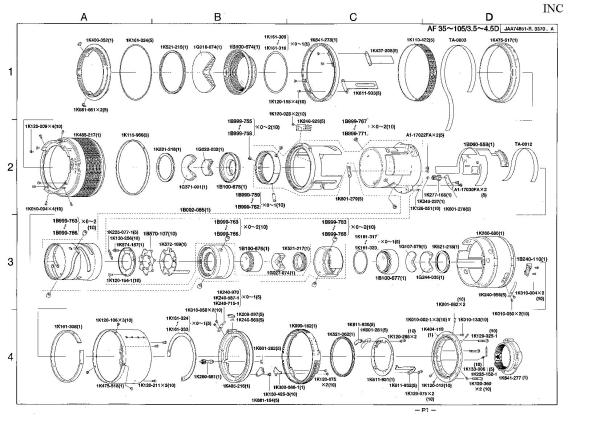
It’s worth noting that there are service and repair manuals for many cameras and lenses out there in the dark corners of the internet, including [Kratz]’s 55-200 lens. Reading the repair procedures Nikon techs use shows just how many tools, fixtures, and custom bits of software go into making one of these lenses work.

The Ultimate Puzzle Desk — MYST Eat Your Heart Out

This project is absolutely mind boggling. Created by [Kagen Sound], this desk would fit right at home inside the MYST games. It has a pipe organ inside, and you can open a secret compartment by playing a specific tune.

Besides being an absolute marvel of woodworking, the hidden mechanics inside this desk make our heads hurt. The pipe organ aspect works by pushing in little drawers — this forces air into organ pipes at the front of the desk. But some of the air is redirected into a pneumatic memory board — which can actually keep track of the notes you play. When the correct tune is played, it triggers a pendulum which releases a secret compartment. All you need is a trap door over an abyss and you’ve recreated The Goonies.

Sure, it’d be easy to do that with an Arduino or something… but the pneumatic memory board is made of wood. Entirely made of solid wood. [Kagen] says it took countless hours to design, at least five different versions before he found one that worked.

Continue reading “The Ultimate Puzzle Desk — MYST Eat Your Heart Out”