Where Are They Now: Terrible Kickstarters

Kickstarter started out as a platform for group buys, low-volume manufacturing, and a place to fund projects that would otherwise go unfinished. It would be naive of anyone to think this would last forever, and since these humble beginnings, we’re well into Peak Kickstarter. Now, Kickstarter, Indiegogo, and every other crowdfunding platform is just another mouthpiece for product launches, and just another strategy for anyone who needs or wants money, but has never heard of a business loan.

Of course there will be some shady businesses trying to cash in on the Kickstarter craze, and over the last few years we’ve done our best to point out the bad ones. Finding every terrible Kickstarter is several full-time jobs, but we’ve done our best to weed out these shining examples of the worst. Following up on these failed projects is something we have been neglecting, but no longer.

Below are some of the most outrageous Kickstarters and crowdfunding campaigns we’ve run across, and the current status of these failed entrepreneurial endeavors.

Continue reading “Where Are They Now: Terrible Kickstarters”

Raspberry Pi And Windows 10 IoT Core: A Huge Letdown

Last Spring, Microsoft unveiled their plan for Windows and the Internet of Things. It starts with the Raspberry Pi and Windows 10 IoT Core – a stripped down system with Windows API calls running on an ARM architecture. Yes, Microsoft is finally moving away from the desktop, building a platform for a billion Internet of Things things, or filling the gap left by tens of thousands of POS terminals and ATMs running XP being taken offline. Either one is accurate.

Earlier this week, Microsoft announced the first public release of Windows 10 IoT Core. This is the review, but here’s the takeaway: run. Run as fast as you can away from Windows IoT. It’s not worth your time unless you have a burning desire to write apps for Windows, and even then you could do a better job with less effort with any Linux distro.

Continue reading “Raspberry Pi And Windows 10 IoT Core: A Huge Letdown”

Amazon Dash: Hack It To Run Your Own Code

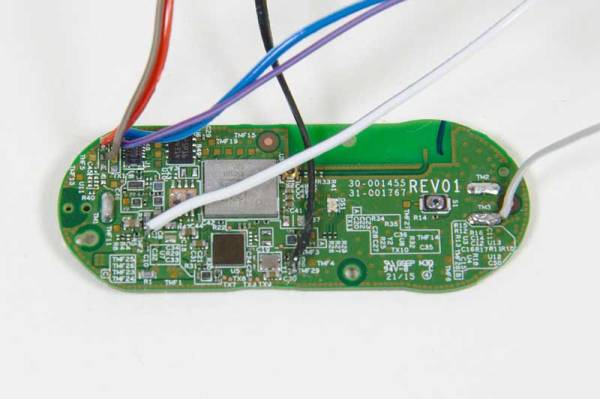
The Amazon Dash is a $5 push-to-buy-cat-litter button which has excellent potential for repurposing, but you need to know what is going on inside first. [Tony Dicola] has the details in this excellent bare metal guide to the Dash. In this, he covers how to get inside the Dash and reprogram it to do something more interesting than buying cat litter.

He first cracks the device open, connecting a programmer, then building a toolchain to compile programs to run on. This isn’t for the faint-hearted because you are programming directly for a device that wasn’t really built for it, but [Tony] has posted examples and there are few tools to hold your hand on the way. There is a safety net, [Tony] provided details on how to reset the Amazon Dash Button if you manage to brick it.

We have seen some interesting hacks that repurpose the Dash to capture your child’s bowel movements by intercepting the device connecting to WiFi, but this guide takes it a step further. It allows you to run your own code, which turns this into a really low-cost and well-engineered all-in-one WiFi device. The missing piece is proof-of-concept code to run the WiFi module inside. If you’re working on that we’d love to hear about it!

Continue reading “Amazon Dash: Hack It To Run Your Own Code”

Emulating A Hard Drive With The Raspberry Pi

[Chris] recently moved a vintage IBM 5150 – the original PC – into his living room. While this might sound odd to people who are not part of the Hackaday readership, it actually makes a lot of sense; this PC is a great distraction-free writing workstation, vintage gaming machine, and looks really, really cool. It sat unused for a while, simply because [Chris] didn’t want to swap out piles of floppies, and he doesn’t have a hard drive or controller card for this machine. After reviewing what other retrocomputer fans have done in this situation, he emulated a hard drive with a Raspberry Pi.

The traditional solution to the ‘old PC without a hard drive’ problem is the XTIDE project. XTIDE is a controller card that translates relatively new IDE cards (or an emulated drive on another computer) as a hard drive on the vintage PC, just like a controller card would. Since a drive can be emulated by another computer, [Chris] grabbed the closest single board computer he had on hand, in this case a Raspberry Pi.

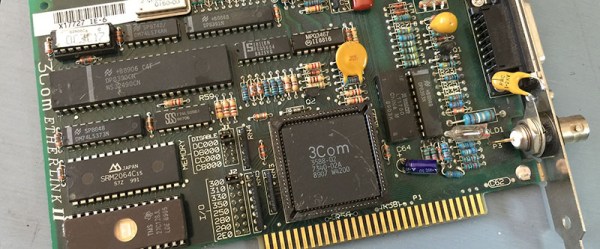
After burning an EPROM with XTIDE to drive an old network card, [Chris] set to work making the XTIDE software function on the Raspberry Pi side of things. The hardware on the modern side of the is just a Pi and a USB to RS232 adapter, set to a very low bitrate. Although the emulated drive is slow, it is relatively huge for computer of this era: 500 Megabytes of free space. It makes your head spin to think of how many vintage games and apps you can fit on that thing!

Oracle CSO To Customers: Leave The Vulnerabilities To Us

[Mary Ann Davidson], chief security officer of Oracle, is having a bad Tuesday. The internet has been alight these past few hours over a blog post published and quickly taken down from oracle’s servers. (archive) We’re not 100% sure the whole thing isn’t a hack of some sort. Based on [Mary’s] previous writing though, it seems to be legit.

The TL;DR version of Mary’s post is that she’s sick and tired of customers reverse engineering Oracle’s code in an attempt to find security vulnerabilities. Doing so is a clear violation of Oracle’s license agreement. Beyond the message, the tone of the blog says a lot. This is the same sort of policy we’re seeing on the hardware side from companies like John Deere and Sony. Folks like [Cory Doctorow] and the EFF are doing all they can to fight it. We have to say that we do agree with [Mary] on one point: Operators should make sure their systems are locked down with the latest software versions, updates, and patches before doing anything else.

[Mary] states that “Bug bounties are the new boy band”, that they simply don’t make sense from a business standpoint. Only 3% of Oracles vulnerabilities came from security researchers. The rest come from internal company testing. The fact that Oracle doesn’t have a bug bounty program might have something to do with that. [Mary] need not worry. Bug Bounty or not, she’s placed her company squarely in the cross-hairs of plenty of hackers out there – white hat and black alike.

All The Unofficial Electronic Badges Of DEF CON

2015 was the year of the unofficial hardware badge at DEF CON 23. There were a ton of different hardware badges designed for the love of custom electronics and I tried to catch up with the designer of each different badge. Here is the collection of images, video demos, and build details for each one I saw this weekend.

Whiskey Pirates

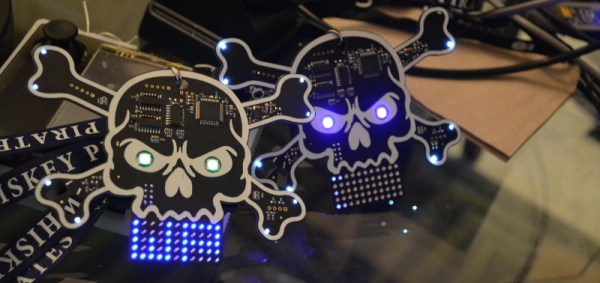
[TrueControl] did a great job with his badge design this year for the Whiskey Pirate Crew. This is a great update from the badge he designed last year, keeping the skull and bones outline. It uses a PSOC4 chip to control a ton of LEDs. The eyes are RGB pixels which are each on their own PCB that is soldered onto the back of the badge, with openings for the LED to show through. Two AA batteries power the board which has a surface-mount LED matrix. The user controls are all capacitive touch. There is a spinner around one eye, and pads for select and back. The NRF24L01 radio operates at 2.4GHz. This badge is slave to commands from last year’s badge. When the two are in the same area the 2015 badges will scroll the nickname of the 2014 badge it “sees”. The piezo element also chirps many different sounds based on the interactions with different badges.

[True] makes design an art form. The matte black solder mask looks fantastic, and he took great care in use of font, size, alignment, and things like letting copper show through for a really stunning piece of hardware art.

Keep reading for ten more great badges seen over the weekend.

Continue reading “All The Unofficial Electronic Badges Of DEF CON”

amazon dash button

Hacking The Amazon Dash Button To Record Whatever You Want

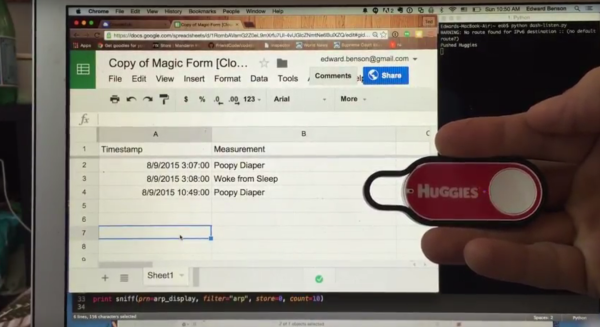
We’re still not too sure if the Amazon Dash button is a brilliant marketing and advertising ploy, or is just downright stupid. But what we do know, is for $5, it’s a lot of hackable tech that could be used for more… useful purposes. The big A sells these dash buttons for one purpose — you push the button and whichever product is assigned to it shows up on your doorstep in a few days. [Ted Benson] wanted them to do more than that so he turned a few dash buttons into a way of tracking his baby’s health!

Apparently, data acquisition of your baby’s wake-up times and poops is useful to identify health patterns. [Ted] tried using some phone apps to keep track of this stuff, but found it would be a lot easier if there was just a big button on the wall or something… which is where he got the idea to make use of the Amazon Dash button.

It’s actually really simple to do. Buy the dash button, do the setup with Amazon… but don’t do the final step: selecting the product you want to order. If you don’t select anything, you won’t order anything…

Continue reading “Hacking The Amazon Dash Button To Record Whatever You Want”