Recently there’s been some buzz in the news that Pepsi, or more accurately the company’s Russian division, had partnered with a startup by the name of StartRocket to experiment with the idea of putting “billboards” in space. After overwhelmingly negative response to the idea on social media, Pepsi’s official line is that the StartRocket experiment was a one-time partnership, and that the company has no plans to push ahead with a space advertising program “at this time”.
Concept art from StartRocket
Had this been the first time a worldwide conglomerate like Pepsi had turned their eyes up into the black and saw dollar signs, you might think that humanity’s brief flirtation with space-bound advertisements was nothing but a social media stunt. But the truth of the matter is that companies such as Coca-Cola and Pizza Hut have been trying to get their products off terra firma since the 1980’s. This isn’t even Pepsi’s first attempt, despite what their PR department might want you to believe right about now.
So why haven’t we seen advertisers putting their money into space advertising schemes? Well, we have, actually. They just haven’t been terribly effective and the average person likely has no recollection of them. We’re seeing considerable excitement about spaceflight in the new media right now with billionaires like Elon Musk and Jeff Bezos battling to see who can build the most outlandish rockets, but historically, you’d do better getting a 10 second spot during the Super Bowl than plastering your logo on the side of a weather satellite.
In honor of Pepsi’s recent blunder, let’s take a look at some of the standout attempts to conquer advertising’s true true final frontier from the last few decades.
Hundreds of years from now, the story of humanity’s inevitable spread across the solar system will be a collection of engineering problems solved, some probably in heroic fashion. We’ve already tackled a lot of these problems in our first furtive steps into the wider galaxy. Our engineering solutions have taken humans to the Moon and back, but that’s as far as we’ve been able to send our fragile and precious selves.
While we figure out how to solve the problems keeping us trapped in the Earth-Moon system, we’ve sent fleets of robotic emissaries to do our exploration by proxy, to make the observations we need to frame the next set of engineering problems to be solved. But as we reach further out into the solar system and beyond, our exploration capabilities are increasingly suffering from communications bottlenecks that restrict how much data we can ship back to Earth.
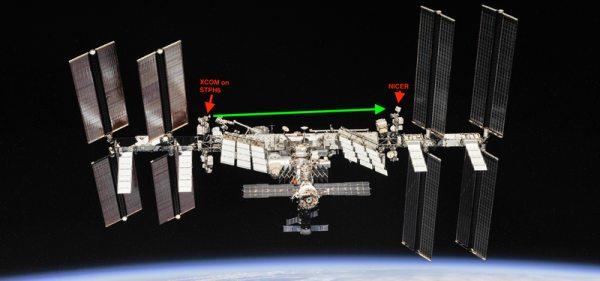
We need to find a way to send vast amounts of data back as quickly as possible using as few resources as possible on both ends of the communications link. Doing so may mean turning away from traditional radio communications and going way, way up the dial and developing practical means for communicating with X-rays.
The United States is going back to the moon, and it’s happening sooner than you would think. NASA is going back to the moon in 2024, and they might just have the support of Congress to do so.
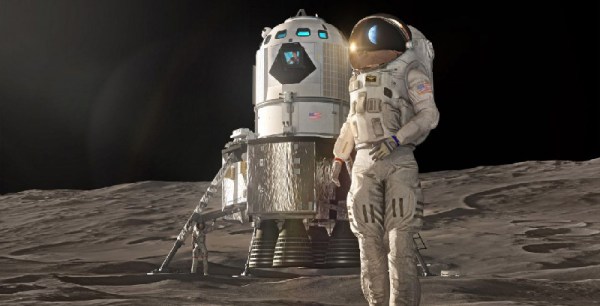
Getting to the moon is one thing, and since SpaceX launched a car to the asteroid belt, this future of boots on the moon after Apollo seems closer than ever before. But what about landing on the moon? There’s only ever been one Lunar Lander that has taken people down to the moon and brought them back again, and it’s doubtful that design will be used again. Now, Lockheed has their own plan for landing people on the moon, and they might be able to do it by 2024.
There’s no shortage of ways a satellite in low Earth orbit can fail during the course of its mission. Even in the best case scenario, the craft needs to survive bombardment by cosmic rays and tremendous temperature variations. To have even a chance of surviving the worst, such as a hardware fault or collision with a rogue piece of space garbage, it needs to be designed with robust redundancies which can keep everything running in the face of systemic damage. Of course, before any of that can even happen it will need to survive the wild ride to space; so add high-G loads and intense vibrations to the list of things which can kill your expensive bird.
After all the meticulous engineering and expense involved in putting a satellite into orbit, you might think it would get a hero’s welcome at the end of its mission. But in fact, it’s quite the opposite. The great irony is that after all the time and effort it takes to develop a spacecraft capable of surviving the rigors of spaceflight, in the end, its operators will more than likely command the craft to destroy itself by dipping its orbit down into the Earth’s atmosphere. The final act of a properly designed satellite will likely be to commit itself to the same fiery fate it had spent years or even decades avoiding.
You might be wondering how engineers design a spacecraft that is simultaneously robust enough to survive years in the space environment while at the same time remaining just fragile enough that it completely burns up during reentry. Up until fairly recently, the simple answer is that it wasn’t really something that was taken into account. But with falling launch prices promising to make space a lot busier in the next few years, the race is on to develop new technologies which will help make sure that a satellite is only intact for as long as it needs to be.
Some bittersweet news today as we get word that Israel’s Beresheet spacecraft unfortunately crashed shortly before touchdown on the Moon. According to telemetry received from the spacecraft right up until the final moments, the main engine failed to start during a critical braking burn which would have slowed the craft to the intended landing velocity. Despite attempts to restart the engine before impact with the surface, the craft hit the Moon too hard and is presumably destroyed. It’s likely that high resolution images from the Lunar Reconnaissance Orbiter will eventually be able to give us a better idea of the craft’s condition on the surface, but at this point the mission is now officially concluded.
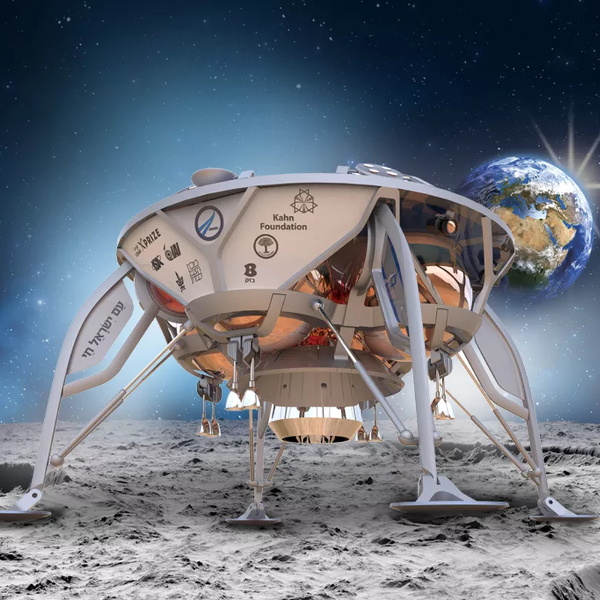
The Beresheet Lander
It’s easy to see this as a failure. Originally conceived as an entry into the Google Lunar X Prize, the intended goal for the $100 million mission was to become the first privately funded spacecraft to not only touch down on the lunar surface, but navigate laterally through a series of powered “hops”. While the mission certainly fell short of those lofty goals, it’s important to remember that Beresheet did land on the Moon.
It didn’t make the intended soft landing, a feat accomplished thus far only by the United States, Russia, and China; but the fact of the matter is that a spacecraft from Israel is now resting on the lunar surface. Even though Beresheet didn’t survive the attempt, history must recognize Israel as the fourth country to put a lander on the surface of our nearest celestial neighbor.
It’s also very likely this won’t be the last time Israel reaches for the Moon. During the live broadcast of the mission, after it was clear Beresheet had been lost, Prime Minister Benjamin Netanyahu vowed his country would try again within the next two years. The lessons learned today will undoubtedly help refine their next mission, and with no competition from other nations in the foreseeable future, there’s still an excellent chance Israel will be able to secure their place in history as the fourth country to make a successful soft landing.
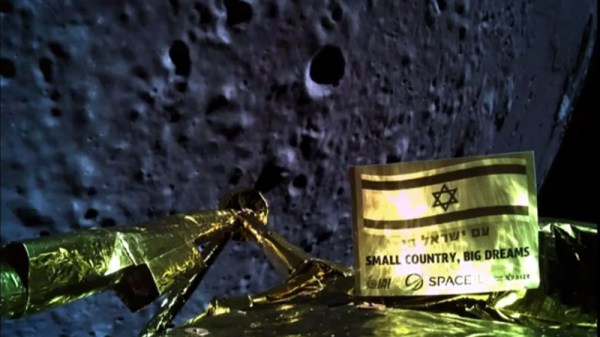
Beresheet’s view during descent
Of course you’ve got to get to the Moon before you can land on it, and in this respect, Beresheet was an unmitigated success. We previously covered the complex maneuvers required to put the craft into lunar orbit after riding to space as a secondary payload on the Falcon 9 rocket; a technique which we’ll likely see more of thanks to the NASA’s recent commitment to return to the Moon. Even if Beresheet never attempted to land on the surface, the fact that it was able to enter into a stable lunar orbit and deliver dramatic up-close images of the Moon’s surface will be a well deserved point of pride for Israel.
This won’t be the last time that hundreds of millions of dollars worth of high-tech equipment will be lost while pushing the absolute edge of the envelope, and that’s nothing to be upset over. Humans have an insatiable need to see what’s over the horizon and that means we must take on a certain level of risk. The alternative is stagnation, and in the long run that will cost us a lot more than a few crashed probes.
With the destruction of the Microsat-R reconnaissance satellite on March 27th, India became the fourth country in history to successfully hit an orbiting satellite with a surface-launched weapon. While Microsat-R was indeed a military satellite, there was no hostile intent; the spacecraft was one of India’s own, launched earlier in the year. This follows the examples of previous anti-satellite (ASAT) weapons tests performed by the United States, Russia, and China, all of which targeted domestic spacecraft.
Yet despite the long history of ASAT weapon development among space-fairing nations, India’s recent test has come under considerable scrutiny. Historically, the peak of such testing was during the 1970’s as part of the Cold War rivalry between the United States and then Soviet Union. Humanity’s utilization of space in that era was limited, and the clouds of debris created by the destruction of the target spacecraft were of limited consequence. But today, with a permanently manned outpost in low Earth orbit and rapid commercial launches, space is simply too congested to risk similar experiments. The international community has strongly condemned the recent test as irresponsible.
For their part, India believes they have the right to develop their own defensive capabilities as other nations have before them, especially in light of their increasingly active space program. Prime Minister Narendra Modi released a statement reiterating that the test was not meant to be a provocative act:
Today’s anti-satellite missile will give a new strength to the country in terms of India’s security and a vision of developed journey. I want to assure the world today that it was not directed against anybody.
India has always been against arms race in space and there has been no change in this policy. This test of today does not violate any kind of international law or treaty agreements. We want to use modern technology for the protection and welfare of 130 million [1.3 Billion] citizens of the country.
Further, the Indian Space Research Organisation (ISRO) rejects claims that the test caused any serious danger to other spacecraft. They maintain that the test was carefully orchestrated so that any debris created would renter the Earth’s atmosphere within a matter of months; an assertion that’s been met with criticism by NASA.
So was the Indian ASAT test, known as Mission Shakti, really a danger to international space interests? How does it differ from the earlier tests carried out by other countries? Perhaps most importantly, why do we seem so fascinated with blowing stuff up in space?
Jubilant crowds at the gates of Downing Street. (Jenny List)
In a completely unexpected move, the British Prime Minister Theresa May yesterday announced outside Number 10 Downing Street that the UK would resume its space launch programme, 47 years after its cancellation following the launch of the Prospero satellite. She outlined a bold plan with a target of placing the Doc Martens of a British astronaut on the Lunar surface as early as 2024. Funded by the £350m per week Brexit windfall, the move would she said place the country at the forefront of a new 21st century Space Race with the North Koreans.
An estimated 2 million jubilant supporters took to the streets of London at the news, bringing the capital to a halt as they paraded with colourful banners from Hyde Park to Trafalgar Square and down Whitehall past her Downing Street home. Meanwhile the value of shares in the popular British high street bakery firm Patisserie Gregoire jumped by 19% as it was revealed that their new vegan sausage roll had in fact been a secret trial of the British astronaut diet. Continue reading “Britain Rejoins The Space Race”→